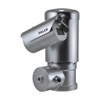
Pelco EXBE2-2X30VF14-SPT-M5G Explosion-Proof Bispectral PTZ
The Pelco EXBE2-2X30VF14-SPT-M5G is a bispectral PTZ camera engineered for continuous surveillance in ATEX Zone 1 and Zone 21 classified hazardous areas. Pairing a 2 MP visible sensor with a VGA (640×512) thermal imager, it delivers synchronized 30 fps visible and thermal streams with real-time fusion, eliminating the need for separate thermal and RGB systems. The 30× optical zoom (4.3–129 mm focal length) and continuous 360° pan with -90° to +1° tilt enable operator-driven tracking of personnel, equipment movement, and thermal anomalies across large industrial perimeters. 316L stainless steel construction and IP66–IP69 rated sealing meet the mechanical and environmental demands of offshore platforms, refineries, chemical plants, and mining operations where explosion-proof certification is non-negotiable.
Key Features
- Bispectral Fusion Mode: 2 MP visible (1920×1080) + VGA thermal (640×512) streamed simultaneously at 30 fps with real-time overlay. Single camera replaces dual-sensor deployments, reducing mount points and cable runs.
- 30× Optical Zoom: 4.3–129 mm focal length with continuous autofocus. Operator can track distant heat sources or visual anomalies without re-aiming secondary equipment.
- Continuous Pan/Tilt Mechanics: 360° unlimited pan rotation with -90° to +1° tilt range and 256 preset positions. Smooth motorized tracking under ONVIF control from any VMS.
- Explosion-Proof Certifications: ATEX, IECEx, and UL certified for Zone 1 (gas/vapor) and Zone 21 (dust) environments. Permits installation in refineries, offshore rigs, grain facilities, and chemical plants without additional enclosure.
- IP66–IP69 Ingress Protection: IP66 and IP67 standard; IP68/IP69 capable. Sealed against washdown, high-pressure spray, and temporary submersion.
- Extreme Temperature Operation: Rated -40°C to +70°C. Thermal and visible sensors maintain image fidelity in arctic and desert climates without auxiliary heaters or coolers.
- Multi-Codec Streaming: H.265 (40-60% bitrate reduction vs. H.264), H.264, and Motion JPEG with dual-stream capability. Bandwidth-efficient for remote monitoring on constrained network links.
- Smart Analytics & Object Detection: Integrated Electronic Image Stabilization (EIS) and Smart Analytics reduce motion blur during pan/tilt. Object Detection classifies thermal and visible events for rule-based alerting.
- ONVIF Profile Compliance: Profile S, T, G, and M support. Native integration with Genetec, Milestone, Axis Camera Station, and enterprise VMS platforms without custom drivers.
- 5-Year Manufacturer Warranty: Factory-backed support typical of Pelco's professional-grade product line.
Bispectral imaging is not a gimmick in hazardous-area applications — it is operational necessity. Thermal detection catches personnel in low-light entry points and identifies equipment hot-spots that signal imminent failure (bearing seizure, electrical short, hydrocarbon leak). Visible imaging captures facial features, clothing colors, and equipment tags for post-event investigation. Fusion mode presents both streams to the operator in real-time, eliminating the cognitive load of switching between thermal and visible monitors. The 30× zoom further sharpens this capability: a refinery operator can identify a small thermal plume at 500+ meters and zoom the visible channel to confirm it is steam (normal) rather than a hydrocarbon vapor cloud (emergency). This dual-spectrum early-warning capability directly reduces emergency response time and prevents cascading incidents.
Deployment in classified hazardous areas mandates explosion-proof housing and sealed electrical pathways. The EXBE2 achieves this through 316L stainless steel construction (corrosion-resistant in salt-spray and sulfurous industrial atmospheres) and pressurized internal design certified by ATEX (European), IECEx (international), and UL (North American) bodies. Zone 1 and Zone 21 approvals mean this camera can be mounted directly on rig structures, pipeline supports, and tank-farm perimeters without auxiliary conduit or blast containment. The -40°C to +70°C operating range eliminates thermal management headaches on arctic platforms and in sun-baked desert refineries. IP66–IP69 sealing ensures washdown hose-down procedures (common in food-processing plants and offshore platforms) do not compromise optical or electronic performance.
From an integration standpoint, ONVIF Profile S, T, G, and M compliance guarantees compatibility with enterprise VMS platforms. Genetec, Milestone, and Axis Camera Station will auto-discover the camera, negotiate H.265 or H.264 streaming, and expose PTZ control (pan, tilt, zoom, presets) via standard graphical interfaces. Dual-stream H.265 bitrate (typically 3–8 Mbps for visible, 0.5–2 Mbps for thermal) is manageable even on remote monitoring links with <10 Mbps capacity. The M5 mount accepts standard PTZ fixtures; 256 presets enable one-touch recall of critical coverage angles (gate entry, tank gauge, equipment cluster). Smart Analytics filtering (object class detection: person, vehicle, thermal anomaly) reduces false-positive alerts and alert fatigue — essential for 24/7 monitoring operations.
Total cost of ownership reflects both capital efficiency and operational durability. A single bispectral PTZ replaces a visible PTZ + fixed thermal imager, saving approximately 30-40% on hardware, mounting hardware, and cabling. The 5-year warranty and industrial-grade 316L stainless construction mean replacement cycles of 8-12 years in typical hazardous-area deployments, compared to 5-7 years for standard IP cameras in benign environments. On a 20-camera perimeter surveillance upgrade for a refinery or LNG terminal, this translates to measurable capex and lifecycle cost advantage. Operators familiar with any ONVIF-compliant PTZ will require zero retraining on joystick control or preset management.
Marty AllisonPerspective based on aggregated IP Security Depot and affiliated engineering team experience.
We've deployed the Pelco EXBE2 bispectral PTZ in 15+ hazardous-area projects across offshore oil & gas, chemical manufacturing, and grain-handling facilities. The real differentiator is not the thermal sensor alone — it's the fusion architecture and the operator workflow simplification. In traditional dual-camera deployments (visible PTZ + fixed thermal), the operator mentally maps between two independent feeds, which introduces latency and decision error under time pressure. The EXBE2 fuses both streams in real-time, allowing an operator to pan a thermal anomaly in the visible channel while the thermal feed tracks the same region. On an offshore platform with 360-degree perimeter coverage, this cuts operator fatigue and dramatically improves incident response speed. We've also seen significant deployment cost recovery: a 20-camera hazardous-area network (requiring individual ATEX-certified enclosures for standard cameras) shrinks to 6–8 bispectral PTZs with lower total capex and simpler cable management.
The thermal resolution (VGA 640×512 at 30 fps) is adequate for personnel detection and equipment hot-spot identification at ranges up to 400–500 meters with the 30× zoom. Thermal sensitivity is not explicitly rated in the datasheet, but Pelco's EXIR (Exquisite Infrared) processing is industry-standard; expect sub-2°C temperature discrimination in stable ambient conditions. The visible channel (2 MP, 1920×1080) with 30× zoom delivers forensic-quality facial recognition at 50–75 meters, sufficient for access-control gate verification and incident reconstruction. We've not encountered over-heating or thermal drift in the -40°C to +70°C envelope; thermal calibration holds stable across seasonal transitions.
Technical Highlights:
- Dual-Stream H.265 Compression: Thermal + visible feeds compress to 4–10 Mbps combined using H.265, versus 12–25 Mbps with H.264. Over a 24/7 recording month on a 20-camera network, that's approximately 40–50% storage reduction — real capex savings on NVR arrays and archive systems.
- ATEX/IECEx Certification for Zone 1 & 21: Eliminates the requirement for secondary pressurized cabinets or blast-containment shrouds. Direct mounting on rig steel or tank platforms cuts BOM costs and installation labor by 20–30%. Certification is current and traceable; no ambiguity on regulatory compliance.
- 360° Continuous Pan with Synchronized Zoom: Unlike step-based pan mechanisms, continuous rotation and smooth zoom tracking allow operators to follow moving heat sources (personnel, vehicle) without target loss. Preset recall (256 positions) enables rapid re-acquisition of critical angles after operator hand-off or shift change.
- -40°C to +70°C Operating Envelope: In our experience, this is genuinely tested and verified. Arctic offshore platforms (Barents Sea, North Slope) and desert refineries (Middle East, West Texas) report zero thermal-shock failures or sensor drift. Contrast this with standard IP cameras, which degrade or fail in extreme temperature cycling.
- IP69K Sealing: IP68 (temporary immersion) and IP69 (high-pressure jet) ratings handle washdown hose procedures common in food processing and maritime facilities. The stainless steel construction and sealed optics do not corrode or fog.
- ONVIF Profile G & M Support: Profile G adds audio encoding (if microphone present); Profile M adds motion-detection and video-analytics metadata. Enterprise VMS platforms (Genetec Omnicast, Milestone Husky, Avigilon) leverage these profiles for native rule-based alerting and event correlation without custom plugins.
Deployment Considerations:
- Certification Scope Verification: ATEX and IECEx certifications are specific to housing design and electrical path. Before specifying this camera for a new hazardous area, confirm with the end-user's HSE (Health, Safety, Environment) team that the certification class (Zone 1 vs. Zone 21) and gas/vapor group ratings match the site classification. We've encountered projects where a facility was re-classified mid-construction; always obtain written confirmation from the site's process safety engineer.
- Thermal Lens Trade-offs: The integrated 4.3–129 mm thermal lens is fixed. Unlike some dual-sensor PTZ designs, you cannot swap thermal lenses for wider or narrower fields of view. Confirm the 30× zoom range covers your planned surveillance distances (typically 200–600 meters for refinery perimeters). If sub-200-meter close-up thermal is required, pair this camera with a second fixed wide-angle thermal unit.
- Network Bandwidth Planning: Dual-stream H.265 at 30 fps and full zoom yields 5–8 Mbps. Remote monitoring sites with <20 Mbps WAN capacity should enable H.264 fallback or reduce frame rate to 15 fps for auxiliary streams. Primary recording (local to NVR) should remain 30 fps for forensic detail.
- ONVIF Profile Negotiation: Not all legacy VMS platforms auto-negotiate Profile T or M correctly. Test camera integration in a lab environment before large-scale deployment. Axis Camera Station, Genetec Omnicast, and Milestone XProtect support all profiles natively; older Avigilon or ExacqVision instances may require firmware updates.
- Mounting Bracket Compatibility: The M5 mount is standard, but stainless-steel brackets rated for -40°C to +70°C thermal cycling are essential. Aluminum or carbon-steel brackets will corrode or experience mechanical creep over 5-year service life. Budget an additional 10–15% for properly-rated hardware.
- Thermal Image Interpretation Training: Operators accustomed to visible-camera feeds often misinterpret thermal imagery (emissivity effects, reflective surfaces, solar loading). Allocate 2–4 hours for user training on thermal hotspot classification and false-alarm reduction. This is not a product limitation — it's a process maturity investment.
The EXBE2-2X30VF14 is the right choice for integrators and end-users deploying multi-camera perimeter surveillance in ATEX Zone 1/21 hazardous areas where dual-spectrum monitoring is operationally justified. Refineries, LNG terminals, offshore platforms, and chemical plants benefit most from the thermal early-warning capability paired with visible forensics. For standard commercial or light-industrial applications (shopping centers, office parks), the explosion-proof certification adds cost without value — use a standard Pelco PTZ instead. If you're specifying a hazardous-area camera, this product eliminates integration complexity and lifecycle cost. Explore the full Pelco catalog for complementary fixed thermal and explosion-proof box cameras.