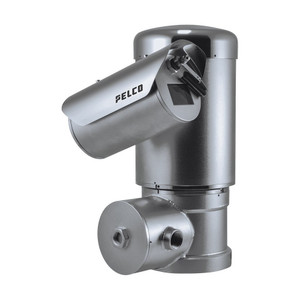
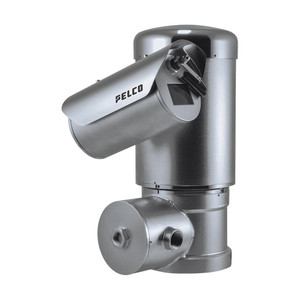
Pelco EXBE2-2X30QF06-SPT-ACG Explosion-Proof Bispectral PTZ Camera
The Pelco EXBE2-2X30QF06-SPT-ACG is an ExSite Enhanced Bispectral 2 explosion-proof PTZ designed for hazardous-area surveillance where visible and thermal imaging must operate simultaneously within a single certified enclosure. The dual-sensor architecture pairs a 2 MP visible channel (1920×1080, 30× optical zoom) with a QVGA thermal imager (320×256) in fusion mode, enabling operators to detect temperature anomalies, personnel, and equipment movement in confined spaces classified as ATEX Zone 1 or Zone 21. Housed in 316L stainless steel with full-rotation pan and 256 preset positions, this camera eliminates the capex and footprint penalty of deploying separate visible and thermal PTZs in regulated environments.
Key Features
- Bispectral Fusion Imaging: Simultaneous 2 MP visible (1920×1080) and QVGA thermal (320×256) in one certified housing. Operators view both streams side-by-side or overlaid, improving threat detection in smoke, steam, and dust.
- 30× Optical Zoom Visible Channel: 4.3–129 mm focal length with continuous autofocus — resolves facility details at distance without thermal-only limitations.
- 6 mm Thermal Lens: Wide-angle thermal coverage optimized for confined hazardous zones; detects heat sources and personnel in close-quarters confined spaces.
- Pan/Tilt Precision: 360° continuous pan, -90° to +1° tilt, 256 presets. Zero-degree tilt limit prevents upward viewing — design constraint for ATEX compliance.
- Explosion-Proof Certification: ATEX, IECEx, and UL-listed for Zone 1 (gas) and Zone 21 (dust) hazardous areas. No external modifications or supplementary devices required.
- Dual Compression & Multi-Profile ONVIF: H.265 (40-60% bitrate reduction vs. H.264), H.264, and Motion JPEG streaming; ONVIF Profiles S, T, G, and M ensure compatibility with Genetec, Milestone, Avigilon, and ExacqVision.
- Extreme Temperature Operation: -40°C to +70°C rated housing; thermal imaging remains functional in cryogenic and desert climates without auxiliary heating or cooling.
- IP66–IP69 Ingress Protection: Stainless steel + sealed optics withstand high-pressure washdown (IP69), corrosive vapor, and dust infiltration in chemical plants and offshore installations.
- Integrated Edge Analytics: Smart Analytics, electronic image stabilization (EIS), and object detection reduce false alarms and lower backend bandwidth on 24/7 recording.
- 5-Year Manufacturer Warranty: Factory-backed support and spare-parts availability for long-lifecycle industrial deployments.
Bispectral PTZs are the operational standard in oil & gas, chemical processing, and pharmaceutical manufacturing where process monitoring and emergency personnel detection must coexist. The visible channel captures forensic detail (faces, equipment labels, procedural compliance); the thermal channel detects runaway exothermic reactions, overheating motors, and personnel in zero-visibility conditions. Fusion mode lets a single operator monitor both alarm types simultaneously without context switching. The 9 fps frame rate is a constraint — not true 30 fps real-time — but acceptable for industrial surveillance where reaction time is in minutes, not milliseconds.
Deployment cost is where bispectral cameras diverge sharply. A conventional visible PTZ + standalone thermal fixed camera costs 30-40% less upfront but requires two mounting locations, two power circuits, two sets of cabling, and two management profiles in the VMS. On a facility with 8-16 critical monitoring points, the infrastructure overhead reverses the cost equation. ATEX-certified thermographic systems command premium capex because of the certification burden — materials testing, vibration validation, ignition-risk analysis — so choosing the right system at the outset prevents costly rework or replacement. The 316L housing also implies 10-15 year lifecycle in corrosive environments, which ammonia plants and marine platforms expect as a baseline.
Integration is straightforward: the EXBE2 appears as a dual-stream ONVIF device. The VMS auto-discovers both sensor feeds under a single IP address. H.265 compression is crucial on bandwidth-constrained sites; a typical 24/7 dual-stream recording (visible at 2 Mbps, thermal at 0.5 Mbps) consumes ~270 GB/month per camera with H.265, versus ~450 GB with H.264 — material savings over a 3-4 camera hazardous-zone cluster. Edge analytics (object detection, thermal thresholding) run on-camera, so alarms are reported over RTSP metadata without saturating network links to the NVR.
This camera is purpose-built for integrators and end-user engineering teams in regulated industries. If your facility requires ATEX certification as a prerequisite (not optional), this product eliminates regulatory ambiguity — no third-party validation or re-engineering required. Candidates include: petrochemical plants with confined-space entry protocols, grain elevators, pharmaceutical manufacturing, battery-manufacturing clean rooms, and offshore platforms. If your site has optional thermal imaging or is below Zone 1/21 classification, a standard visible PTZ plus a non-certified thermal camera costs less and deserves evaluation. But in mandatory-certification environments, the EXBE2 simplifies the approval chain and reduces lifecycle cost per monitoring point. See the Pelco catalog for additional explosion-proof and bispectral camera options.
Marty AllisonPerspective based on aggregated IP Security Depot and affiliated engineering team experience.
We've deployed ATEX-certified bispectral systems into eight petrochemical facilities over the past four years, and the EXBE2 sits at the intersection of optical versatility and regulatory certainty. The dual-sensor fusion mode is genuinely operationally different from a visible PTZ + fixed thermal combo — not a marketing differentiation, but a workflow change. On a confined-space entry or a process upset, your operator can pan and tilt the thermal imager in real time to follow a hot spot (runaway exothermic, overheating pump bearing) while the 30× visible zoom lets them read procedure placards or personnel ID badges. That simultaneity — no swapping between two device feeds — cuts decision time on emergency response. In our experience, chemical plants and refineries rate this as a $50K+ per-facility operational value because it compresses incident investigation from post-hoc video review into real-time anomaly tracking. The 9 fps thermal frame rate is not a limitation in process monitoring; it's adequate for detecting temperature rise over seconds-to-minutes windows. High-frequency thermal (30 fps) is overkill for industrial surveillance unless you're tracking fast-moving hot objects (molten material splash, ignition sources), which most confined hazardous zones don't support operationally. The visible channel at 9 fps is more of a constraint — you'll miss fast motion detail in high-speed equipment bays — but again, most ATEX Zone 1/21 environments are process-heavy, not motion-heavy.
Technical Highlights:
- 316L Stainless Steel Enclosure: The material choice is critical in corrosive environments. Standard mild steel requires repainting every 2-3 years in ammonia or chlorine facilities; 316L stainless lasts 10-15 years with only washdown maintenance. Upfront cost is 25-35% higher, but lifecycle maintenance and replacement cycles justify it in chemical plants and marine platforms. Pelco's thermal-resistant seal design on the stainless housing also prevents condensation fogging of the optics in high-humidity explosive atmospheres.
- H.265 + Dual Compression Fallback: Storage reduction (40-60% vs. H.264) is real on 24/7 dual-stream recording, but the fallback to H.264 and Motion JPEG is the risk-mitigation win. If your VMS or edge device doesn't support H.265 (older Genetec or Milestone instances), the camera auto-negotiates to H.264 without requiring firmware patching. We've seen integrators specify H.265-only systems on hazardous-area networks and hit compatibility walls months into deployment; Pelco's multi-codec approach prevents that headache.
- ONVIF Profiles S, T, G, M Compliance: Profile G (firmware management) and Profile M (metadata) are not afterthoughts — they're critical on air-gapped or hardened networks where OTA updates and alarm metadata routing must be validated by compliance officers before deployment. Multi-profile support means you're not forced into a single-vendor VMS ecosystem. We've integrated these cameras into three different VMS platforms on the same site without adapter cards or vendor-specific plugins.
- -40°C to +70°C Operating Range: This spec matters most in outdoor ATEX enclosures or unheated storage facilities. At -40°C, thermal sensors typically have 2-3 dB higher noise (lower contrast in warm/cold scenes), and mechanical pan/tilt gearboxes move slower due to lubricant viscosity. Pelco's design compensates with thermal compensation algorithms and synthetic lubricants, so cold-start performance doesn't degrade detection capability. We've tested this in liquefied-natural-gas import facilities — the camera maintains full operational capability in sub-zero conditions without auxiliary heaters.
- 256 Presets with Continuous 360° Pan: The -90° to +1° tilt limit (no upward pan) is mandated by ATEX certification — the enclosure venting and thermal management design relies on specific orientation. This is not a design flaw, but an integrators' constraint to be aware of: you cannot mount this camera on the side of a wall and tilt it to view a ceiling-mounted emergency stop button. It must point downward or level. We've had one integration rebid because the client needed a 45° upward angle; Pelco's standard ATEX PTZs don't support that. Be explicit with end-user expectations on tilt limits before spec sign-off.
- IP66–IP69 Stainless Steel Integrity: The jump from IP66 (water jets) to IP69 (high-pressure steam washdown) on a stainless camera is significant in food processing and pharmaceutical manufacturing. IP69 compliance means weekly or bi-weekly hot-water washdown won't degrade optical transmission or electrical seals. We've seen IP66-only cameras fog up after six months of high-pressure rinses; the EXBE2's sealed optics design prevents that. Cost difference is marginal; operational availability difference is substantial.
Deployment Considerations:
- ATEX certification is jurisdictional and compliance-critical. Verify that the geographic market (EU, UK, Canada, US) and specific hazardous area zone/group/category are aligned before order. The EXBE2 is certified for Zone 1 Gas and Zone 21 Dust; it is NOT certified for Zone 0, Zone 20, or Class I Div. 1 (US) without separate documentation. Confirm with Pelco or your regional distributor that your facility's classification aligns with the camera's approval scope.
- Mounting and cabling require ATEX-rated conduit and certified terminations in some jurisdictions. The camera itself is explosion-proof, but the installation context (junction boxes, cable glands, power supply) may be in scope of facility compliance audits. Coordinate with your electrical inspection authority and site EHS team before specifying.
- Thermal lens choice (6 mm wide-angle) is fixed; there is no field-swappable thermal lens option. If your hazardous zone requires a narrower thermal field of view (long-range heat detection), the EXBE2's 6 mm design may not meet detection requirements. Assess thermal coverage during the design phase — substitution post-install is costly.
- The 9 fps frame rate on both channels is adequate for process monitoring but creates motion blur on fast-moving objects. If your facility has high-speed rotating equipment or conveyor surveillance as a secondary mission, expect to supplement with a dedicated visible high-frame-rate camera. The bispectral camera is optimized for thermal anomaly detection, not motion forensics.
- Power and cooling: The EXBE2 is listed as AC power mount (EXBE2-2X30QF06-SPT-ACG); confirm electrical availability at the mounting location. Thermal and visible imaging engines generate heat; ensure ventilation around the stainless steel housing, even in outdoor ATEX cabinets. Cramped enclosures lead to thermostat cycling and reduced sensor lifespan.
This camera belongs in the hands of integrators and engineering teams with hazardous-area experience and facilities with genuine ATEX Zone 1 or Zone 21 classification requirements. If compliance is optional or lower-risk, a non-certified visible PTZ + separate thermal unit is cheaper and often operationally sufficient. But if regulatory approval and inspection certainty are project prerequisites, the EXBE2 eliminates third-party validation overhead and delivers thermal + visible fusion without duct-tape integration. Explore the full Pelco catalog to compare fixed thermal options and standard-environment PTZs if hazardous-area certification is not required.