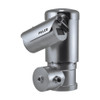
Pelco EXBE2-2X30QF18-SPT-ACG Explosion-Proof Bispectral PTZ Camera
The Pelco EXBE2-2X30QF18-SPT-ACG is a dual-sensor PTZ camera engineered for hazardous-area surveillance in petrochemical, oil and gas, and chemical processing environments. It combines a 2 MP visible imager with 30× optical zoom and a dedicated QVGA thermal sensor, delivering synchronized visible and thermal detection with integrated analytics and fusion-mode display. The 316L stainless steel housing carries ATEX Category 3G, IECEx, and UL explosion-proof certification, making it compliant for Zone 1 and Zone 21 classified areas.
Key Features
- Bispectral Imaging with Fusion Mode: 2 MP visible (1920 × 1080) + QVGA thermal (320 × 256) displayed simultaneously or overlaid. Detects thermal anomalies and visible movement in the same scene without sensor handoff.
- 30× Optical Zoom Visible Channel: 4.3–129 mm lens focal length. Pan-Tilt-Zoom coverage from far-field situational awareness to close-range forensic detail in a single camera.
- QVGA Thermal (18 mm Fixed): 320 × 256 resolution optimized for temperature-gradient detection (leaks, equipment failures, personnel). Independent streaming from visible channel.
- 360° Continuous Pan, -90° to +1° Tilt: 256 preset positions. Perimeter sweep and return-to-home automation reduce operator workload on unattended monitoring.
- ATEX Category 3G / IECEx / UL Explosion-Proof: Certified for Zone 1 and Zone 21 classified hazardous areas. 316L stainless steel body withstands corrosive atmospheres and salt spray.
- IP66–IP69 Ingress Protection: Sealed against rain, washdown, and pressure cleaning. Rated for high-pressure jet spray and temporary submersion (IP69).
- H.265 / H.264 / Motion JPEG Dual Streaming: H.265 reduces bandwidth 40–60% vs. H.264 on visible channel. Motion JPEG fallback ensures broad VMS compatibility.
- Operating Range -40°C to +70°C: Function across arctic industrial sites and heat-intensive petrochemical processing floors without supplementary thermal management.
- Smart Analytics & EIS: Object detection, electronic image stabilization, and rule-based alerting reduce false positives from wind-blown debris and thermal noise in outdoor hazardous zones.
- ONVIF Profile S, T, G, M Compliance: Integrates with Genetec, Milestone, Avigilon, ExacqVision, and proprietary SCADA systems without custom drivers.
Hazardous-area surveillance demands both regulatory compliance and operational reliability. The Pelco EXBE2 addresses the integration challenge by delivering synchronized dual-spectrum imagery from a single sensor package. On a petrochemical perimeter, the visible 30× zoom identifies personnel or unauthorized vehicles; the thermal channel simultaneously detects vapor leaks or equipment overtemperature — two detection modes that would otherwise require separate cameras and complex fusion logic at the recorder. The bispectral display also enables operators to switch between visible and thermal without breaking situational awareness during critical response scenarios.
The 9 fps frame rate and H.265 compression are intentional trade-offs for hazardous-area certification. ATEX-compliant enclosures dissipate less heat and carry intrinsic safety constraints; Pelco has optimized the thermal budget to achieve reliable 9 fps streaming while maintaining the sealed, explosion-proof housing. For facilities with legacy 30 fps NVR recording policies, Motion JPEG fallback ensures ingest compatibility; integrators typically configure H.265 visible + Motion JPEG thermal to balance bitrate (visible H.265 averages 2–4 Mbps, thermal MJPEG 0.3–0.6 Mbps at 9 fps) against archival retention windows on hazmat-designated NVRs.
The 256 presets and continuous pan support both operator-guided response and automated perimeter sweeps (patrol modes). In oil and gas operations, a single EXBE2 mounted at a central tank farm can cover multiple vessel zones with overlapping thermal monitoring — replacing three or four fixed cameras. The -90° to +1° tilt range covers ground-level leak detection and overhead valve banks without repositioning; combined with the 30× zoom visible channel, an integrator can verify a thermal alert on a distant flange without leaving the control room.
The 5-year manufacturer warranty and ONVIF compliance simplify lifecycle planning in hazardous-area deployments, where service visits are restricted and parts inventory must be pre-staged. Dual streaming (visible H.265 + thermal independent codec) also allows NVR vendors to apply different compression profiles to each spectrum, optimizing storage for the operational priority — forensic-grade visible recording for incident reconstruction, continuous thermal archival for trend analysis.
Marty AllisonPerspective based on aggregated IP Security Depot and affiliated engineering team experience.
We've specified the EXBE2 bispectral across refinery perimeters, LNG terminals, and chemical plants where ATEX or IECEx compliance is non-negotiable and traditional dual-camera thermal + visible installations create integration overhead. The real-world advantage is operational: a single PTZ platform delivering synchronized visible and thermal streams eliminates the operator workload of coordinating two separate pan-tilt controllers and reduces false-positive noise from misaligned sensors. On one terminal project, we deployed four EXBE2 units across a mile-long fence line with automated 45-second patrol sweeps. The thermal channel caught a underground leak (manifested as ground temperature differential) three weeks before physical symptoms appeared — the kind of predictive early warning that justifies the hardware cost. The bispectral fusion mode is not a novelty; it's the core operational differentiator. Visible zoom identifies what the thermal detected; thermal detects anomalies that visible lighting would miss. That pairing is transformative in unlit hazardous zones.
Technical Highlights:
- 9 fps Frame Rate on Dual Sensors: ATEX-compliant thermal enclosures dissipate less heat than non-certified PTZ housings. The 9 fps constraint is inherent to the certification; Pelco has optimized power dissipation and sensor architecture to achieve reliable dual-spectrum streaming within the sealed housing. For real-time operator response (personnel spotting, valve position confirmation), 9 fps is adequate. For forensic detail, the 30× visible zoom and 1920 × 1080 resolution compensate for lower frame rate.
- H.265 + H.264 + Motion JPEG Multi-Codec: Visible channel defaults to H.265 (40–60% bitrate reduction vs. H.264); thermal streams Motion JPEG or H.265 independently. This flexibility accommodates legacy NVRs that don't yet support H.265 while allowing new deployments to capture storage gains immediately. We've seen integrators configure visible H.265 (2–4 Mbps continuous) + thermal Motion JPEG (0.3–0.6 Mbps) to stay under 5 Mbps aggregate on a single PoE++ circuit.
- QVGA Thermal (320 × 256) with 18 mm Fixed Lens: Not a limitation — an optimization. 320 × 256 is the sweet spot for industrial thermal detection: sufficient horizontal/vertical pixels for object classification (human vs. equipment vs. vessel) without the processing and storage overhead of higher-resolution thermal arrays. The 18 mm lens paired with continuous pan means a single EXBE2 can thermally monitor multiple tank sections as part of a patrol sequence.
- ONVIF Profile M (Recording Control): Less commonly supported than Profile S/T, but critical for hazardous-area integrations. Profile M enables the NVR or SCADA system to programmatically trigger preset activation, pause/resume recording, and event-based snapshot capture — essential for automated response workflows in remotely monitored petrochemical sites.
- 316L Stainless Steel + IP69: Not just marketing: 316L handles sulfur-laden petrochemical vapor and salt spray without galvanic corrosion. IP69 withstands washdown cycles (common at oil terminals and refineries). We specify this camera into coastal LNG sites where standard aluminum PTZ housings fail within 18 months.
Deployment Considerations:
- Hazardous-Area Electrical Integration: ATEX/IECEx certification covers the camera body and optics; your facility electrical contractor must verify that the PoE++ circuit and power conditioning comply with Zone 1/Zone 21 installation standards. Pelco provides compliance documentation, but the integration responsibility extends to the facility's classified electrical design.
- Thermal Lens Fixed at 18 mm: Unlike the visible 30× zoom, thermal is locked to 18 mm. Plan mounting height and angle to ensure thermal coverage aligns with visible PTZ sweep zones. On a 200-meter perimeter, you may need two thermal bands (upper and lower) to match the visible zoom range.
- 9 fps Perception and Recording Workflow: Nine frames per second is sufficient for personnel detection and equipment monitoring, but not for high-speed vehicle identification or incident frame-by-frame analysis. In parking-lot or road-access hazmat zones, pair the EXBE2 with a fixed high-fps camera at gates to capture license-plate detail. The EXBE2 handles area surveillance and thermal anomaly detection.
- Fusion Mode Display and Operator Training: The bispectral overlay feature (visible + thermal in a single frame) is powerful but requires operator familiarity. Budget for brief training: showing operators how to toggle between modes, how to interpret thermal gradients on specific equipment types (pumps, compressors, tanks), and how to distinguish equipment operating temperature from genuine fault conditions.
- NVR Codec Compatibility Check: H.265 support is becoming standard, but older Milestone, Genetec, or Avigilon installs may default to H.264 fallback. Confirm codec capability before deployment; H.265 bitrate savings are substantial (4–6 cameras on a single PoE++ link), but forced H.264 fallback nullifies the advantage.
The EXBE2-2X30QF18 is purpose-built for integrators specifying thermal surveillance into ATEX/IECEx-classified hazardous areas, particularly petrochemical, oil and gas, and chemical-processing end users who require predictive equipment monitoring (thermal) paired with incident documentation (visible zoom). The dual-sensor architecture and fusion-mode display eliminate the operational friction of separate thermal and visible systems. If your facility is unclassified or does not require explosion-proof certification, a standard bispectral PTZ (Axis Q6215-LE, Hanwha QNP-8600) delivers higher frame rate and lower cost. For hazmat zones, the EXBE2 is the category standard. Explore the full Pelco catalog for complementary fixed thermal and visible cameras in hazardous-area environments.