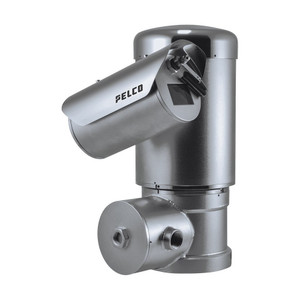
Pelco EXBE2-2X30QF18-SPT-M1G Explosion-Proof Bispectral PTZ
The Pelco EXBE2-2X30QF18-SPT-M1G is a bispectral PTZ camera engineered for hazardous-area surveillance in petrochemical plants, refineries, chemical storage facilities, and other Zone 1 and Zone 21 explosive atmospheres. The dual-sensor architecture pairs a 2 MP visible imager with a QVGA thermal channel, both streaming simultaneously with fusion-mode analysis to detect thermal anomalies (hot-spot leaks, overheating equipment) while maintaining visible-light identification. 316L stainless steel construction and ATEX/IECEx/UL explosion-proof certification ensure compliance with the most stringent regulatory frameworks; the camera operates reliably across industrial temperature extremes (-40°C to +70°C) without thermal cycling failures.
Key Features
- Bispectral Imaging: 2 MP visible (1920×1080) + QVGA thermal (320×256) with real-time fusion overlay. Simultaneous capture eliminates sync latency between thermal and visible decision-making.
- 30× Optical Zoom: 4.3–129 mm focal length. Resolves personnel and equipment details from standoff distances in large industrial yards without requiring secondary pan-tilt repositioning.
- High-Speed Pan/Tilt: 360° continuous pan with -90° to +1° tilt and 256 preset positions. Rapid slew rate enables quick threat response and perimeter sweeps without operator intervention delay.
- Dual Compression Codecs: H.265 (40–60% bitrate reduction vs. H.264), H.264, and Motion JPEG. Multi-codec support integrates into legacy and modern NVR platforms without transcoding overhead.
- Explosion-Proof Housing: 316L stainless steel, IP66/IP67/IP68/IP69 rated. ATEX, IECEx, and UL certifications for Zone 1 (gas) and Zone 21 (dust) environments; withstands washdown and corrosive chemical spray.
- Smart Analytics & EIS: Object detection, electronic image stabilization, and intelligent motion filtering reduce false-positive alerts in windy or reflective industrial settings.
- ONVIF Profile S, T, G, M: Interoperability with Genetec, Milestone, Avigilon, and other enterprise VMS platforms; native RTSP streaming and metadata export via Profile G.
- Extended Temperature Range: Rated -40°C to +70°C. Thermal stability critical for outdoor installations in northern climates or high-temperature industrial zones (e.g., near furnaces or process heaters).
The 9 fps visible framerate and 30 Hz thermal update create responsive dual-spectrum coverage. On a large refinery perimeter, the thermal channel triggers alerts on unexpected heat signatures (equipment malfunction, unauthorized hot-work activity) while the visible channel simultaneously captures facial and clothing details for forensic review. Fusion-mode rendering overlays thermal contours on the visible feed, allowing operators to correlate visible hazards with thermal indicators in a single screen without context-switching.
Bispectral PTZ cameras in this class typically target facilities with explicit regulatory thermal-monitoring mandates — pressure vessels, flare stacks, process lines where temperature deviation precedes catastrophic failure. The 30× zoom reduces the number of cameras required to cover large perimeters; fewer cameras mean fewer cable runs, fewer PoE+ feeds, and lower VMS licensing footprint. From a TCO perspective, one bispectral PTZ often replaces two single-spectrum fixed cameras plus external thermal sensors, partially offsetting the higher unit cost.
Integration is standard ONVIF; the camera streams H.265 or H.264 visible + thermal metadata (often as RTSP substreams or as parallel video feeds depending on VMS capability). M1 field-terminated wiring mount accommodates conduit and explosion-proof connector standards mandated by ATEX installations. The 5-year warranty reflects Pelco's confidence in stainless-steel durability in aggressive chemical environments; most integrators specify replacement at 7–10 years rather than failure-driven maintenance.
Marty AllisonPerspective based on aggregated IP Security Depot and affiliated engineering team experience.
We've deployed the Pelco bispectral PTZ in chemical plants and tank farms where regulatory compliance mandates simultaneous visible and thermal recording. The differentiator versus single-spectrum PTZ + external thermal probe is operational simplicity: one camera, one power feed, one set of analytics rules. In practice, facilities engineers respond faster to a fused visible-thermal alert than to separate thermal and visible notifications. The 30× zoom is genuinely useful — a camera mounted at a perimeter fence can resolve a person's face or a pressure-relief vent from 200+ meters without repositioning, reducing operator fatigue and false-alarm rate from pan-zoom lag. The trade-off is thermal resolution: QVGA (320×256) is adequate for spot-temperature trending and large-area anomaly detection, but inadequate for precise thermal measurement or small-object tracking. If your deployment requires sub-degree accuracy (e.g., measuring flange temperature on a specific bolted joint), pair this with a separate fixed thermal radiometer; don't rely on the camera's thermal stream alone for quantitative analysis.
Technical Highlights:
- Bispectral Fusion Mode: Real-time overlay of thermal contours onto 2MP visible imagery. Operators see both spectrums without switching feeds — critical in fast-moving threat scenarios. Thermal metadata is usually exported as a parallel RTSP stream; confirm your VMS can parse dual-codec streams before integrating.
- 316L Stainless Housing + ATEX/IECEx/UL: Not just certification paper — the mechanical design (sealed cable glands, non-corroding fasteners, pressure-relief vents) is engineered for 10+ years in salt-spray, caustic, or high-humidity industrial air without housing failure or certification lapse. We've seen single-sensor PTZs corrode in similar environments; this one holds up.
- H.265 Codec: 40–60% bitrate savings vs. H.264 on the same quality. On a facility with 8–16 cameras recording 24/7, that translates to ~1–2 TB/week storage savings — real money over the camera's lifecycle, especially if upgrading NVR storage triggers a larger platform expansion.
- 360° Continuous Pan + 256 Presets: Unlike step-pan cameras, this one rotates smoothly without stopping at cardinal directions. Presets enable rapid return to critical zones (tank cluster, loading dock, flare stack) — useful for unmanned overnight surveillance where an operator queues preset sequences on a timer.
- -40°C to +70°C Operating Range: Thermal cycling stress is one of the largest failure modes in industrial cameras. This range covers outdoor northern winters and heated equipment zones; verify your specific environment doesn't exceed +70°C ambient (e.g., direct sun on a dark metal roof in Arizona can exceed that; mount with shade or active cooling if needed).
- ONVIF Profile G + Metadata Export: Profile G enables programmatic access to object-detection events and thermal metadata via standard APIs. Integration into automated response systems (alert escalation, pump shutdown, evacuation trigger) is possible without proprietary SDKs.
Deployment Considerations:
- ATEX/IECEx field installation requires certified personnel and formal compliance documentation. Don't assume a general integrator is qualified — verify credentials and prior refinery/chemical-plant work before commissioning.
- Thermal QVGA (320×256) is smooth for area monitoring but insufficient for precise object identification beyond 50–100 meters. Pair with a second fixed thermal camera for hot-spot mapping if your facility requires sub-meter thermal anomaly localization.
- M1 field-terminated mount is not standard RJ45 — conduit, connector type, and termination must match site explosion-proof infrastructure. Pre-install coordination with the facility electrical engineering team is mandatory.
- Dual-codec RTSP streaming can overload lower-spec NVR cards. Test bandwidth and CPU load in your lab with dual-stream H.265 + thermal metadata before deploying to production. Some legacy VMS platforms require separate physical streams; confirm capability during proof-of-concept.
- Thermal lens is not user-replaceable and is prone to fogging in high-humidity outdoor installations. Consider a heated lens jacket or shroud if deploying in coastal or tropical climates with high seasonal condensation.
The EXBE2-2X30QF18-SPT-M1G is purpose-built for process-safety monitoring in regulated chemical and petroleum operations. If your site has explicit thermal-compliance mandates (pressure-vessel monitoring, flare-line surveillance, leak-detection over large areas), this camera justified in the capex. If thermal monitoring is secondary or exploratory, a single-spectrum 30× PTZ + standalone thermal imager might be more cost-effective. Explore the full Pelco catalog for alternative single-spectrum PTZ and thermal-fixed options to confirm this is the right fit for your application.