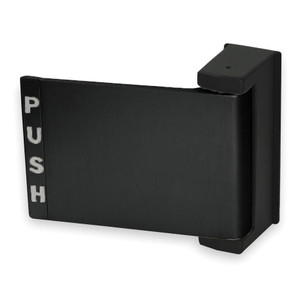
HES 4591-02-00-335 Exit Paddle Switch
The HES 4591-02-00-335 is a paddle-actuated exit switch built for institutional and commercial access control installations where emergency egress reliability and regulatory compliance are non-negotiable. This device controls door release mechanisms in secure facilities, balancing quick emergency evacuation with access control integrity.
Overview
Exit paddle switches are the interface between occupants and door release systems. The 4591-02-00-335 operates via a simple downward paddle press—a motion that meets ADA accessibility requirements and works reliably even under stress or in low-visibility conditions. Heavy-duty mechanical engineering means this switch survives thousands of activation cycles without drift or calibration loss, a critical attribute in high-traffic corridors, stairwells, and secure perimeters where switches see daily use.
Key Features
- Paddle Mechanism (ADA-Compliant): Requires downward force to activate—intuitive operation for occupants unfamiliar with the specific door, and meets accessibility codes that prohibit grip-strength or fine-motor activation. No confusion in an emergency.
- High-Cycle Durability: Heavy-duty construction rated for thousands of mechanical actuations without performance degradation. Institutional deployments often see dozens of egress events per day; this switch is engineered to handle that without maintenance overhead.
- Access Control Integration: Compatible with standard electric strikes, magnetic locks, and access control panels that monitor door release. The switch itself is a simple normally-open contact closure—integrates with any panel supporting dry relay inputs.
- Consistent Actuation Force: Designed to prevent false trips from vibration or incidental contact while remaining responsive to intentional egress attempts. Critical in secure facilities where accidental door releases create compliance breaches.
- Professional Wiring & Mounting: Accepts standard terminal connections for integration into control loops. Mounting provisions support both surface and recessed installation depending on door frame and aesthetic requirements.
- Security & Safety Dual Compliance: Operates as an egress device under fire/emergency conditions (panic hardware rules often require manual actuation with no electronics or code dependencies) while supporting access control in normal operation via integrated panel logic.
Integration & Compatibility
The 4591-02-00-335 functions as a simple switching device—a dry contact closure that communicates door release intent to an upstream access control system or emergency egress panel. No proprietary protocols, no firmware updates. This simplicity is intentional: emergency egress equipment must work under power loss, network failure, and credential server outages. Pair this switch with access control systems that monitor door release logic, or integrate into security system integration architectures that coordinate egress with alarm state and occupant notification.
In locked-down facilities (data centers, secure labs, server rooms), the 4591-02-00-335 often serves as the manual override—a physical pull to release a magnetically held door when all electronic authorization fails. Confirm your door frame and strike mechanism support the paddle form factor before ordering; some retrofits require bracket adaptation.
Deployment Considerations
Install the switch at standard egress height (typically 36–48 inches from floor) and ensure the paddle extends at least 4 inches from the mounting surface to satisfy ADA requirements and ensure tactile feedback. In areas with frequent false alarms or accidental releases, verify your access control panel includes debounce logic or momentary-press programming to prevent nuisance door strikes.
This device is an electromechanical switch only—it does not authenticate credentials, log events, or communicate via Ethernet. All audit trail and access logging responsibilities fall to the upstream access control panel. If your compliance framework requires per-occupant egress logging, confirm your panel vendor supports that level of integration before deployment.
Why Choose the HES 4591-02-00-335
Choose this switch when you need ADA-compliant manual egress without added electronics, firmware risk, or power dependencies. It is the correct model for institutional deployments (schools, hospitals, government buildings, laboratories) where regulated egress is a legal requirement and simplicity reduces operational risk.
The HES catalog includes other paddle and push-button variants for specialized use cases—consult access control hardware guides if your facility requires wireless monitoring, audible feedback, or integrated LED status indication on the switch itself.
When to Choose a Different Model
If your application requires electronic event logging directly on the switch, audible/visual alarms, or integration with a cloud-based credential server, explore higher-functionality models in the HES access control family that combine switching with wireless or networked reporting. If your door frame cannot accommodate a 4-inch paddle extension, consider a compact push-button variant designed for tight mounting spaces.
Frequently Asked Questions
Q: Is the HES 4591-02-00-335 ADA compliant?
A: Yes. The paddle mechanism meets ADA accessibility standards because it requires only downward force (not grip strength or two-handed operation) and provides tactile feedback. Verify mounting height (36–48 inches) and paddle extension (minimum 4 inches) during installation to satisfy your jurisdiction's specific codes.
Q: Does the 4591-02-00-335 work with any access control panel?
A: Yes, provided your panel accepts normally-open dry relay contacts. The switch itself is a simple contact closure—no proprietary wiring or programming. Wire the switch terminals to a monitored door release input on your panel, and the panel controls the strike or magnetic lock logic.
Q: Can the HES 4591-02-00-335 be surface-mounted or recessed?
A: Both mounting styles are supported via standard terminal provision and bracket adaptation. Confirm your door frame and strike mechanism geometry before specifying surface vs. recessed installation to avoid rework.
Q: What happens if the access control panel loses power?
A: The switch remains mechanically functional—pressing the paddle closes the contact. Whether the door unlocks depends on your electric strike or magnetic lock failsafe design. Plan failsafe behavior (fail-secure vs. fail-open) during system design in consultation with your fire marshal and security integrator.
Q: Does the 4591-02-00-335 include audible or visual feedback?
A: No. The switch is mechanical only—no LED, no buzzer, no electronic signaling. If your facility requires occupants to hear confirmation that egress was authorized, integrate the switch with an external buzzer or strobe controlled by your access control panel.
Q: How many activation cycles can the paddle mechanism handle?
A: The 4591-02-00-335 is rated for thousands of mechanical actuations without degradation. In high-traffic corridors with dozens of daily egress events, this switch will serve institutional deployments reliably for years with no maintenance or calibration.
Ted PerryPerspective based on aggregated IP Security Depot and affiliated engineering team experience.
The HES 4591-02-00-335 is the mechanical egress workhorse you install when the access control layer upstream might fail but the door must still open. This switch operates on a simple principle: downward paddle force closes a normally-open contact. No firmware, no network, no credential lookup. That simplicity is its strength in regulated environments like hospitals, government buildings, and secure labs where egress is a legal mandate that cannot depend on electronic subsystems.
Technical Highlights:
- Dry Contact Closure (Normally Open): The switch output is a simple pair of terminals that short when the paddle is pressed. Any access control panel or electric strike controller that monitors a dry input can accept this signal—no proprietary wiring or protocol negotiation required. This eliminates vendor lock-in and simplifies troubleshooting.
- ADA-Compliant Paddle Actuation: Downward force activation (not grip, not rotation, not lever pinch) satisfies accessibility codes and works reliably even when an occupant is in distress or wearing gloves. The tactile feedback is immediate—users know the switch registered their action.
- Mechanical Durability for Thousands of Cycles: Heavy-duty construction rated for high-traffic institutional use—dozens of egress events per day without fatigue or calibration drift. In a school corridor or hospital stairwell, this switch endures years of daily activation without maintenance or parts replacement.
Deployment Considerations:
- The 4591-02-00-335 is not an electronic lock or credential reader—it is a manual release interface only. All access control logic, audit logging, and failsafe behavior reside in your upstream panel or strike controller. Confirm your panel supports the door release sequencing you need (e.g., does it unlock only during business hours, or does egress always work?). Fire code often mandates that egress cannot be restricted by electronic logic, so your panel design must handle that.
- Mounting height and paddle extension are regulatory factors in most jurisdictions. The ADA guidelines specify 36–48 inches from floor and minimum 4-inch paddle reach. Verify local building codes before installation to avoid compliance rework. A misaligned or undersized paddle creates accessibility liability and may trigger code enforcement action.
- The switch is electromechanical only—it produces no alarm signals, no email notifications, and no event logs of its own. If your compliance framework requires per-occupant egress tracking, your access control panel must log the door release event, not the switch.
Choose the HES 4591-02-00-335 for institutional egress deployments where simplicity, regulatory alignment, and failsafe mechanical operation trump electronic feature richness. It is the correct model for schools, hospitals, secure facilities, and government buildings where emergency evacuation must work even if the network is down and the credential server is offline.