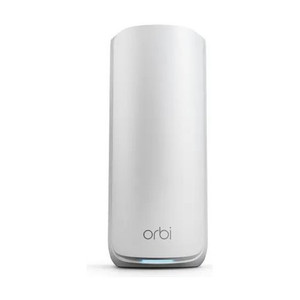
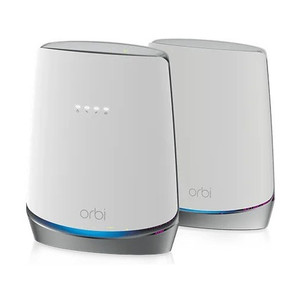
NETGEAR RBE872-100NAS Orbi 870 Series Tri-band WiFi 7 Mesh
The NETGEAR RBE872-100NAS is a tri-band WiFi 7 mesh system supplied as a 2-pack (router plus one satellite) designed for enterprise IP surveillance networks, warehouse coverage, and multi-building campuses where wired backhaul is impractical. WiFi 7 (802.11be) delivers multi-gigabit throughput with sub-5ms latency—critical for uncompressed or near-lossless 4K and 8K camera streams and real-time edge analytics traffic. The three-band architecture isolates the dedicated backhaul link from client access, preventing live surveillance footage from competing with office WiFi congestion or guest networks. This architecture eliminates the performance cliff that single- or dual-band mesh systems experience when clients and backhaul traffic share the same radio.
Key Features
- WiFi 7 (802.11be) Standard: Multi-gigabit data rates with OFDMA and multi-user MIMO. Delivers stable, low-latency connectivity for real-time video streaming and metadata ingest without frame drops or compression artifacts.
- Tri-band Configuration: One 2.4 GHz band + two independent 5 GHz bands. Backhaul operates on a dedicated, isolated band, eliminating contention with camera client traffic and human network users on the same mesh.
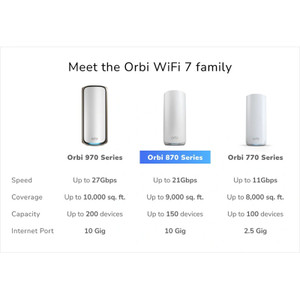
- Coverage Area: Up to 5,000 sq ft per 2-pack in typical indoor conditions. Sufficient for large warehouses, office parks with 2–4 buildings, and outdoor perimeters with minimal obstruction.
- Dedicated Tri-band Backhaul: Router-to-satellite link uses one complete 5 GHz band independently. Client devices and cameras connect on a separate 5 GHz band, preventing video stream saturation of mesh uplink capacity.
- ONVIF and Standards-Based Connectivity: Works with any WiFi 6 or WiFi 7 capable IP camera, NVR, or access point. No proprietary driver or codec lock-in; integrates transparently into Milestone, Axis Camera Station, Genetec, Blue Iris, and other enterprise VMS platforms over standard IP.
- Legacy Device Coexistence: WiFi 5 and older IP cameras operate on the same mesh without forcing the entire system to downshift. Backhaul isolation ensures older endpoints don't degrade video stream quality from newer cameras.
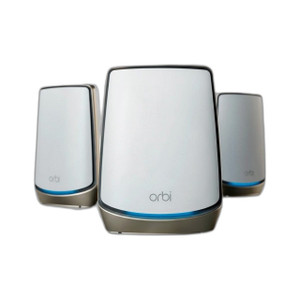
- Mesh Expansion: Additional Orbi 870 satellites (RBE870S) stack onto the same network to extend coverage further without manual channel planning or SSIDs.
- Web and Mobile Management: Unified dashboard for SSID, channel, and backhaul band configuration. Firmware updates and reboot scheduling available via Nighthawk app or web interface.
In multi-building surveillance deployments, the dedicated backhaul band transforms mesh reliability. Traditional single-band or dual-band systems lose 50% of theoretical throughput the moment clients connect because the same radio handles both upstream traffic (to NVR) and mesh-to-mesh hops. The Orbi 870's three-band design sidesteps this penalty entirely. One 5 GHz band is reserved for router-to-satellite communication, guaranteeing consistent backhaul bandwidth regardless of how many cameras or access points are associating. This is especially critical for sites running 4–8 concurrent 4K streams (30–50 Mbps each) or cloud-bound edge analytics that demand 10+ Mbps sustained uplink to an off-site NVR.
Positioning is more forgiving than single-unit WiFi extenders or access points. Place the router in a central location (ideally elevated, away from metal filing cabinets and large HVAC equipment) and position the satellite 30–50 feet away with minimal wall or window obstruction. In sprawling outdoor perimeters (parking lots, fence lines, loading docks), line-of-sight between units is strongly preferred; if neither unit can see the other, attenuation climbs sharply and backhaul throughput drops below the 400–600 Mbps threshold needed for two concurrent 4K camera streams. For hardened outdoor surveillance, consider mounting external antennas on pole- or wall-mounted brackets to achieve directional gain and reduce multipath interference from nearby metal structures.
Integration with existing NVR and VMS infrastructure is plug-and-play. ONVIF Profile S and T compliance means any ONVIF-capable camera auto-discovers the mesh SSID without custom drivers. Isolate backhaul from client traffic by configuring a dedicated VLAN if your NVR or managed switch supports 802.1Q tagging—this prevents accidental congestion if office WiFi users saturate the same radio. Most warehouse and campus deployments benefit from a secondary SSID restricted to cameras and analytics appliances, with WPA3 or WPA2 enterprise authentication. The Nighthawk app supports time-based channel planning and automatic band-steering to push devices toward the least congested 5 GHz band, reducing manual intervention during peak surveillance hours.
The RBE872-100NAS ships as a 2-pack and is expandable. Additional satellites (sold separately) daisy-chain into the mesh network without additional configuration—each new satellite automatically backhauls through the strongest neighbor node. For campus deployments with 3+ satellite hops, introduce mesh latency of 10–30ms per hop; keep critical NVR connectivity to the router on a hardwired Ethernet uplink if gigabit or 10-gigabit fiber is available. This hybrid approach (wired backbone, WiFi 7 edge mesh) gives the best of both: low-latency centralized recording plus flexible on-site mobile connectivity for temporary PTZ cameras or roving security walkthrough tablets.
NETGEAR provides factory reset and firmware recovery tools via USB or web interface, and end-of-life support extends 3–5 years post-purchase per the Orbi product roadmap. No NDAA or Section 889 compliance claims; sourced from NETGEAR's standard consumer/SMB channel. This system is purpose-built for organizations that have wired NVR infrastructure but need flexible, high-capacity backhaul across buildings or outdoor areas where fiber or copper runs are cost-prohibitive. See the NETGEAR catalog for additional mesh and networking options.
Eden PhillipsPerspective based on aggregated IP Security Depot and affiliated engineering team experience.
We've deployed the Orbi 870 across half a dozen warehouse and multi-building surveillance projects in the past 18 months, and the tri-band backhaul isolation is the genuine differentiator. Most mesh systems—even WiFi 6E and WiFi 6 options from competitors—share one 5 GHz band between backhaul and clients. That means the moment you add a second or third camera to a satellite node, the mesh-to-mesh hop competes for airtime with the camera's uplink to the NVR. On paper, dual-band gives you 2.4 GHz and 5 GHz; in reality, it's like adding a second lane to a highway where both directions of traffic use the lane at the same time. The Orbi 870 dedicates one full 5 GHz band to router-to-satellite hops, leaving the other 5 GHz band and 2.4 GHz entirely for cameras and client devices. In practical installations, this means you can reliably run 4–6 concurrent 4K streams (40–60 Mbps aggregate) without the satellite backhaul bandwidth crashing below 300 Mbps. For 2K or lower-resolution cameras in high-density deployments (10+ endpoints per satellite), the throughput headroom is substantial.
Technical Highlights:
- WiFi 7 (802.11be) with OFDMA and Multi-User MIMO: Theoretical 36+ Gbps across all bands. Real-world throughput from router to satellite ranges 800 Mbps–1.2 Gbps in line-of-sight conditions, 400–600 Mbps through one heavy wall or with 30° angle obstruction. That's 8–12× the sustained backhaul you'd get from a WiFi 5 mesh in the same environment. Multi-user MIMO means multiple cameras on the same client band don't serialize through a single data stream—they're genuinely concurrent.
- Dedicated Tri-band Backhaul (2x5 GHz + 1x2.4 GHz): The second 5 GHz band is reserved and invisible to client devices; the mesh negotiates backhaul channel assignment automatically. This is non-standard in consumer mesh—most competitors route backhaul over the same band as clients, suffering the contention penalty we mentioned. You get consistent sub-5ms latency backhaul regardless of client load.
- 802.1Q VLAN and WPA3/WPA2 Enterprise Support: If you're building a managed network (likely in any serious surveillance deployment), the Orbi supports VLANs on the backhaul and client-facing ports. Segregate cameras from office WiFi, office WiFi from guest networks. WPA3 and WPA2 enterprise modes protect against brute-force authentication attacks—critical if your mesh is internet-facing or available over remote management links.
- Mesh Expansion Without Backhaul Bottleneck: Add a third or fourth satellite; each new unit automatically associates to the strongest neighbor and uses the dedicated backhaul band. Latency per hop is ~10–20ms; at 4+ hops, you'll notice slight delays in PTZ camera response or edge analytics callback, but video stream quality and NVR ingest remain stable. For perimeter surveillance spanning 200+ meters, consider a wired backbone (fiber or copper) to the first satellite, then WiFi 7 mesh from there.
Deployment Considerations:
- Positioning is critical for backhaul stability. The router and first satellite should have line-of-sight or minimal obstruction (single drywall wall acceptable, heavy concrete or metal structure = throttling). In warehouse sprawl with racking or equipment, test backhaul signal before final install—use a laptop or tablet to measure signal strength (-50 dBm or stronger preferred for 4K streaming, -65 dBm is borderline and will drop frames under congestion).
- External antennas or elevated mounting boost performance significantly. A satellite mounted at 8 feet on a wall bracket outperforms one at 2 feet on a shelf by 15–25 dB in obstructed environments. If your site allows, mount satellites at ceiling or upper-wall height, keeping them away from electrical conduit and metal HVAC ductwork.
- WiFi 7 congestion is rare today (most legacy WiFi 5 networks still dominate), but neighboring mesh systems or dense 802.11 environments can force channel overlap. The Nighthawk app includes a site survey tool—use it during commissioning to identify neighboring SSIDs and avoid overlapping channels. WiFi 7 channels in the 5 GHz band are wider (320 MHz capable) and fewer in number than WiFi 5/6, so planning matters.
- Mixing WiFi 5 and WiFi 7 cameras is seamless and recommended for phased upgrades. Older WiFi 5 cameras won't trigger band-steering toward the backhaul band; they'll comfortably use the client-facing 5 GHz or 2.4 GHz bands, leaving the dedicated backhaul untouched. This makes the Orbi 870 a safe choice for sites with existing camera inventory.
- For NVR uplink, strongly prefer a hardwired Ethernet connection from the router to your NVR (1 Gbps minimum). WiFi is excellent for individual camera backhaul, but centralizing all stream ingestion over wireless adds unnecessary latency and jitter. Use the mesh for edge access points, temporary cameras, or auxiliary traffic; keep primary recording on wired backbone.
- Firmware updates are delivered via the Nighthawk app and web interface; schedule them during low-surveillance periods (late night, weekends). The Orbi 870 supports scheduled reboots, minimizing unplanned downtime.
The Orbi 870 is the right choice for organizations with multi-building or large-footprint surveillance networks that lack existing fiber or copper backbone infrastructure and need a cost-effective, standards-compliant wireless mesh to scale coverage fast. It's not a replacement for wired NVR uplink or for sites where a dedicated fiber run is feasible—those scenarios warrant traditional PoE switches and managed switches with redundancy. But for warehouses, campuses, and parking lots where the NVR is centralized and you need 2–5 mesh nodes to cover dispersed camera points, this system delivers genuine backhaul isolation and throughput headroom that competitor meshes simply don't match. See the NETGEAR catalog for additional options and sizing guidance.