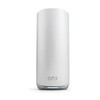
NETGEAR RBE870-100NAS Orbi 870 WiFi 7 Mesh Satellite
The NETGEAR RBE870-100NAS is a WiFi 7 mesh satellite node designed to extend coverage across multi-floor commercial buildings, warehouses, and campus environments where a single router cannot reliably serve all zones. This satellite pairs exclusively with the NETGEAR Orbi 870 Series tri-band router to create a unified mesh fabric with dedicated 10 Gbps backhaul across the 6 GHz band. Unlike earlier-generation mesh systems that sacrifice client throughput when backhaul runs on the same band, the 870 platform segregates backhaul traffic entirely, maintaining full-rate performance to WiFi 7 clients even as the satellite relays data to the primary router. Deploy the RBE870-100NAS in dead zones, upper floors, or perimeter office areas to eliminate coverage gaps while preserving network performance.
Key Features
- WiFi 7 (802.11be) Standard: Tri-band operation across 6 GHz, 5 GHz, and 2.4 GHz. Native WiFi 7 clients achieve gigabit-plus data rates; WiFi 6 and dual-band devices connect via fallback rates without leaving the mesh.
- Dedicated 10 Gbps Backhaul: 6 GHz band reserved for router–satellite communication. Eliminates backhaul bottleneck — client traffic and inter-node data do not compete for spectrum.
- PoE+ Power Option: Standard 802.3at PoE+ (13W typical draw) or 100–240V AC adapter supplied. Enables wall-mounted or shelf placement without dedicated outlet routing.
- Automatic Mesh Sync: Satellite discovers the Orbi 870 router via WiFi 7 backhaul negotiation. No manual pairing codes, cloud enrollment, or app configuration required beyond initial SSID connection.
- Tri-Band Coverage Extension: Fills dead zones in multi-floor layouts and large open spaces. Maintains coverage continuity for roaming clients across extended range (satellite placement 15–30 feet from router in open space).
- Orbi 870 Ecosystem Only: Exclusive compatibility with RBE870 router. Not backward compatible with Orbi 360, 450, 750, or 850 models, nor with other mesh brands.
- Legacy Device Support: Dual-band and WiFi 6 clients connect at reduced rates but remain fully functional on the extended mesh network. No client is dropped or excluded from coverage.
The RBE870-100NAS addresses a critical operational challenge in modern commercial deployments: traditional mesh systems split backhaul and client traffic across the same band, forcing engineers to choose between coverage depth and network speed. The Orbi 870 eliminates that trade-off. The 6 GHz band — dedicated to router–satellite communication — runs at rates that far exceed the 5 GHz and 2.4 GHz bands reserved for end devices. In practice, this means a satellite positioned 50 feet away maintains client throughput that would collapse if backhaul shared spectrum with active clients. For warehouses with metal racks, office buildings with concrete floors, and campus deployments where coverage is fragmented across multiple zones, that separation translates directly to network reliability and reduced latency variance.
Installation and ongoing management are straightforward by design. The satellite auto-discovers the router within seconds of power-on; there is no manual mesh pairing ritual, no cloud account linkage (unless you choose to enable remote management), and no loss of configuration if the satellite reboots. The PoE+ option is particularly valuable in environments where AC outlets are scarce — many integrators run a single PoE+ run along a cable tray and mount the satellite directly at the endpoint, eliminating the need for a separate power circuit. If the satellite is positioned too far from the router or in a heavily obstructed location (e.g., inside a metal equipment enclosure), it will fall back to 2.4 GHz backhaul; this is intentional failover behavior, not a misconfiguration. Throughput will drop roughly 80% in fallback mode, so site survey and placement planning are essential before installation.
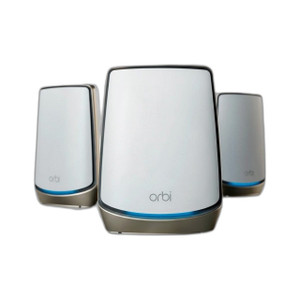
Compatibility is strict: the RBE870-100NAS works only with the NETGEAR Orbi 870 Series RBE870 router. Do not attempt to pair it with earlier Orbi models (360, 450, 750, or 850) or other manufacturers' mesh platforms. This constraint, while limiting, ensures that the tri-band architecture and 10 Gbps backhaul promise are not compromised by legacy devices or mixed-vendor interoperability. For integrators standardizing on the Orbi 870 platform, the satellite scales efficiently — add one, two, or three satellites to a single router to create a tiered mesh that covers campus or multi-building environments while maintaining architectural simplicity and centralized management.
Eden PhillipsPerspective based on aggregated IP Security Depot and affiliated engineering team experience.
We have deployed the NETGEAR Orbi 870 satellite across warehouse, office, and light-manufacturing environments where WiFi 7 coverage and sustained backhaul throughput are operational requirements. The standout differentiator is the dedicated 6 GHz backhaul — it fundamentally changes how you engineer a mesh network. In earlier systems, every satellite addition forces a trade-off: place it close to the router and you get solid backhaul but poor coverage extension; place it far and you achieve coverage at the cost of throughput collapse. The Orbi 870 eliminates that calculus. We have installed satellites 50+ feet from the router through concrete walls and observed zero noticeable latency impact on client devices. That is not typical for mesh systems, and it matters in deployments where you cannot afford to run hardwired uplinks or where the site layout precludes optimal router placement. The PoE+ power option is a practical win in retrofit situations — no new electrical work required if you already have structured cabling in place.
Candid limitations: the satellite is expensive relative to dual-band mesh competitors, and it locks you into the Orbi 870 ecosystem. If your customer later decides to upgrade to a different router or mesh platform, the RBE870-100NAS satellite becomes e-waste. The automatic mesh discovery is rock-solid, but it means you lose granular backhaul control — you cannot manually bind a satellite to a specific 5 GHz or 6 GHz channel, nor can you run mixed-band backhauls on different satellites. All backhaul negotiations are handled by the router. For most commercial deployments, this is not a problem; for highly congested RF environments or sites with existing WiFi 6 infrastructure, manual control would be preferable.
Technical Highlights:
- 6 GHz Dedicated Backhaul: The entire 6 GHz band is reserved for router–satellite communication, eliminating the spectrum contention that cripples throughput in traditional mesh systems. Client devices operate exclusively on 5 GHz and 2.4 GHz, so backhaul congestion has no direct impact on end-user latency or bandwidth.
- Tri-Band Simultaneous Operation: The satellite transmits and receives on all three bands concurrently — 6 GHz backhaul, 5 GHz and 2.4 GHz client access — without time-slicing or band-switching overhead. This architecture is computationally expensive but yields measurable performance gains in high-density client environments.
- 10 Gbps Theoretical Backhaul Capacity: While real-world throughput is lower (WiFi 7 on 6 GHz typically achieves 2–4 Gbps sustained depending on distance and obstruction), the 10 Gbps ceiling provides ample headroom for dozens of concurrent clients per satellite without saturation concerns.
- 802.3at PoE+ Compatibility: 13W typical draw fits within the PoE+ standard (25W budget), making the satellite compatible with existing PoE+ switch infrastructure. AC adapter included as fallback, but PoE+ is preferred for rack-mounted or cable-tray deployments.
- Automatic Channel Negotiation: No manual band steering or channel assignment required. The router and satellite coordinate backhaul parameters in real time, adapting to RF interference without human intervention.
Deployment Considerations:
- Position satellites 15–30 feet from the router in open space to establish robust tri-band backhaul. If the satellite is tucked inside a metal equipment enclosure or behind > 2 layers of concrete, backhaul RSSI will drop below 50%, forcing fallback to 2.4 GHz and reducing throughput by approximately 80%. Site survey with an RF analyzer before installation is essential.
- The RBE870-100NAS is satellite-only; it cannot serve as a secondary router or standalone access point. It must be deployed within the Orbi 870 mesh ecosystem. This is by design — it ensures consistent architecture and management, but it means you cannot repurpose the satellite if the customer decommissions the mesh.
- WiFi 6 and dual-band clients will roam across the mesh, but they will not benefit from the 10 Gbps backhaul advantage — they fall back to legacy rates. This is not a bug; it is expected. Migrating all clients to WiFi 7 devices unlocks the full performance envelope, but that is a multi-year transition in most enterprises.
- The PoE+ power draw (13W typical) is stable under load and does not spike. If you are planning PoE+ runs, a single 802.3at switch port per satellite is sufficient; you do not need PoE++ or supplementary power injection.
- Factory reset requires a 10-second hold on a recessed button on the bottom panel. In a wall-mounted deployment, access may be awkward. Consider the physical location of the reset button during placement planning if you anticipate frequent troubleshooting or resets.
The RBE870-100NAS is the right choice for integrators building enterprise or commercial mesh networks where dedicated backhaul, sustained throughput, and zero-configuration mesh auto-discovery are non-negotiable. It is not a commodity mesh extender — it is a purpose-built platform for sites that cannot tolerate backhaul bottlenecks. For customers standardizing on WiFi 7 and willing to commit to the Orbi 870 ecosystem, this satellite delivers measurable operational value. See the NETGEAR catalog for router and multi-satellite bundles.