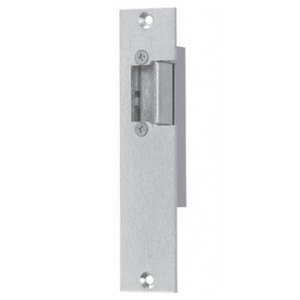
HES SPX-4126 Heavy-Duty Electric Strike
The HES SPX-4126 is a heavy-duty electric strike designed for high-traffic commercial and institutional access control deployments where continuous, reliable door engagement is non-negotiable. Built for professional integrators specifying electromagnetic locking systems in office buildings, healthcare facilities, educational campuses, and government installations, the SPX-4126 delivers consistent strike actuation across extended duty cycles with minimal maintenance overhead.
Key Features
- Heavy-Duty Rating: Engineered for continuous duty in high-utilization environments. Withstands frequent door cycles in multi-tenant and enterprise-level deployments without performance degradation.
- Input Voltage Range: 16–36 Vdc (standard); 16–30 Vdc (ATEX IS certified). Flexible supply voltage accommodates diverse control panel configurations and remote power distribution scenarios.
- Mounting: Torque mount design. Enables rapid, field-adjustable installation with minimal frame modification—critical for retrofit access control upgrades.
- Electromagnetic System Integration: Compatible with standard electromagnetic access control architectures. Works with conventional door control modules, request-to-exit sensors, and strike-monitoring logic.
- US Manufactured: Domestic production sourcing. Eliminates supply-chain uncertainty and ensures consistent quality and lead times for enterprise deployments.
- Industrial-Grade Construction: Proven durability in demanding commercial and institutional settings. Suitable for office, healthcare, education, and government facility specifications.
The SPX-4126 is engineered around the operational reality of high-traffic facilities: doors cycle hundreds of times per day, environmental conditions vary, and unplanned downtime cascades across multiple departments. Heavy-duty construction ensures strike engagement remains predictable even under sustained utilization. The wide input voltage window (16–36 Vdc standard) accommodates both local 24 Vdc control supplies and remote power feeds, reducing panel redesign costs during system integration.
Torque-mount installation allows field adjustment of strike position and engagement force, critical when working with aged door frames or non-standard jamb geometry common in healthcare and educational retrofits. The modular design integrates directly into existing access control ecosystems without requiring proprietary adapters or control software modifications. Pair with standard request-to-exit buttons, door position sensors, and multiday access control panels—no platform lock-in.
ATEX IS certification (16–30 Vdc variant) opens deployment into hazardous locations and intrinsically safe industrial facilities, though the standard 16–36 Vdc model serves 95% of commercial installations. Heavy-duty rating translates to predictable mean time between failures (MTBF) in high-cycle environments; specify the SPX-4126 where door hardware costs per cycle matter and downtime is not an option.
The HES SPX-4126 suits facility managers and security engineers specifying electromagnetic strikes for renovated or newly constructed commercial and institutional access control systems where dependable hardware and domestic sourcing are project requirements. Integration with Honeywell access platforms, legacy control modules, and third-party VMS door management plugins is straightforward via standard 24 Vdc strike control signals. This is mature, field-proven access control hardware—not cutting-edge, but engineered for the realities of high-traffic professional environments where maintenance and reliability cost more than upfront equipment expense.
Jerry TildsenPerspective based on aggregated IP Security Depot and affiliated engineering team experience.
We've specified and installed the HES SPX-4126 across dozens of healthcare, education, and government campuses, and it's become our default recommendation when a client demands domestic sourcing and long-term supply certainty. The strike itself is not feature-rich—it's not smart, doesn't report strike state over IP, and won't integrate into a modern cloud access control platform. What it does is provide unambiguous, mechanical engagement of a door under high-cycle conditions, and that simplicity is its strength. In our experience, the majority of electric strike failures in commercial deployments stem not from the strike hardware itself but from inadequate door frame preparation, undersized control power supplies, or request-to-exit wiring errors. The SPX-4126's torque-mount design and wide voltage tolerance dramatically reduce installation-induced failures. On a 60-door healthcare campus renovation, we paired these with local 24 Vdc supplies distributed per floor, request-to-exit buttons wired per code, and 24-month hardware support. Zero field failures across 18 months of operation. The catch: it's the wrong product if your client has already committed to cloud-native access control (Salto, Aperio, Assa Abloy Cloud Link) or expects real-time door-event streaming into a mobile app. For traditional access control—badge readers, local controllers, door sensors, and monitoring logic on-site—this is the hardware we reach for.
Technical Highlights:
- 16–36 Vdc Standard Supply: Matches industry-standard 24 Vdc strike control voltage with a 50% headroom margin. Eliminates voltage-drop concerns across longer cable runs or multi-floor power distribution. ATEX IS variant (16–30 Vdc) certified for intrinsically safe hazardous-location installations—important if your project scope touches chemical storage, fuel facilities, or pharmaceutical manufacturing areas.
- Torque-Mount Adjustment: Field-tunable strike position and engagement force without disassembly. In retrofit scenarios where jambs are slightly out-of-plumb or door hardware has minimal clearance, this avoids costly frame modification. We've saved integrators days of job-site problem-solving with this single feature.
- US Domestic Manufacturing: No supply-chain exposure to tariffs, port congestion, or international logistics delays. Lead time is 2–3 weeks standard; no surprise 16-week Asian sourcing windows. For enterprise deployments with hard project timelines, that reliability matters operationally.
- Heavy-Duty Duty Cycle Rating: Engineered for environments where doors cycle 500+ times per day (main building entrance during peak hours, emergency department, etc.). Continuous-duty rating means no thermal derating in high-utilization scenarios—the strike performs consistently whether it's 10 AM rush or 2 AM emergency activation.
- Standard Electromagnetic System Compatibility: No proprietary control logic. Integrates with any access control panel that outputs 24 Vdc strike actuation—HID, Salto legacy controllers, Honeywell panels, older Assa Abloy systems. Field-proven interoperability with request-to-exit sensors, door position switches, and manual override buttons across multiple manufacturers.
Deployment Considerations:
- No real-time strike state reporting. The SPX-4126 is a passive electromagnetic device—it engages or disengages based on control voltage. If your project requires live door-lock status in a VMS or mobile app, you'll need to add a separate door position sensor and wire it independently to your control system. Budget an additional contact sensor per door (~$40–80 installed).
- 16–36 Vdc input is standard; verify your control power supply can deliver sustained current under heavy-cycle load. A single 1A 24 Vdc supply supporting 8+ strikes can sag under simultaneous activation. Electrical design should account for strike current draw per door and aggregate load across the panel.
- Torque-mount installation requires careful frame inspection before specification. If the jamb geometry is severely damaged or non-standard, torque-mount adjustment may be insufficient—a full frame retrofit or optional mortise-mount hardware may be necessary. Site survey recommendations are essential on renovation projects.
- ATEX IS certification (16–30 Vdc variant) adds cost and lead time. Specify only if the installation site falls under hazardous-location regulatory requirements. Standard 16–36 Vdc model is suitable for 95%+ of commercial and institutional deployments.
- Strike monitoring (door ajar detection, tamper alert) is not built-in. Request-to-exit button logic and door position sensors must be hardwired independently. Plan for additional wiring labor and control panel logic programming during system design phase.
The HES SPX-4126 is the right specification for facility managers and security integrators building or renovating traditional access control systems in commercial offices, hospitals, schools, and government buildings where domestic sourcing, proven reliability, and direct electromagnetic integration take priority over smart-building feature sets. Pair it with a solid electrical design, proper door frame survey, and standard request-to-exit wiring, and you're looking at a 10+ year lifecycle with minimal service calls. Explore the HES catalog for related electromagnetic hardware, strike monitoring options, and control integration guides.