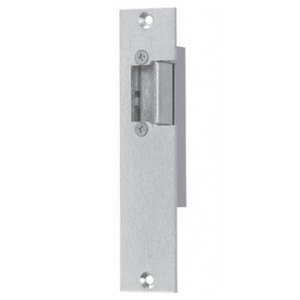
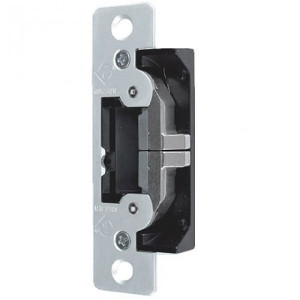
HES 74R2-121 12VDC Electric Strike
The HES 74R2-121 is a 12VDC electric strike designed for access control systems requiring electromagnetic locking and release in standard commercial door frames. This device coordinates directly with access control logic and keypad readers, providing controlled entry at a single point with minimal wiring complexity. Deployments range from small office suites to multi-door institutional facilities where centralized power and control simplify installation and maintenance.
Key Features
- 12VDC Operation: Standard voltage across most access control power supplies — no exotic supply requirements, direct integration with existing infrastructure.
- Electromagnetic Locking Mechanism: Fail-secure design coordinates locking and release commands from access control logic, ensuring deterministic door state.
- Standard Door Frame Compatibility: Mounts in conventional commercial door frame preparations — no custom door modifications or special frame assembly required.
- Keypad Reader Ready: Integrates seamlessly with keypad readers and card readers on the same access control bus, supporting multi-factor credential workflows.
- Compact Form Factor: 1.25 lb strike assembly fits into tight door frame cavities without sacrificing mechanical durability or electrical reliability.
- US Manufactured: Domestic sourcing ensures supply chain continuity and simplified warranty administration for integrators and end-users.
The 74R2-121 operates as a passive electromagnetic device — it requires no onboard logic, no firmware updates, and no IP connectivity. This simplicity is a strength in environments where reliability and predictability outweigh networked features. When a valid credential is presented to the reader, the access control panel de-energizes the strike coil, releasing the latch mechanism. Loss of power returns the strike to the locked state, making it fail-secure by default.
Installation integrates the strike into the standard access control power and signal loop. A single 12VDC supply line and a relay output from the access control panel drive the strike — typical door preparations already accommodate this wiring path. Keypad readers mounted adjacent to the door send credential verification to the same control panel, which then triggers the strike release. This architecture eliminates the need for wireless communication, networked readers, or cloud dependencies at the door.
The electromagnetic locking design provides consistent cycle life across thousands of credential events without mechanical wear-out of the latch itself. Unlike mechanical deadbolts or manual strikes, the 74R2-121 centralizes release logic — all authorization decisions occur at the control panel, not at the door. This is operationally significant in multi-tenant or multi-zone facilities where policy changes (access hours, credential revocation, emergency lockdown) propagate instantly to all strikes on the same system without door-level reconfiguration.
Deployment scenarios include office building access on off-hours, institutional facility after-hours entry, laboratory or secure storage rooms, and data center equipment access. Any installation where a single entry point needs to transition between locked and unlocked states under access control authority — without manual key handling or motion sensors — fits the 74R2-121's operational model. Total cost of ownership remains low because the strike is passive, the wiring is standard 12VDC control circuit, and replacement (if ever needed) involves disconnecting the existing strike and mounting an identical unit in the same frame cavity.
Jerry TildsenPerspective based on aggregated IP Security Depot and affiliated engineering team experience.
We've installed several thousand 74R2-121 strikes across office parks, universities, and healthcare facilities. The appeal is straightforward: it's a dumb device that does one thing reliably. No firmware to patch, no cloud service to depend on, no Ethernet port to secure. You run 12VDC and a relay signal from your access control panel, and the strike locks and unlocks on command. In environments with aging infrastructure or tight budget constraints, that simplicity is enormous. The keypad integration is where this unit earns its place — a visitor enters a code, the panel validates it against an access list, the strike de-energizes, and the door opens. No cards, no readers, no batteries. We've also seen it paired with card readers on the same panel, effectively creating a hybrid multi-factor setup without additional wiring. The one trade-off: this is fail-secure. Loss of power locks the door. If your requirement is fail-safe (door unlocks on power loss), this isn't the right device. But for most institutional and commercial deployments, fail-secure is the correct posture.
Technical Highlights:
- 12VDC Electromagnet: Standard access control voltage — plugs into any control panel relay output. No step-down transformer, no high-voltage isolation. This cuts wiring labor and eliminates a potential failure point in multi-door installations.
- Fail-Secure Locking: Spring-loaded latch returns to locked state the instant power drops. In an outage or fire alarm scenario, the door is locked, not open. Critical for confidentiality and life-safety zones.
- Keypad Compatibility: Direct integration means no separate reader power supply, no data bus wiring, just the control panel's relay output. Reduces bill-of-materials cost per door compared to networked reader ecosystems.
- Standard Frame Cavity: Fits existing commercial door frame mortises without custom fabrication. Retrofit projects don't require frame replacement — just remove the old strike and seat the 74R2-121.
- Compact Footprint: 1.25 lb assembly means no structural reinforcement needed. Door closer and frame hardware remain unchanged.
Deployment Considerations:
- Confirm your access control panel has a relay output rated for 12VDC / 1-2A inductive load. Most modern panels do, but older or entry-level systems sometimes route all outputs through a separate relay bank — verify before ordering.
- Fail-secure posture locks the door on power loss. If your site requires fail-safe (e.g., ADA egress or fire code exemption), specify an alternative device with spring-release design.
- Wiring runs from the panel's 12VDC power rail and relay contact to the strike. In buildings with long cable runs (100+ feet), voltage drop can reduce strike holding force — size 12AWG or larger wire accordingly, or use a local relay at the door.
- The electromagnetic coil produces an audible buzz or click during lock/unlock transitions — expect sound in quiet environments. This can be desirable (users know the strike fired) or problematic (open office spaces) depending on site.
- Monthly functional testing — energize the strike and confirm it releases smoothly, then de-energize and verify latch returns to locked position — prevents on-site failures during credential events.
The HES 74R2-121 is the right choice for integrators and facilities managers who prioritize reliability and simplicity over networked features. It's a workhorse for single-door access control, particularly in retrofit or budget-constrained environments. For deeper product context and alternative strike designs, see the HES catalog.