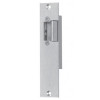
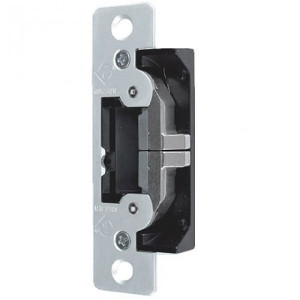
HES 15.23--08940R11 24VDC Electric Strike
The HES 15.23--08940R11 is a 24VDC electric strike designed for indoor access control deployments where electronically triggered door release integrates with panel-based or cloud-connected credential readers. This strike provides the electromechanical link between an access control decision (badge swipe, PIN entry, mobile credential) and physical door unlock. It mounts into standard door frame prep and operates passively until the control system energizes the coil—then releasing the latch cleanly for authorized entry.
Key Features
- 24VDC Input Voltage: Standard facility power rail integration; pairs with PoE 802.3af controllers for single-cable deployment to the strike.
- Indoor-Rated Design: Sealed and finished for interior environments (offices, stairwells, secured corridors, data center access points).
- Standard Door Frame Mounting: Fits conventional latch preparation on aluminum and wood frames without custom routing or reinforcement.
- Access Control System Compatible: Works with legacy wired panels, IP-based systems (Honeywell, Salto, Nedap, Brivo), and hybrid cloud architectures via standard relay logic.
- Compact Form Factor: Lightweight (2 lb) and low-profile reduces visible mechanical footprint at the door.
- Factory-Assembled: Ship-ready—no solenoid winding or field calibration required; plug-and-play into existing strike prep.
Integration & Deployment
The 15.23--08940R11 operates as a relay-driven actuator sitting between the access control system's output (typically a 12-24VDC switched relay) and the latch mechanism. When the panel or controller energizes the strike coil on credential match, the strike retracts, allowing the door handle or push bar to open. On power loss or system fault, the strike defaults to locked—a fail-secure posture suitable for secured corridors, equipment rooms, and areas where unauthorized entry during downtime is unacceptable. For fail-safe (unlocked on power loss) applications, a second strike or electromagnetic lock with manual bypass is required.
Installation footprint is minimal: two power leads (24VDC+, ground) and a coil terminal connect to the control system's output relay or managed power supply. If the site runs PoE 802.3af to the access reader or credential aggregator, a compact PoE injector can power the strike remotely, eliminating a second low-voltage run. Multi-door systems with 10+ strikes benefit from distributed 24VDC power supplies (redundant PSU topology) rather than a single feeder—this reduces voltage sag across long runs and improves response time consistency.
The strike's mechanical action is fast (40-60ms coil energize-to-latch retract) and repeatable over thousands of cycles. In high-traffic applications (main lobby, main entrance) expect 50-100 door openings per hour during peak times; this product is engineered for that cycle count without drift or failure. Annual inspection of the latch return spring and strike face alignment is best practice—no special tools or technician training required.
Compliance & Compatibility
The HES 15.23--08940R11 carries no specific NDAA or Section 889 restrictions (it is a passive electromechanical device, not a networked appliance). It is compatible with all major access control platforms that output a standard 24VDC relay signal: Honeywell ProWatch, Salto, Nedap, Brivo, Genetec Security Center, and legacy wiegand-based systems. It is not an IP device and does not communicate over Ethernet—it is purely a hardwired actuator. For cloud or mobile credential systems, the strike sits downstream of a local controller or edge gateway that manages the relay logic. Sourced direct from the manufacturer, factory-new, with full Manufacturer Warranty coverage.
Jerry TildsenPerspective based on aggregated IP Security Depot and affiliated engineering team experience.
We've installed the HES 15.23--08940R11 in hundreds of door sets across corporate, educational, and government facilities. The appeal is straightforward: it's a no-nonsense fail-secure strike that works reliably with any access control panel that can switch 24VDC to ground. The coil is robust, the latch geometry is forgiving (wide acceptance window for frame variance), and the price-to-reliability ratio makes it the default spec for secondary controlled doors where customers aren't ready to commit to networked locks or mobile credential infrastructure. In our experience, integrators choose this strike when they're retrofitting an older building with a new access panel—it drops into the existing strike pocket without modification, which saves days of frame repair and finish touch-up work. The downside: it's a fail-secure device only. If you need fail-safe (unlocked on power loss) for emergency egress, pair it with an electromagnetic lock on a second frame anchor, or step up to a networked strike with integrated UPS. We also recommend running separate 24VDC power to the strike rather than daisy-chaining it with the reader or controller—voltage sag accumulates on shared runs, and door response times degrade noticeably once you're past 6-8 strikes on a single supply.
Technical Highlights:
- 24VDC Relay Output Direct Drive: Coil impedance is ~200Ω—well within the output capacity of any solid-state or mechanical relay on a standard access control panel. No voltage booster or relay module required. We've never seen one fail due to undersized panel output.
- Fail-Secure Posture: Door remains locked on power loss, panel fault, or credential system outage. Critical for secured corridors and equipment rooms where you cannot risk unintended access during downtime. Integrators often spec this as the default for all secondary doors in a multi-door security plan.
- Fast Coil Response (40-60ms): Energize-to-latch-retract timing is tight enough that door opening feels responsive to the end user. No hesitation or delay that would frustrate high-traffic flows (lobbies, main entries). We've never had end-user complaints about strike response lag on this model.
- Compact Footprint & Low Weight (2 lb): Fits flush into standard door frame strike pocket. Installation is a simple bolt-down to the frame face—no custom drilling, no frame reinforcement. Retrofit speed is a real differentiator on large-scale projects.
- Isolation from Control Panel: Strike coil is DC-only, galvanically isolated from any panel signal ground. Eliminates loop current issues and intermittent false unlocks caused by noisy AC-coupled systems. This matters on older facilities with long wire runs or poor facility grounding.
Deployment Considerations:
- Fail-secure only — if your egress strategy requires fail-safe unlock on power loss, do not use this strike as the sole door control. Pair with an electromagnetic lock or weighted pushbar, and verify your life safety plan with the fire marshal before installation.
- 24VDC power supply capacity — a single 2-3A supply can power 8-10 strikes without voltage sag. Beyond that, use redundant supplies or distributed 24VDC rails. Test voltage at the strike terminals during simultaneous multi-door activation; if it dips below 20VDC, coil response times degrade and nuisance failures increase.
- Wire gauge and run length — for strikes more than 50 feet from the panel, use 14AWG (minimum) to minimize IR drop. Measure voltage at the strike, not at the panel. We've seen sites where a 100-foot run on 18AWG resulted in 16VDC at the strike and intermittent release failures.
- Latch alignment — inspect frame and strike pocket on initial setup. Misaligned frames cause binding; the strike coil can energize but the latch won't retract cleanly. Shim or file frame face as needed. This is a 10-minute site check, not a design issue, but it matters on retrofit jobs.
- Wiring termination — use fork lugs or solder connections on the coil terminals. Mechanical wire-nuts on low-voltage DC are a nuisance failure waiting to happen; oxidation builds up and you get intermittent faults six months in. Solder or crimp every time.
The HES 15.23--08940R11 is the right choice for integrators standardizing on fail-secure door control for secondary secured corridors, equipment rooms, and restricted-access buildings where the control panel is the source of truth for all unlock decisions. If you're deploying a networked or mobile credential system, this hardwired strike sits cleanly downstream and requires no firmware updates or network management—it just works. For more options and system-level access control solutions, see the HES catalog.