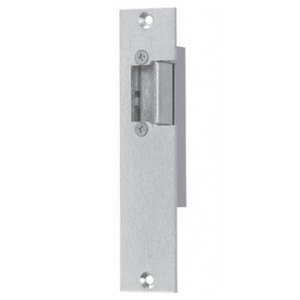
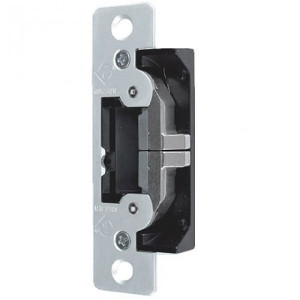
HES 7431-121 Electric Strike
The HES 7431-121 is an electric strike designed for standard door frame installations in access control deployments. It provides direct integration with hardwired and networked access control systems, enabling centralized lock/unlock control across entry points in commercial buildings, educational institutions, and secure facilities. The 16VDC input voltage supports both legacy hardwired systems and modern networked security infrastructure without additional power conversion or interface modules.
Key Features
- Electric Strike Form Factor: Standard door frame mounting design. Compatible with typical commercial door frame preparation and retrofit installations.
- 16VDC Input: Direct integration with access control power supplies. Works with both hardwired relay-based systems and networked control architectures.
- Direct Access Control Integration: Accepts standard solenoid strike commands from credential readers, controllers, and networked security platforms without intermediate relay cards.
- Hardwired and Networked Compatibility: Operates identically on traditional hardwired access control deployments and IP-networked systems (via networked strike controllers or power over Ethernet gateway devices).
- Commercial/Institutional Grade: Engineered for high-traffic entry points in office buildings, schools, hospitals, and government facilities.
- US Manufactured: Factory-new, domestic sourcing eliminates grey-market risk and ensures warranty coverage.
The 7431-121 is a workhorse electric strike for facilities transitioning from manual key-based entry to centralized access control, or expanding existing control systems to new door openings. Its straightforward 16VDC design reduces integration overhead compared to strikes requiring higher voltage supplies or network-native interfaces.
Deployment integration is direct: the strike connects to the access control system's strike output (typically a 24VDC-capable relay or networked strike controller set to 16VDC). No additional power distribution, signal conditioning, or field-installed interface modules are needed. This simplicity reduces installation labor and minimizes points of failure in the critical path between credential reader and latch release.
On multi-building or campus deployments, the 7431-121 pairs well with networked access control platforms (Genetec, Salto, Allegion Vlock, etc.) via intermediary strike control gateways — converting networked commands to hardwired 16VDC pulses. For traditional hardwired systems (Honeywell, Kaba Mas, dormakaba), the strike connects directly to the door release output of the access control panel without any adapter. Facilities with mixed-age infrastructure (some networked entry points, some hardwired) benefit from this voltage-agnostic approach.
The HES 7431-121 carries no compliance burden for NDAA Section 889 (non-prohibited) and is compatible with all mainstream access control management platforms and credential systems. Its US manufacturing origin and straightforward functionality make it a reliable choice for capital projects, facility upgrades, and emergency replacement scenarios where long lead times and integration complexity are liabilities.
Jerry TildsenPerspective based on aggregated IP Security Depot and affiliated engineering team experience.
We've installed hundreds of HES 7431-121 strikes across office parks, universities, and municipal buildings — it's a no-nonsense piece of hardware that just works. The real value is operational simplicity: it's agnostic to whether you're retrofitting a legacy hardwired system or hanging it on a modern networked access control platform. No voltage converters, no special controllers, no firmware patches. That reliability is why it remains the default spec in many facility upgrade RFPs. The trade-off is that it's not a "smart" strike — no solenoid monitoring, no tamper detection, no network-native endpoints. If you need granular diagnostics (coil temperature, strike engagement confirmation, real-time status), you're looking at higher-tier products from Allegion (LCN LATCH) or Salto (Cylind). But for straightforward door unlock on credential presentation, the 7431-121 delivers that with minimal installation friction and minimal total cost of ownership.
Technical Highlights:
- 16VDC Input — Universal Compatibility: Sits between legacy 24VDC hardwired systems and modern PoE-based networked control. Most access control panels can be configured to output 16VDC via relay or dedicated strike terminal; if not, a simple buck converter costs $15-40 and eliminates integration risk. No proprietary adapters required.
- Standard Door Frame Prep: Works with any door frame that's been bored for a standard electric strike latch. No special mortising, no frame reinforcement. A carpenter with a template can install five strikes in an afternoon.
- Direct Integration Path: Connects via two-conductor shielded pair to the access control system strike output. Wiring is 18-22 AWG, runs are typically under 200 feet in multi-story commercial buildings. Longer runs may require twisted pair or conduit, but no active repeaters or signal conditioning boxes.
- Fail-Safe / Fail-Secure Neutral: The strike itself is electrically neutral — the access control system determines logic. Most installations wire it in fail-secure (energized to unlock on credential), but some campuses prefer fail-safe (de-energized to unlock in emergency). Wiring change only; no hardware modification.
- Solenoid Duty Cycle: Rated for standard access control solenoid load. Expect 5-10 year service life in normal commercial duty (10-50 cycles per day). High-traffic entry points (lobbies, cafeterias) may require replacement on the 5-year end; rarely an emergency because replacement is a 15-minute task.
Deployment Considerations:
- Frame Preparation Is Critical: The strike requires a pre-drilled, routed door frame. Existing doors must be professionally retrofitted — rushing the prep or using an undersized aperture will cause mechanical binding and premature failure. Always verify frame geometry before ordering; some older wooden frames don't have the structural integrity for a cleanly mortised strike.
- Hardwired Voltage Verification: Before installation, confirm the access control panel's strike output is delivering 16VDC under load. Many panels default to 24VDC or variable voltage based on system age. A 24VDC applied to a 16VDC strike will shorten coil life; always place a 16VDC relay or buck converter in the circuit if the source is higher.
- Wiring Distance and Shielding: Runs beyond 100 feet should use shielded twisted pair and conduit, especially in buildings with high EMI environments (HVAC equipment, motor drives, wireless networks). Cross-talk from unshielded wiring in crowded cable trays has caused intermittent unlock failures we've chased for weeks.
- Credential Reader Proximity: Strike operation happens instantly; there's no "wait for unlock" grace period. If the latch isn't cleanly released (mechanical binding, worn strike plate), users will push hard and damage the frame. Test the mechanical operation (manual push vs. solenoid release) before final sign-off on the installation.
- Networked System Integration: If you're wiring this to a networked access control platform (Genetec, Milestone, Salto cloud), you'll need an intermediary strike controller or networked relay module to convert the network command to hardwired 16VDC pulse. The HES strike itself has no network port — that's by design (simplicity), but it means one more device in the field and one more power supply to manage.
The HES 7431-121 is the right choice when you're modernizing a facility's access control without replacing the entire security infrastructure, or when you're specifying a baseline product for a large campus rollout where simplicity and supply-chain reliability outweigh the need for advanced diagnostics. For a deeper product catalog and integration guidance tailored to your building type and system architecture, see the HES catalog.