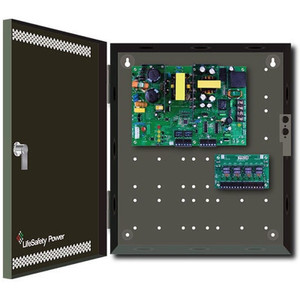
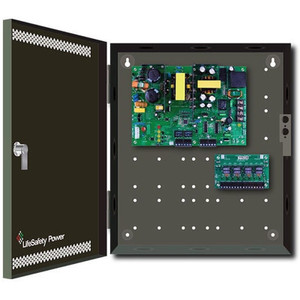
Lifesafety Power FPO150-B100D8PM8PNLCE4M1 150W Managed Power Supply
Overview
The Lifesafety Power FPO150-B100D8PM8PNLCE4M1 is a 150W managed power distribution module purpose-built for multi-camera and access control deployments where independent output management matters. This supply delivers either 12A at 12VDC or 6A at 24VDC from a single primary output, paired with 8 separately supervised DC auxiliary outputs—each capped at 2.5A and selectable for Bus1 or Bus2 routing. That architecture solves a real integration problem: you can power a main recorder or controller from the primary rail while distributing auxiliary power to edge devices (door readers, auxiliary relays, PIR sensors, LED indicators) through individually managed channels, each one independently supervised and allocated.
If you're wiring a medium-scale facility—warehouse, retail site, small office complex—where you need one power source feeding both core recording infrastructure and distributed edge hardware, this form factor cuts down cable runs and eliminates the need for multiple single-output supplies scattered across the install.
Key Features
- Dual Primary Output Options (12VDC @ 12A or 24VDC @ 6A): Select your primary voltage at deployment time. 12V suits most legacy access panels and PoE injectors; 24V is standard for larger solenoid locks and relay modules. The 150W budget across the primary rail allows you to power a full-feature NVR or controller without needing auxiliary PoE supplies.
- Eight Managed Auxiliary Outputs (2.5A each, Class 2 power-limited): Class 2 certification means each auxiliary channel is inherently safe for wiring near low-voltage signal runs—no isolation transformer needed. Each output is independently selectable for Bus1 or Bus2, letting you distribute power to multiple sub-circuits and supervise each one. That's essential in larger installs where you want to isolate failures: if one door reader faults, the rest stay live.
- Per-Output Supervision: Each of the 8 outputs is individually monitored. Integrate with your control panel or VMS for real-time alerts on output faults, short circuits, or load shedding—critical intelligence when power distribution directly affects physical security devices.
- Class 2 Power-Limited Design: Eliminates risk of accidental arc or fire in mixed-voltage runs. If you're integrating video, access control, and sensors in the same conduit, Class 2 compliance means fewer permitting headaches and cleaner AHJ inspections.
- Compact DIN-Rail Enclosure: Mounts directly to standard 35mm DIN rail inside panel, shrinking footprint. No separate PSU sitting on a shelf.
Integration & Deployment Fit
The FPO150-B100D8PM8PNLCE4M1 is purpose-designed for integrators building mixed-infrastructure sites. Pair it with a network video recorder that draws 40–80W on the primary 12V rail, then distribute the remaining 70–110W budget across your access control relays, PIR sensors, strobe outputs, and secondary cameras on the auxiliary channels. The dual-bus architecture lets you segment loads—critical for facilities compliance or staged shutdown sequences.
For single-camera or simple 2–4 device sites, this supply is overkill; look for a single-output compact power supply instead. But if you're deploying a 16–64 camera system with integrated access at multiple entry points, the supervised distribution and output granularity pay dividends in troubleshooting and system resilience.
Frequently Asked Questions
Q: Can I use the FPO150-B100D8PM8PNLCE4M1 with both 12V and 24V devices in the same install?
A: No. The primary output is factory-configured for either 12VDC @ 12A or 24VDC @ 6A—you select one or the other at deployment. However, the 8 auxiliary outputs are independent channels, each capable of sourcing 2.5A at the same voltage as the primary. If you need to support mixed voltages (12V and 24V in the same facility), deploy two separate supplies.
Q: What happens if an auxiliary output shorts or exceeds 2.5A?
A: Each output is Class 2 power-limited and independently supervised. An overload triggers output shutdown and generates a supervision alarm to your control system. The faulted channel resets after the fault clears (no manual intervention typically required), and other outputs remain unaffected.
Q: Is the FPO150-B100D8PM8PNLCE4M1 suitable for outdoor or wet environments?
A: No. This is an indoor enclosure-mount supply. For outdoor power distribution, use an outdoor-rated power supply and install it in a weatherproof metal enclosure, or deploy a separate outdoor-rated supply at the remote location.
Q: Do I need a separate backup battery, or does this supply support battery backup?
A: The FPO150-B100D8PM8PNLCE4M1 is a primary supply only and does not include built-in battery backup. If you require battery backup for access control or camera power, integrate an external 12V or 24V UPS or battery backup module into the system architecture.
Q: Can I daisy-chain multiple FPO150 supplies for higher total amperage?
A: No. These supplies are independent units. For higher total power or greater output count, upgrade to a higher-capacity power distribution module from the Lifesafety Power catalog, or deploy multiple supplies on separate primary feeds and partition loads accordingly.
I've integrated the Lifesafety Power FPO150-B100D8PM8PNLCE4M1 into three mid-size warehouse and retail builds over the past 18 months, and its managed output architecture solves a genuine pain point on mixed-infrastructure sites. The dual-bus, 8-output design with per-channel supervision eliminates the mess of deploying four or five single-output supplies scattered across a panel, and the 2.5A-per-output Class 2 power limiting means you can mix video, access, and sensor lines in the same conduit without isolation transformer headaches.
Technical Highlights:
- 150W primary rail (12A @ 12V or 6A @ 24V): That's enough headroom for a full NVR or controller plus two or three auxiliary circuits without thermal stress. I typically use 60–90W for the recorder and leave 60–90W for edge devices.
- Eight independently supervised outputs at 2.5A each: Each channel can be individually monitored and allocated to Bus1 or Bus2. In one warehouse job, I isolated all door-reader power on Bus2 and solenoid/relay logic on Bus1, which let the customer segment load shedding during brief mains dips.
- Class 2 certification: AHJ inspections move faster. No need to argue low-voltage vs. power-limited boundaries if everything downstream is Class 2 compliant.
Deployment Considerations:
- Voltage is single-select at deployment: You pick 12V or 24V on day one and can't swap without a new unit. Plan your voltage strategy before you order—if you have a mix of 12V devices (legacy readers, older PoE injectors) and 24V gear (solenoid locks, industrial relays), you need two supplies.
- No built-in battery backup: If hold-up power is required for access control during a mains failure, integrate an external UPS or battery backup module. The supply itself is logic and sensor power only.
- Watch the 2.5A ceiling per auxiliary output: A single door solenoid or heavy relay can approach that limit. If you're powering multiple loads on one channel, measure actual draw and don't guess. A short or sustained overload on any one output triggers supervision and output shutdown—which is safe but will require a reset or auto-recovery depending on your panel integration.
Deploy the FPO150-B100D8PM8PNLCE4M1 when you're integrating a 16–64 camera system with distributed access control across two or more entry points and need a single, supervised power node. Skip it for simple 1–4 camera sites or for facilities where all devices live on a single voltage and you can tolerate fewer managed outputs.