Lifesafety Power FPO150-B100C8D8NLCE4-4SL1 150W Power Supply with Dual-Output Relay Control
Overview
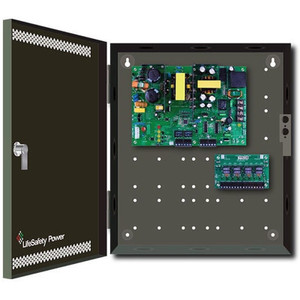
The FPO150-B100C8D8NLCE4-4SL1 is a 150W industrial power supply designed to centralize power delivery and electromechanical lock control in access control and building automation systems. It delivers either 12A at 12VDC or 6A at 24VDC — selectable at installation — making it suitable for mixed-voltage environments where both conventional and modern IP-based security infrastructure coexist. The unit supports eight relay outputs fused at 3A each, with per-output selectable failsafe or failsecure logic (FAI-capable), plus eight DC auxiliary outputs also fused at 3A, each assignable to either Bus1 or Bus2. This architecture eliminates single points of failure in access control networks and allows granular control over door locks, magnetic bolts, and auxiliary field devices without requiring separate control panels.
Compatibility
The FPO150 integrates into Lifesafety Power access control ecosystems and works with third-party lock hardware, motion sensors, and auxiliary devices that operate within 12V or 24V DC specifications and 3A per-output current budgets. It is compatible with systems using the Single FPO Buss/Flex Cable Kit referenced in the model designation, supporting daisy-chain or distributed topology configurations across multiple zones. Confirm your existing lock controllers, readers, and field devices operate within the 12V or 24V range before deployment.
Installation Notes
Install in an environmental-controlled enclosure or UPS-backed cabinet to protect the supply from moisture, dust, and thermal stress. Each relay output requires a dedicated fused circuit or device load rated not to exceed 3A; oversizing loads will trip the fuse and disable that output. The dual-voltage configuration (12V/24V) is selected via internal jumper or terminal block at commissioning — document the selection clearly to avoid field confusion. The bus topology allows chaining multiple units, but verify voltage consistency across all connected nodes before energization.