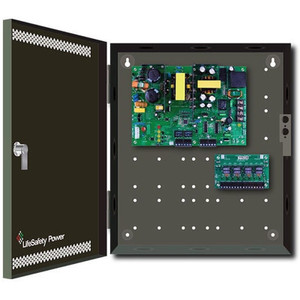
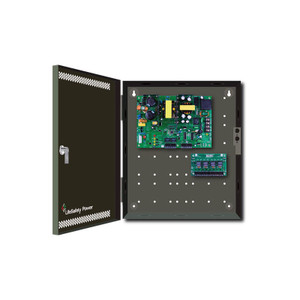
Lifesafety Power FPO150-B100M8NLC2SD4PE6M 150W Managed Power Supply
Overview
The Lifesafety Power FPO150-B100M8NLC2SD4PE6M is a compact 150W managed power distribution module built for multi-camera surveillance and access control deployments where you need independent fused outputs and no single point of failure for multiple devices. This unit delivers 150W total capacity configured as either 12A at 12VDC or 6A at 24VDC—enough to run eight networked IP cameras plus door controllers, strobes, or auxiliary equipment from a single, consolidated supply point.
The core value here is managed distribution: each of the eight outputs is independently fused at 3A, meaning a short or overload on one camera won't take down your entire installation. That alone saves troubleshooting time and keeps uptime high in installations where you can't afford a blanket power failure. The E6 enclosure (30H × 23W × 6.5D inches) mounts easily in a cabinet or on a wall, and the modular fused architecture makes it straightforward to configure and test before deployment.
Key Features
- 150W Total Capacity: Sufficient for a small-to-medium camera cluster (typically 8–12 low-power IP cameras), eliminating the need to run separate power feeds or power injectors to individual devices. Reduces cable clutter and simplifies field maintenance.
- Dual Output Configuration: Choose 12A at 12VDC or 6A at 24VDC depending on your device mix. 24VDC option supports longer cable runs with lower voltage drop, critical in warehouse or perimeter installations where cameras are distant from the power source.
- 8 Independent Fused Outputs: Each channel is protected by a 3A fuse, isolating faults to a single output. If a camera shorts or draws excessive current, the other seven channels remain live. No need to replace the entire unit or troubleshoot a cascading failure.
- Compact E6 Form Factor: Dimensions of 30H × 23W × 6.5D inches fit standard 19-inch cabinet rails or wall mounting. Small footprint doesn't sacrifice port density or cooling, important when floor or rack space is limited in server rooms or control centers.
- Industrial-Grade Construction: Metal enclosure and managed power architecture (FPO150-B100M8NLC2SD4PE6M) designed for continuous duty in mechanical, environmental, and thermal conditions typical of warehouse, manufacturing, or outdoor surveillance hubs where consumer-grade supplies fail quickly.
- Supervised Output Control: Built-in monitoring and control per channel supports remote shutdown, load reporting, and integration with NVR or access control systems, reducing on-site visits to diagnose power issues.
Integration & Compatibility
The FPO150-B100M8NLC2SD4PE6M integrates into standard power supply installations wherever you are consolidating feeds for multiple IP cameras or mixed video and access control infrastructure. The managed output architecture works with any PoE injector or standalone camera that accepts 12V or 24V DC input. Eight independent fuses mean you can safely mix devices with different current profiles on the same unit without worrying about load imbalance.
For larger deployments, consider stacking multiple units or pairing with a network video recorder (NVR) that supports external power supervision, allowing the recorder to log faults, send alerts, or trigger failover logic if a power line goes down. This is particularly valuable in critical surveillance zones such as loading docks, server rooms, or access points where a brief outage could compromise security footage.
When to Choose a Different Model
If you require higher total wattage (more than 150W), larger current per output (above 3A fused per channel), or integrated battery backup with uninterruptible power supply (UPS) functionality, look to higher-capacity models in the Lifesafety Power catalog. If your deployment is a single camera with low power draw, a simple wall-mount power injector is more cost-effective. Conversely, if you need remote power management, environmental monitoring, or thermal telemetry built into the power unit itself, evaluate industrial managed PDU (power distribution unit) options designed for that scope.
Frequently Asked Questions
Q: Can I use the FPO150-B100M8NLC2SD4PE6M for both 12V and 24V cameras simultaneously?
A: No. The unit is configured at installation as either 12A/12V or 6A/24V. You cannot mix output voltages on the same unit. Choose the voltage that matches your camera and device set, or use separate units for each voltage group.
Q: What happens if one of the 3A fuses blows?
A: That single output shuts down, but the other seven outputs continue to operate. Replace the fuse (3A rated) for that channel. The modular design means no downtime for the rest of your installation.
Q: Does the FPO150-B100M8NLC2SD4PE6M support battery backup?
A: The unit does not include integrated battery or UPS functionality. It is a managed distribution supply only. For battery-backed scenarios, integrate an external UPS or backup supply into the input side of the FPO150.
Q: Is the FPO150-B100M8NLC2SD4PE6M suitable for outdoor environments?
A: The E6 metal enclosure is industrial-grade but not explicitly rated for direct outdoor exposure. Mount it in a protected cabinet, weatherproof box, or indoors near a wall-mounted exterior camera. If you need outdoor power distribution, enclose the unit in an NEMA 4X or IP66 cabinet.
Q: Can I wall-mount the FPO150-B100M8NLC2SD4PE6M?
A: Yes. The compact 30H × 23W × 6.5D form factor supports wall or cabinet mounting. Ensure adequate ventilation around the unit to prevent thermal stress during sustained load.
Q: How much current does each of the eight outputs draw continuously?
A: Each output is fused at 3A. The maximum safe continuous draw per channel is 3A; exceeding this triggers the fuse protection. Total system draw cannot exceed 12A at 12V (or 6A at 24V) across all eight outputs combined.
The FPO150-B100M8NLC2SD4PE6M fills a specific but genuine gap in surveillance power architecture: you need to consolidate eight modest-load devices into one supply without sacrificing fault isolation or complicating future swaps. The independent 3A fuses per output are the key—they're your guarantee that a damaged camera or shorted wire doesn't cascade into a total loss. That's not theory; that's the difference between a five-minute fuse swap and a two-hour outage while you troubleshoot which device killed your entire camera array.
Technical Highlights:
- 150W Capacity (12A/12V or 6A/24V): Scales to roughly 8–12 standard IP cameras without forcing you into separate power feeds or injectors. Consolidation cuts installation labor and inventory complexity.
- Eight 3A Fused Outputs: Each channel is independently protected. A camera short on output #3 does not affect outputs #1, #2, #4–#8. Isolation-by-design beats a centralized fuse approach for uptime.
- 24VDC Option: If your cameras or access control devices are 100+ feet from the hub, the 6A/24V configuration incurs lower voltage drop than 12V over long runs, preserving voltage spec at the device end. A real win in warehouse or perimeter deployments.
Deployment Considerations:
- Single-Voltage Configuration: You commit to either 12V or 24V at installation. If you mix voltage families in your camera plan, you'll need two units or a retrofit. Plan your power architecture before ordering.
- Thermal Load in Confined Spaces: The E6 enclosure is compact, but 150W dissipates real heat under sustained load. If you mount it inside a small equipment cabinet with limited airflow, monitor temperature or add supplemental cooling. Fuses can nuisance-trip if the surrounding air is hot.
- No Battery Backup Native: This is distribution, not UPS. If a utility fail means downtime risk, budget a separate battery or UPS module on the input side—don't rely on the FPO150 alone.
The FPO150-B100M8NLC2SD4PE6M is your move when you're deploying 8–12 camera clusters (loading dock, warehouse aisle, multi-entrance access control) and you need confidence that a single fault doesn't kill your whole security picture. It's also the pragmatic choice for integrators who want to reduce truck rolls: one unit, eight outputs, eight replaceable fuses, and a clear mental model of how the power flows.