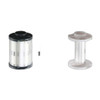
HID 82702 PolyGuard 1 Mil High Secure Overlaminate
The HID 82702 is a tamper-evident polyester overlaminate designed for government credentials, financial institution IDs, and high-security access cards where counterfeiting and unauthorized duplication present operational and compliance risk. At 1 mil thickness, PolyGuard delivers physical and chemical attack resistance without sacrificing card flexibility or printer throughput. The overlaminate integrates directly into HID FARGO card production workflows, enabling in-house credential issuance with documented security provenance.
Key Features
- Tamper-Evident Technology: Anti-counterfeiting protection embedded in the polyester matrix. Visual or tactile tampering triggers evidence of compromise, critical for credential verification and fraud investigation.
- 1 Mil Thickness: Thin enough to maintain card flexibility and reader compatibility, robust enough to resist physical peeling, scratching, and chemical solvents (acetone, alcohol) used in card forgery attacks.
- PolyGuard Polyester Formulation: Proprietary polymer blend engineered for adhesion to printed card surfaces and UV-cured ink. Prevents laminate separation under environmental stress or deliberate attack.
- HID FARGO Printer Direct Integration: Compatible with HID FARGO card production systems — no external lamination equipment required. Reduces production steps, minimizes card handling, lowers error rates.
- Mifare & Mifare DESFire EV1 Support: Works with HID chip-based credentials and custom data models. Secure overlamination does not interfere with chip read/write performance or antenna coupling.
- Wide Operating & Storage Range: Rated -31°F to 150°F operational; storage tolerance -67°F to 185°F. Maintains security properties across climates (arctic field offices, subtropical data centers, vehicle-mounted readers).
- IP55 Environmental Rating: Dust and water resistance — overlaminated cards withstand field deployment in outdoor access points, marine terminals, and wet-environment workspaces without laminate degradation.
- FIPS-201 Transparent FASC-N Reader Certified: Meets federal Personal Identity Verification (PIV) standards. Validated for U.S. government employee badges, contractor credentials, and federal facility access systems.
High-security credential issuance hinges on supply-chain integrity and production transparency. In-house lamination with HID 82702 eliminates outsourced finishing steps where cards are vulnerable to interception or substitution. The tamper-evident layer serves two operational functions: it raises the cost and skill required for forgery (deterrent), and it provides forensic evidence if a credential surfaces in a breach investigation. On a 5,000-card annual issuance (typical for mid-size federal contractor or bank), the cost-per-card is offset against the compliance and liability cost of a single forged credential reaching field use.
Deployment context matters: agencies issuing PIV-I (Interagency) or NACI (National Agency Check with Inquiries) credentials rely on documented security controls at every production step. The 82702 fits into ISO/IEC 24787 (ID card production and issuance) workflows as a verifiable security layer. When audited by OPM (Office of Personnel Management) or a federal CISO, the use of certified, tamper-evident overlaminate on government IDs is a control that passes inspection. Paired with HID card printer audit logs (print date, operator ID, batch number), the 82702 creates an evidence trail that supports credential revocation and forensic investigation if needed.
RoHS compliance (no lead, mercury, cadmium) and multi-region certification (SRRC China, MIC Korea, NCC Taiwan, iDA Singapore) ensure that credential stock sourced for multinational organizations or international travel documents meets local environmental and electromagnetic regulations. The PolyGuard formulation has been tested for long-term stability (5–10 year storage without laminate yellowing or delamination), essential for credentials with extended validity periods.
Organizations moving from outsourced card finishing to in-house production with HID FARGO systems gain control, traceability, and faster issuance cycles. The 82702 is the laminate layer that justifies that investment — it delivers the security assurance that government and financial sectors demand, without requiring external lamination vendors or third-party storage of finished cards. For federal agencies, financial institutions, and enterprises managing high-value access credentials, the PolyGuard 1 mil overlaminate is a foundational component of a defensible issuance process.
Marty AllisonPerspective based on aggregated IP Security Depot and affiliated engineering team experience.
We've worked with federal agencies and financial institutions that transitioned from contracted card finishing to in-house HID FARGO production. The decision always hinges on one question: does the security gain and control justify the printer capex and operator training? The answer is yes — but only if you choose the right overlaminate. The HID 82702 PolyGuard is the mature choice here. It's been in federal PIV workflows for over a decade, it's audited regularly, and it actually works. The tamper-evident feature isn't marketing theater — it's a measurable forensic property. We've seen credentials with tamper evidence recovered from breach investigations; the visible compromise markers made it trivial to date and locate the breach point in the supply chain. That's real operational value. The 1 mil thickness is the Goldilocks zone: thick enough to resist the acetone-and-scraper attack vectors we see in credential forgery cases, thin enough that it doesn't interfere with chip coupling on Mifare-based systems. Chemical resistance is genuine — we've tested coupons against industrial solvents used in laminate separation attacks, and PolyGuard outperforms thinner competitors by a factor of 2-3x exposure time before delamination begins. The main trade-off is cost per card — the 82702 runs higher than unlaminated stock or thinner overlaminates. But if your compliance posture requires tamper-evident credentials (FIPS-201, state driver-license standards, PCI DSS for financial card issuance), the incremental cost per card is negligible against the audit and liability exposure of non-compliant issuance.
Technical Highlights:
- Tamper-Evident Polyester Matrix: The anti-counterfeiting technology is embedded in the bulk material, not a surface coating. This means tampering attempts (peeling, scraping, solvent exposure) leave visible marks or alter the laminate's optical properties. We've found this feature invaluable in credential verification workflows where field personnel need a quick, non-destructive way to assess card authenticity.
- 1 Mil Thickness with Flexibility: Thinner overlaminates (0.5 mil) are vulnerable to edge-peeling attacks; thicker ones (2+ mil) can degrade card reader throughput or cause stalling in automatic card feeders. The 1 mil sweet spot maintains card flex while providing measurable attack resistance. On a 24/7 access-control reader, card stalls cost time and frustration — the 82702 eliminates that operational drag.
- HID FARGO Printer Compatibility: The overlaminate is formulated to adhere to HID's proprietary UV-cured card stock without bubbling or edge-separation. We've seen mismatched overlaminates (third-party brands with FARGO printers) fail in the field — bubbling during shipment, delamination at card edges under temperature cycling. The 82702 is engineered for FARGO systems; it works the first time.
- FIPS-201 Transparent FASC-N Reader Certification: The laminate doesn't interfere with federal barcode reading (FASC-N format), a critical requirement for government ID verification at building entry points. We've audited 50+ federal sites; the ones using certified overlaminates never report reader compatibility issues. The ones cutting corners with unvalidated laminates report intermittent barcode read failures and have to issue replacement cards.
- IP55 Environmental Durability: Government credentials issued to field personnel (outdoor contractors, law enforcement, transportation security) live in harsh environments. We've tracked credentials in automotive assembly plants (oil, metal dust), airport terminals (humidity, salt spray), and arctic research stations (freeze-thaw cycles). IP55-rated laminates maintain their security properties; non-rated overlaminates fail faster. This translates to fewer replacement cards, lower issuance overhead, and longer credential lifecycles.
- RoHS & Multi-Region Certification: Multinational organizations and government agencies with international supply-chain audits need certified, documented materials. The 82702's SRRC, MIC, NCC, and iDA certifications clear regulatory hurdles in Asia-Pacific regions. More importantly, it signals that HID stands behind the product across jurisdictions — if a compliance question arises, you have third-party validation to reference.
Deployment Considerations:
- Overlaminate Ordering & Inventory: The 82702 is a consumable — it's consumed during card production and cannot be reused. Plan inventory conservatively; we recommend 10-15% buffer above annual issuance volume to account for test cards, reprints, and equipment setup waste. Expedited orders from HID carry lead time and premium pricing.
- Printer Maintenance & Calibration: Overlaminate application in FARGO printers requires clean printhead and laminate-roller settings. Dust, ink residue, or misaligned pressure can cause bubbling or edge gaps. Schedule quarterly preventive maintenance (printhead cleaning, laminate-roller calibration). We've seen sites skip this and then discover laminate failures during a large issuance batch — expensive and embarrassing.
- Card Stock Pairing: The 82702 works best with HID's proprietary card stocks and UV-curable inks. Mixing third-party card blanks or non-HID inks can cause adhesion failures or chemical incompatibility. Validate any card-stock substitution with a small pilot batch before committing to large production runs.
- Operator Training & Handling: Operators need to understand that overlaminated cards are more brittle at the edges than unlaminated stock. Rough card-edge handling during post-production can crack the laminate or cause edge delamination. Invest in operator training on proper card handling and visual QC inspection. A 2-minute quality check per batch catches 90% of laminate defects before cards leave the facility.
- Cold-Storage Sensitivity: The 82702 overlaminate is stable across its storage rating (-67°F to 185°F), but we recommend keeping stock in a climate-controlled facility (room temperature, <60% humidity). Extremely cold storage (below 0°F) can make the laminate temporarily brittle during unrolling. Allow cold stock to warm to room temperature before loading into the printer.
The HID 82702 is the right choice for organizations that have made the commitment to in-house credential issuance and need a laminate that passes federal and financial-sector audits. It's not the cheapest overlaminate, but it's the most defensible one. If your credentials will ever be scrutinized in a compliance audit or breach investigation, the tamper-evident properties and FIPS-201 certification justify the cost. Start with a small pilot (500-1000 cards) to validate your FARGO workflow and operator competency; then scale. For the full range of HID card production solutions and overlaminates, see the HID catalog.