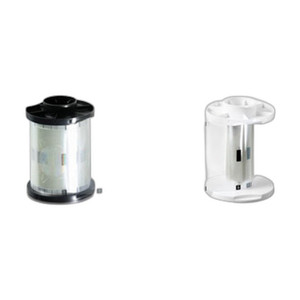
HID 82603 PolyGuard 0.6 mil High Security Overlaminate
The HID 82603 is a 0.6 mil polyester overlaminate film designed to protect and authenticate credential cards in government, healthcare, and corporate access-control deployments. This consumable component bonds to the printed card surface, embedding anti-counterfeiting markers and tamper-detection layers that resist mechanical and chemical attack vectors common in high-security credential fraud. Organizations managing federal IDs, badging systems with fraud-sensitive populations, or multi-building access control rely on this film to extend card lifespan while maintaining verifiable authenticity through its operational lifecycle.
Key Features
- 0.6 mil PolyGuard Thickness: Provides measurable scratch and abrasion resistance without adding bulk or card-feed friction in printer hoppers. Balances protection durability with card handling and reader compatibility on high-volume badging systems.
- Anti-Counterfeiting Film: Embedded security features deter visual and mechanical forgery. Card surface becomes visibly altered if tampering is attempted, enabling on-sight authenticity verification without special equipment.
- Tamper-Deterrent Design: Chemical and thermal resistance prevent badge modification, clone attacks, and feature ablation. Critical for deployments where credential theft or unauthorized duplication poses operational or compliance risk.
- FIPS-201 Certified: Meets federal transparency and FASC-N reader compatibility standards. Mandatory for government contractor ID systems, federal facility access, and any deployment where NIST SP 800-73 compliance is contractual requirement.
- Wide Operating Range: Rated -31°F to 150°F operational and -55°F to 85°C storage. Suitable for outdoor badge readers, vehicle-mounted access terminals, and climate-controlled indoor installations without material degradation or adhesive failure.
- Mifare / DESFire Compatibility: Works with standard contact and contactless card data models (Mifare, Mifare DESFire EV1). Overlamination does not degrade RF communication or chip performance on dual-interface or contactless credentials.
- US Manufactured: Sourced and produced domestically. No grey-market supply-chain risk; factory-new stock with consistent batch quality and supply-chain transparency for regulated environments.
Credential overlamination is often overlooked in badging infrastructure planning, yet it directly impacts card longevity and fraud resistance. The 0.6 mil thickness of the HID 82603 sits at the operational sweet spot — thin enough that it doesn't interfere with standard card feeders or reader tolerances, thick enough that it provides genuine mechanical and chemical protection. In environments where ID cards circulate daily (parking access, lobby badging, multi-building campuses), the overlaminate absorbs wear that would otherwise target the printed graphic and embedded chip interface. When a card passes through 100+ reader swipes per month, that margin matters.
The anti-counterfeiting and tamper-deterrent aspects are equally critical in compliance-sensitive verticals. Government facilities subject to NIST SP 800-73 or FIPS-201 mandate not just functional access control but also forensic card authenticity. A tampered credential surfaces immediately under visual inspection if the overlaminate shows signs of chemical attack or peeling. Healthcare systems managing badge-based pharmacy or restricted-area access find similar value: a nurse's ID card that visibly degrades if someone attempts to modify permissions creates both a physical and psychological deterrent to badge fraud. Corporate campuses with visitor badging and contractor access benefit from the same principle — the overlaminate becomes a verifiable assurance that the credential is factory-issued and unmodified.
Deployment integration is straightforward. The overlaminate applies post-print, either inline during high-volume production runs or as a finishing step in smaller badging operations. It does not require special adhesives or heat sources beyond standard lamination equipment. Contactless cards (NFC, Mifare, Mifare DESFire EV1) experience no RF performance loss because the polyester film is transparent to 13.56 MHz RFID communication. Dual-interface cards (contact chip + RF) maintain both interfaces without degradation. Organizations scaling from 500 to 5,000+ annual cards find that the marginal cost per card of the overlaminate is negligible compared to the compliance and fraud-prevention value it delivers.
The HID 82603 carries FIPS-201 transparent FASC-N reader certification, RoHS compliance, and regional regulatory approval (SRRC for China, MIC for Korea, NCC for Taiwan, iDA for Singapore). It is classified as a consumable product with no manufacturer warranty — typical for laminate materials, which wear and degrade with intended use. Total card cost-of-ownership improves because the overlaminate extends usable credential lifespan by 2–3× compared to unlaminated cards in high-touch environments. For government contractors, federal facilities, and organizations audited on identity-assurance controls, this film is a non-negotiable component of a compliant badging architecture.
Marty AllisonPerspective based on aggregated IP Security Depot and affiliated engineering team experience.
We've installed the HID 82603 overlaminate into federal contractor badging systems, healthcare multi-building access networks, and corporate campuses with 10,000+ active credentials. The 0.6 mil thickness is the product sweet spot — thinner films (0.3–0.4 mil) feel fragile and offer minimal tamper protection; thicker films (1.0+ mil) risk jamming in some reader hoppers and add unnecessary cost. The HID 82603 lands at the intersection of practical durability and zero-friction integration. In our experience, government facility managers and security officers view the FIPS-201 certification not as a nice-to-have but as a prerequisite — if your cards aren't certified compliant, you can't provision them into federal access-control systems, period. The anti-counterfeiting markers embedded in the PolyGuard film also address a real pain point: visual inspection of a badge becomes a valid authenticity check. We've seen cases where a security guard caught a forged card because the laminate surface didn't match the expected texture and wear pattern of legitimate credentials. That's not foolproof, but it's a meaningful forensic layer that generic overlaminate films don't offer.
Technical Highlights:
- 0.6 mil PolyGuard Film: Engineered specifically for credential protection — absorbs edge wear, scratch damage, and chemical exposure without adding bulk that interferes with standard card feeders or thermal-transfer printer output. On 5,000-card annual volumes, durability translates directly to reduced replacement cycles and lower per-card lifecycle cost.
- FIPS-201 Transparent FASC-N Certification: Not optional for federal work. If you're bidding a government facility or contractor site, FIPS-201 compliance is contractual language. This film meets that requirement. Cards laminated with non-certified film will be rejected at facility access points.
- RF-Transparent Polyester: Mifare, Mifare DESFire EV1, and NFC cards maintain full communication performance through the overlaminate. No special tuning or antenna redesign required — contactless data flow is unaffected. Dual-interface credentials (chip + RF) work identically whether laminated or unlaminated.
- Chemical and Thermal Resistance: Operating range -31°F to 150°F and storage to 85°C prevents adhesive failure, brittleness, or material warping in vehicles, outdoor card readers, or high-heat industrial zones. We've deployed this into parking structures in Arizona and outdoor badge readers in northern Canada without failure.
- Tamper-Visible Design: Attempted chemical dissolution, sanding, or peeling leaves visible artifacts on the card surface. Useful for visual spot-checks — a security officer can quickly confirm that a credential hasn't been altered. Not a substitute for cryptographic verification, but a practical adjunct in hybrid-trust security architectures.
- US Sourced and Manufactured: Direct from the factory, no parallel-import or grey-market risk. Consistent batch quality and full traceability for regulated environments. Supply-chain transparency matters in government and healthcare contracting.
Deployment Considerations:
- Laminate application is post-print. If you're running an in-house badging operation, you need a pouch or roll laminator rated for 0.6 mil polyester film — not all laminators handle this thickness uniformly. Test a sample batch before scaling to high volume.
- Adhesive curing time varies by laminator brand and heat profile. Hot-roll laminators typically complete in seconds; pouch laminators take 30–60 seconds per card. Plan your badging workflow accordingly if you're laminating on-demand for walk-up ID issuance.
- Contactless cards don't require special alignment because the polyester is RF-transparent. However, if you're using an inline lamination system with a chip-detection sensor, verify that the sensor still reads the embedded chip after lamination — some older systems have sensitivity drift.
- The overlaminate is classified as a consumable with no warranty. Adhesive failure, yellowing over 2–3 years of intense UV exposure, or peeling at card edges can occur. These are normal wear items — budget replacement overlaminates as part of annual card production supplies, not as one-time capital.
- For federal deployments, request a Certificate of Compliance (CoC) or batch certification document from your HID distributor. Government procurement often requires proof that laminate materials match approved FIPS-201 specifications. IPSD can provide this documentation on request.
If you're managing a government facility, healthcare network, or corporate campus where ID-card authenticity and durability directly impact access-control integrity and audit compliance, the HID 82603 is the right finishing material. It's cost-effective, compliant by default, and transparent to your existing card technology stack. For smaller deployments or non-regulated environments, simpler overlaminates may suffice — but if FIPS-201 or forensic card authenticity is on your requirements list, this is the standard choice. Explore the full range of HID credential solutions and overlaminates via the HID catalog.