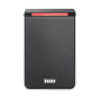
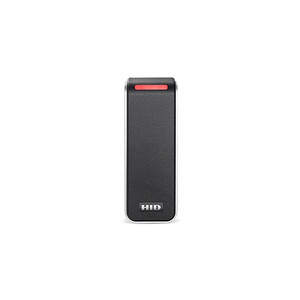
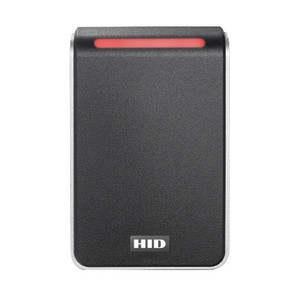
HID 40NKS-01-002CBR SIGNO 40 SEOS Black Silver Reader
The HID 40NKS-01-002CBR is a SIGNO 40 multi-credential reader engineered for access control deployments that span legacy and modern credential ecosystems. It accepts magnetic stripe, 125 kHz proximity cards, NFC (13.56 MHz), and advanced high-frequency formats—DESFire, iCLASS, MIFARE, HID proprietary, and SEOS—all from a single reader without hardware replacement. Communications occur over OSDP v2, encrypting credential data and control commands between the reader and your access control panel. The black housing with silver trim baseplate mounts surface-flush on standard door frames. LED and flash indicators are factory-disabled, supporting inconspicuous, low-visibility installations where visual feedback could compromise perimeter aesthetics or security posture.
Key Features
- Multi-Credential Support: Magnetic stripe, 125 kHz proximity, NFC, DESFire, iCLASS, MIFARE, HID legacy, and SEOS in one reader. Eliminates credential-type silos during infrastructure transitions.
- OSDP v2 Protocol: Encrypted, bidirectional communication between reader and access control panel. Works with any OSDP v2-compliant system (HID, third-party controllers).
- Wired Connectivity: Standard DC power and OSDP serial/IP communication. No wireless interference risk; deterministic credential validation latency.
- Cryptographic Security: Credential data encrypted on certified secure element within the reader. Protects against cloning and man-in-the-middle attacks on high-value credentials (DESFire, iCLASS).
- Discreet Form Factor: Black and silver finish, disabled LED/flash indicators, surface-mounted. Suitable for high-security or aesthetically sensitive environments (corporate lobbies, government facilities).
- Surface-Mount Ready: Factory-configured for standard door frame installation. Automatic surface detection optimizes read range; no post-install tuning required.
- Velocity Detection & Buzzer Disabled: Pre-configured to suppress audio and motion-based false accepts. Integrators can request alternative configurations if needed.
- 2-Year Manufacturer Warranty: Out-of-the-box support and hardware replacement terms.
The SIGNO 40 platform addresses a persistent access control pain point: credential fragmentation. Legacy 125 kHz proximity infrastructures coexist with newer NFC and high-frequency systems in the same facility. Rather than deploying separate readers per credential type or forcing an immediate migration, the 40NKS-01-002CBR consolidates all formats into a single mounting footprint. This reduces panel I/O overhead, simplifies wiring, and lowers per-door hardware cost during multi-year credential transitions.
OSDP v2 is the industry standard for encrypted reader-to-controller dialogue. Unlike older Wiegand or clock-and-data interfaces, OSDP provides mutual authentication, encrypted credential payload transport, and out-of-band command injection—critical for environments where tamper-evident access logs and cryptographic non-repudiation are compliance requirements. The reader's secure element stores keys locally, preventing plain-text credential exposure even if network traffic is captured.
Integration scope depends on your access control platform. HID-branded panels (HID Edge, HID Signo Host) recognize the reader natively; third-party controllers (Salto, dormakaba, Honeywell) require OSDP v2 firmware and proper key exchange during commissioning. Confirm your system supports the credential technologies you intend to deploy—some legacy panels may not validate all high-frequency formats even if OSDP v2 is available. The reader itself is format-agnostic; the limitation typically sits upstream in the credential database or controller logic.
The disabled LED and flash configuration ships factory-enabled. This is intentional for covert or low-profile deployments—think executive suites, secure research labs, or facilities where visual reader feedback could hint at access point locations. If your installation requires local feedback (green/red LED for operator confirmation, buzzer on denial), contact your HID integrator or distributor to request a variant with indicators enabled. Retrofit is possible but requires hardware swap; plan for this during specification.
Surface-mount is the default mechanical configuration. The reader latches onto a standard 86 mm or 120 mm backbox via a symmetrical trim plate (silver). Depth is typical of HID multi-credential readers (~1.2 inches)—confirm your door frame thickness and interior space before ordering. Wiring follows OSDP pinout standards; DC power requirements are modest (<2W at 12V typical), allowing single-cable runs on PoE-enabled OSDP injectors or dedicated reader power supplies.
This reader is ideal for organizations migrating from legacy proximity toward NFC or DESFire credentials while maintaining backward compatibility. It also serves environments with heterogeneous credentials (contractors with old cards, employees with new NFC mobile access, visitor proximity badges) without forcing a unified credential policy immediately. The cryptographic key storage and OSDP encryption make it suitable for regulated access (healthcare, finance, government) where audit trails and tamper-evidence are non-negotiable.
Marty AllisonPerspective based on aggregated IP Security Depot and affiliated engineering team experience.
We've deployed the SIGNO 40 across credential-fragmented environments—hospitals with legacy proximity badges, universities transitioning to NFC mobile access, and corporate campuses where contractors still carry old cards. The real operational win here is eliminating the reader-type decision paralysis. Instead of specifying separate readers for each credential tier or forcing an all-or-nothing credential swap, you mount one reader that accepts everything. That translates directly to lower capex per door during migrations and zero hardware replacement debt when new credential standards emerge. The OSDP v2 backbone ensures that encryption and audit logging don't depend on the credential technology itself—whether it's a 40-year-old proximity card or a brand-new mobile NFC credential, the reader talks to your panel the same way, encrypted and timestamped.
The discreet black-and-silver finish with disabled LEDs is a subtle but important detail. We've seen environments where visible reader feedback actually creates security vulnerabilities—operators can watch the green-light pattern to deduce when a door is armed vs. disarmed, or the absence of a buzzer tells an intruder the panel is offline. By shipping this SKU with LEDs and flash disabled, HID gives security teams the option to run truly silent reader deployments. That said, it's not right for every use case. High-traffic public areas (visitor lobbies, retail) benefit from visual/audio feedback. Know your environment before you lock in this configuration; if you change your mind post-install, it's a reader swap, not a firmware tweak.
Technical Highlights:
- Secure Element Cryptography: Keys live on a certified hardware module inside the reader, not in software or flash. This prevents extraction attacks and ensures that even if the reader is physically compromised, an attacker cannot derive the encryption material. In regulated environments (healthcare, government), this is often a compliance mandate.
- Dual-Band Credential Acceptance (125 kHz + 13.56 MHz): Most multi-credential readers require manual switching or separate antenna paths. The 40NKS-01-002CBR handles both frequencies in parallel without operator intervention. Read latency is imperceptible; the reader validates credentials natively without round-tripping to a server for every tap.
- OSDP v2 Encryption: Unlike older Wiegand or RS-485 interfaces, OSDP wraps every credential read in AES-128 encryption (standard profile) or AES-256 (high-security profile, vendor-dependent). Your access logs are tamper-evident by design—a prerequisite for audit-heavy sectors like pharma and finance.
- Automatic Surface Detection: The reader calibrates its near-field antenna performance based on mounting surface material (metal, painted drywall, laminate). You don't manually tune read range after installation; the reader self-optimizes. This reduces post-install troubleshooting and repeat service calls.
- Velocity Detection Disabled: This reader ships with motion-based false-accept prevention turned off. This is deliberate for high-throughput doors (main lobby turnstiles, emergency exits). If your application requires velocity detection to suppress rapid-tap attacks, you'll need a different SKU or a firmware variant. Clarify this during specification if access control policy mandates anti-tailgating measures.
Deployment Considerations:
- OSDP v2 Mandatory at the Panel: The reader is only as smart as the controller it talks to. If your access control panel is a legacy Wiegand-only system, this reader will not work—you must upgrade the panel or gateway to OSDP v2 first. Test OSDP v2 support in your existing infrastructure before committing to this reader.
- Credential Database Alignment: The reader accepts DESFire, iCLASS, and NFC, but your controller's credential database must have the corresponding keys enrolled. A credential that the reader physically reads will be rejected if the panel doesn't have that key in its whitelist. Coordinate credential provisioning with your identity management workflow during deployment.
- LED/Flash Disabled Factory Configuration: If you later need visual feedback, you'll need to swap the reader for a variant with indicators enabled—it's not a software setting. Decide your feedback requirements early. If uncertain, ask your integrator whether a test installation with indicators first makes sense.
- Wired Connectivity Only: This is a power and data tether. No wireless fallback. If your installation requires offline credential caching or wireless backup during network outage, you'll need a different reader class or a supplementary offline gateway. Plan your power and data distribution accordingly.
- Surface-Mount Geometry: Confirm your door frame has interior space for a ~1.2-inch deep reader and trim plate. Some retrofit installations on thin metal frames or on existing reader cutouts may require adapter plates. Request door frame dimensions from the customer and verify fit before shipment.
The 40NKS-01-002CBR is the right choice for mature access control deployments that need to consolidate credential types, enforce encrypted audit trails, and preserve backward compatibility without hardware churn. If you're replacing end-of-life proximity-only readers in a multi-credential environment, or you're building a new system that needs to accept everything from legacy contractor badges to corporate NFC phones, this is a solid specification. Visit the HID catalog to explore complementary readers, control panels, and credential management tools.