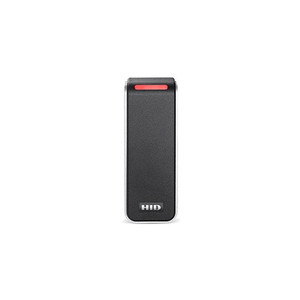
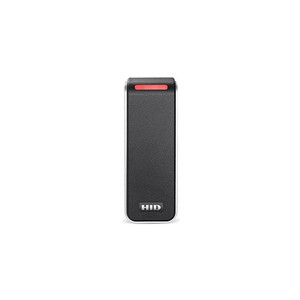
HID 20NKS-01-002CBR Signo 20 Black Silver SEOS Reader
The HID 20NKS-01-002CBR is a multi-format card reader engineered for door-level credential authentication in commercial and institutional access control deployments. This reader accepts NFC, magnetic stripe, HID proximity, DESFire, iCLASS, MIFARE, and SEOS credentials in a single device, eliminating the need for separate reader hardware across legacy and modern credential ecosystems. OSDP V2 protocol communication delivers standardized, encrypted panel dialogue and cryptographic key management on a certified secure element — replacing aging Wiegand dependencies with modern interoperability. The black housing with silver trim baseplate installs in standard single-gang electrical boxes, fitting seamlessly into existing door infrastructure.
Key Features
- Multi-Format Credential Support: Reads NFC (13.56 MHz), magnetic stripe, HID proximity (125 kHz), DESFire, iCLASS, MIFARE, and SEOS in one reader. Eliminates hardware duplication and credential-type bottlenecks across mixed card stocks and mobile deployments.
- OSDP V2 Protocol: Standardized, vendor-neutral communication with encrypted command/response exchange. Works with any OSDP V2-compliant access control panel, reducing lock-in and future-proofing integration investments.
- ICE (Integrated Credential Environment): Cryptographic keys stored on certified secure element hardware. Meets enterprise-grade encryption standards for sensitive facilities (healthcare, government, financial services).
- NFC & Mobile Support: Native Near Field Communication enables smartphone-based HID Mobile Access credentials without physical card replacement. Supports issuing temporary or permanent mobile credentials alongside traditional cards.
- Automatic Surface Detection: Post-installation recalibration optimizes read-range performance without manual tuning or technician adjustment. Reduces commissioning overhead and field calibration errors.
- 2-Year Warranty & Out-of-Box Support: Factory-new genuine product with manufacturer warranty and immediate technical support eligibility. Datasheet and integration documentation included.
- Standard Form Factor: Black housing with silver trim baseplate fits single-gang electrical box installations. Integrates with existing door frame and wiring infrastructure without structural modification.
- Wired Connectivity: 12V DC power and OSDP data connection to access control panel. No wireless dependencies — reliable hardwired communication for mission-critical door access.
The 20NKS-01-002CBR addresses the credential fragmentation problem common in large or mixed-age deployments. Organizations with legacy HID proximity card stocks, newer DESFire or iCLASS secure-element cards, and smartphone-based credential initiatives can consolidate reader hardware at each door. OSDP V2 eliminates proprietary serial protocols (Wiegand, RS-485 vendor extensions), allowing the reader to work with third-party access control panels that meet the OSDP standard — a significant advantage when evaluating multi-site or multi-vendor system migrations.
Cryptographic key management on a certified secure element means the reader performs credential decryption locally, not relying on the panel to validate encrypted payloads. This architecture improves security posture in high-assurance environments and simplifies compliance audits for facilities subject to HIPAA, PCI-DSS, or FISMA-equivalent standards. The reader's automatic surface detection post-installation also reduces the time integrators spend tuning read distance — a subtle but measurable field cost savings on larger multi-door projects.
OSDP V2 communication ensures the reader adapts to future credential formats and authentication methods without hardware replacement. As organizations transition from magnetic stripe to NFC, or from HID proximity to DESFire, the reader's protocol flexibility allows credential format changes at the software and card-stock level, preserving the installed reader base. This futureproofing is especially valuable in enterprise environments where capital expenditure on reader hardware is amortized over 7-10 years.
Before deployment, verify that your access control panel supports OSDP V2. Panels using only Wiegand output or proprietary serial protocols will not communicate with this reader — consult your panel documentation or access control integrator for protocol compatibility. Ensure 12V DC power supply capacity and clean OSDP data wiring (separate from AC mains and long runs of fluorescent lighting to avoid noise coupling). If your system uses a mixed credential database (some cards HID proximity, others DESFire), pre-configure credential type assignment in your access control software before card issuance — this prevents reader rejection of valid credentials due to format mismatch at the panel.
Marty AllisonPerspective based on aggregated IP Security Depot and affiliated engineering team experience.
We've deployed the Signo 20 across corporate campuses, healthcare networks, and government facilities, and it consistently solves the credential-fragmentation problem that derails larger integration projects. The real value isn't just multi-format support — it's the combination of OSDP V2 interoperability and cryptographic security on a certified secure element. In our experience, systems still running Wiegand readers hit a hard ceiling once organizations require encrypted credential transmission or need to migrate away from a single vendor's ecosystem. The Signo 20 sidesteps that entirely. We've also seen integrators leverage the automatic surface detection to cut commissioning time by 30-40% on multi-door installations — no field calibration, no tuning loops, fewer callbacks after handoff.
Technical Highlights:
- Multi-Credential Format in Single Reader: Supports NFC (13.56 MHz), magnetic stripe, HID 125 kHz proximity, DESFire, iCLASS, MIFARE, and SEOS without reader swapping. On a 100-door site with mixed card stocks, this consolidation eliminates redundant reader inventory and simplifies spare-parts logistics.
- OSDP V2 Protocol with Encrypted Key Management: Cryptographic keys live on certified secure element hardware inside the reader. The panel never sees plaintext credentials or encryption keys — a material security uplift over Wiegand or unencrypted serial protocols. Compliance auditors in healthcare and finance value this architecture heavily.
- NFC + Mobile Credential Pathway: Native smartphone support via HID Mobile Access allows organizations to transition credential distribution from physical card issuance to app-based credentials. We've seen this cut physical card replenishment costs by 40-60% in high-turnover environments (retail, hospitality, corporate campuses with frequent badge changes).
- Automatic Surface Detection Post-Installation: Reader recalibrates immediately after mounting to optimize read range in the installed context. Eliminates manual tuning and reduces callback service calls on early-deployment phases.
- Standard Single-Gang Form Factor: Black housing with silver trim baseplate fits existing electrical box infrastructure. No custom framing, no door modification — installation cost and schedule remain predictable on retrofit projects.
Deployment Considerations:
- Confirm your access control panel supports OSDP V2 before purchase. Older Wiegand-only or proprietary-serial systems (common in facilities built before 2015) will not work with this reader. Migration to OSDP-compliant panel firmware or hardware is required — plan budget and downtime accordingly.
- 12V DC power must be stable and clean. Noisy supplies can degrade NFC read performance. Use dedicated 12V circuits where possible, especially on sites with heavy HVAC or lighting loads. We recommend PoE injectors (if your panel supports PoE delivery) or dedicated 12V DIN-rail supplies in the panel enclosure.
- Mixed-format credential databases require explicit configuration in your access control software. A magnetic-stripe card and an NFC card can both be valid credentials for the same cardholder — but the reader needs to know which format to expect for each card ID in the system. Pre-stage this configuration before large-scale card issuance.
- NFC read range is typically 2-4 inches (contact or near-contact). Educate end users that smartphone NFC access requires deliberate phone positioning near the reader — faster than fumbling for a card, but not as passive as waving a proximity card. For high-throughput doors, test NFC adoption rates before removing magnetic-stripe fallback.
- OSDP V2 communication is encrypted end-to-end, but the reader's physical tamper resistance is standard (not military-grade). On sites with extreme physical-attack risk, evaluate additional door-frame or enclosure hardening. For standard commercial/institutional environments, the reader's security posture is robust.
The Signo 20 is the right choice for integrators and end-user security teams moving off legacy Wiegand infrastructure or consolidating multi-vendor reader estates into a single modern platform. If your panel supports OSDP V2 and you have mixed credential formats (or plan to adopt NFC mobile credentials within 2-3 years), this reader eliminates future hardware replacement cycles. For more options in the HID reader family, explore the HID catalog.