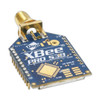
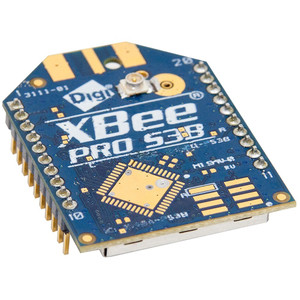
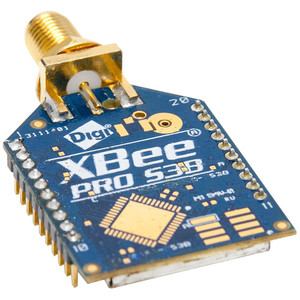
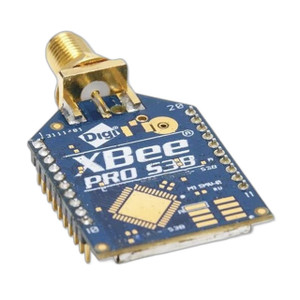
Digi International XBP9B-DMWT-002 900 MHz DigiMesh Module
The Digi International XBP9B-DMWT-002 is a 900 MHz wireless module engineered for long-range mesh networking in remote monitoring, industrial IoT, and distributed sensor applications. Built on the DigiMesh protocol, this XBEE-PRO module eliminates single points of failure through automatic node-to-node relay, allowing signals to propagate across terrain obstacles and through building structures where line-of-sight RF links would fail. Integrators deploying pipeline monitoring, utility meter networks, or sprawling campus sensor arrays benefit from the extended range and self-healing mesh topology — if one node goes down, traffic automatically reroutes through neighboring nodes without manual intervention.
Key Features
- DigiMesh Protocol: Automatic mesh topology with dynamic routing. Failed nodes are bypassed without network reconfiguration, critical for unattended remote deployments.
- 900 MHz Frequency Band: Sub-GHz propagation penetrates vegetation, concrete, and earth better than 2.4 GHz, extending effective range in rural and industrial environments.
- XBEE Module Form Factor: Drop-in compatibility with XBEE-certified host systems, gateways, and battery-powered sensor nodes — no custom RF module redesign required.
- Long-Range Extended Transmission: Typical coverage 10+ miles line-of-sight, reduced but functional through obstacles — suitable for multi-acre perimeters and multi-building campuses.
- Battery-Powered Node Support: Low-power sleep modes enable coin-cell and AA battery operation for 6–18 month field lifespans on remote sensor nodes.
- Repeater/Gateway Flexibility: Single module acts as end device, repeater, or coordinator — deploy the same hardware across diverse roles in a single network.
- 5-Year Manufacturer Warranty: Industrial-grade warranty reflects design confidence in reliability-critical remote installations.
- Industrial Temperature Range: Extended operating envelope tolerates unheated sheds, outdoor junction boxes, and vehicle cabins.
The 900 MHz ISM band (902–928 MHz in North America) is lightly congested compared to 2.4 GHz Wi-Fi and Bluetooth. In rural areas and utility corridors, this translates to fewer collisions and more predictable latency for time-sensitive telemetry. DigiMesh firmware handles frequency hopping automatically — no manual channel planning required. A single XBP9B-DMWT-002 coordinates up to 300+ end devices in a single network, scaling from small 5-node deployments to enterprise-wide sensor grids.
Deployment scenarios typically split into two models: star topology (all nodes relay through a central gateway connected to cloud or on-premises NVR), and mesh topology (nodes relay through each other, reducing dependence on backhaul). Mesh deployments lower total cost of ownership by eliminating the need for multiple gateways or cellular backup links — a failed primary gateway doesn't isolate remote nodes, since mesh routing keeps the network live. Power budgeting is critical: repeater nodes (powered line voltage or large battery packs) handle 24/7 relay duty, while sensor nodes (coin-cell or AA batteries) sleep between transmissions, waking only to send data or relay neighbor traffic. Integrate the module with Digi Device Manager or third-party MQTT brokers via standard serial or network interfaces on the host gateway.
Real-world deployments show measurable ROI in sites with sprawling coverage: pipeline companies avoid $50k+ cellular coverage contracts by using mesh relay; utility districts reduce scheduled site visits (e.g., monthly meter reads) by centralizing data pull into a single gateway query. Packet loss on 900 MHz mesh is typically 1–5% in open terrain, rising to 10–20% in dense foliage or near heavy machinery — acceptable for non-real-time telemetry (temperature, humidity, flow rate) but inadequate for voice or video. Latency averages 100–500 ms on 3–5 hop routes; design firmware to tolerate 2–3 second round-trip delays if you need acknowledgment of critical control commands.
Marty AllisonPerspective based on aggregated IP Security Depot and affiliated engineering team experience.
We've deployed Digi 900 MHz mesh networks across rural utility corridors, agricultural sensor arrays, and multi-site industrial monitoring. The XBP9B-DMWT-002 is a mature, proven radio module — Digi's DigiMesh stack has been hardened through thousands of production deployments over a decade. The real differentiator versus point-to-point WiFi or cellular is resilience: once a mesh network is trained (nodes discover each other and publish routing tables), a single node failure doesn't cascade into network loss. For integrators accustomed to Zigbee or proprietary sub-GHz protocols, the DigiMesh learning curve is gentle — Digi provides reference firmware, cloud management (Device Manager, Remote Manager), and MQTT bridges that lower integration friction. Where we see the most value is in sites where cellular backhaul is unreliable or cost-prohibitive: a pipeline right-of-way spanning 50 miles can be monitored by a 3–5 node mesh relay chain (repeaters on poles or equipment shelters, powered by solar + battery) feeding data to a single internet-connected gateway at the district office. Contrast that with cellular: 50 miles = 5–10 cellular modules at $50–150/month each, plus modem replacements every 3–5 years.
Technical Highlights:
- DigiMesh Routing: AODV-based dynamic routing with configurable hop count (typically 4–6 hops max). Nodes broadcast periodic route advertisements — overhead is 5–15% of airtime on a stable network. Trade-off: lower hop count = lower latency but smaller coverage area; higher hop count = greater range but slower response.
- 900 MHz Propagation: Wavelength ~33 cm allows antenna designs that are physically smaller and less obtrusive than 2.4 GHz. Penetration of foliage and brick is 10–20 dB better than 2.4 GHz, directly extending effective range in suburban/rural settings without power increase.
- Battery Life: A sensor node with Digi sleep modes and 1-minute poll interval on two AA batteries operates 9–14 months. Increase poll interval to 10 minutes and you hit 18+ months — network designer trades responsiveness for capex reduction and maintenance burden.
- Repeater Duty Cycle: A powered repeater handling 50–100 relay packets per minute draws 80–200 mW continuously (solar + battery setup typical). Design power budget assuming repeaters are always on; sensor nodes can sleep 99%+ of the time.
- XBEE Pin Compatibility: Standard XBEE footprint (20-pin DIP) drops into development boards, USB sticks, and industrial gateways with zero hardware redesign. Serial/API firmware configuration over UART at 115.2k baud.
Deployment Considerations:
- Antenna placement is critical on 900 MHz — a module in a metal enclosure loses 15–25 dB without external antenna connector. Specify modules with SMA connectors and pole-mounted omni or Yagi antennas; budget antenna runs into your infrastructure cost.
- FCC/ISED certification applies only to the specific host system + module combination. Digi publishes pre-certified reference designs; if you use a non-standard gateway, verify your integrator has filed the necessary RF test report or obtained conditional certification.
- Mesh convergence time after network topology change (e.g., node power-off) is 30–120 seconds depending on configuration. For time-critical failover, design application firmware to handle brief routing delays gracefully; don't expect sub-second reroute.
- ISM band 900 MHz is unlicensed but faces occasional interference from industrial equipment (some wireless door openers, legacy telemetry systems). Site survey before deployment — measure RF environment with a spectrum analyzer if you're in a manufacturing facility or power plant.
- DigiMesh firmware updates are OTA-capable but require custom bootloader integration. Plan for firmware refresh every 2–3 years; Digi provides security patches and bug fixes for 7+ years post-production.
The right buyer for this module is an industrial integrator or utility engineer building distributed sensor networks in coverage-challenged areas where cellular is cost-prohibitive or unreliable. Compare against LoRaWAN (narrower bandwidth, public network dependency, longer range on lower data rate) and NB-IoT (cellular fallback, carrier fees). This module wins when you need private, owner-operated, resilient mesh on customer property. See the Digi International catalog for complementary gateways, power supplies, and antenna systems.