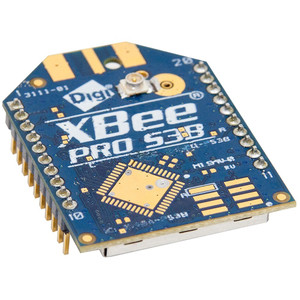
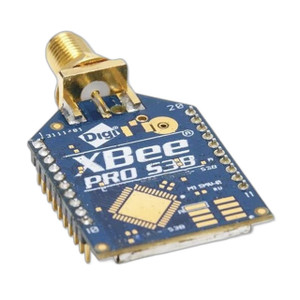
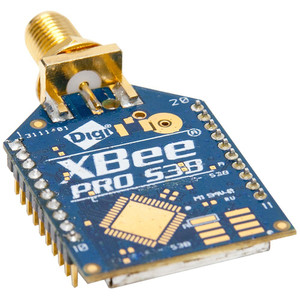
Digi International XBP9B-DMST-002 900 MHz DigiMesh Wireless Module
The Digi International XBP9B-DMST-002 is an XBEE-PRO 900HP S3B long-range mesh module designed for industrial IoT, remote monitoring, and distributed sensor deployments where wired infrastructure is impractical or cost-prohibitive. Operating in the unlicensed 900 MHz ISM band, this module combines extended transmission range with DigiMesh topology flexibility—supporting both point-to-multipoint and self-healing mesh architectures. Its 250 kbps data rate and ultra-low power envelope (2.7–3.6 VDC) make it ideal for battery-powered remote sensors, pipeline monitoring, agricultural telemetry, and offshore/remote facility asset tracking.
Key Features
- 900 MHz Frequency Band: Unlicensed ISM spectrum with global availability. Longer wavelength penetrates vegetation, terrain, and building materials better than 2.4 GHz alternatives, enabling deployment in dense foliage or indoor/outdoor mixed environments.
- Operating Range Up to 6 Miles (Line of Sight): Real-world range extends to 2–3 miles in typical terrain with obstacles. Sufficient for perimeter monitoring, remote well sites, and distributed facility nodes without intermediate repeaters.
- DigiMesh Point-to-Multipoint and Mesh Topology: Self-healing mesh allows dynamic routing around failed nodes—no single point of failure. Point-to-multipoint mode simplifies star deployments with a central gateway and multiple remote endpoints.
- 250 kbps Data Rate: Adequate for intermittent sensor telemetry, alarms, and status updates. Not suitable for continuous streaming; trades speed for range and power efficiency.
- Ultra-Low Power Supply (2.7–3.6 VDC): Single AA or AAA battery operation possible with sleep modes enabled. Typical sensor nodes achieve 2–5 year battery life on alkaline cells depending on transmission duty cycle.
- XBEE-PRO 900HP S3B Module Form Factor: Standard XBEE socket compatibility. Integrates into established development platforms, gateways, and custom PCB designs without redesign.
- DigiMesh Firmware (PRO variant): Enhanced range, improved noise immunity, and support for larger mesh networks (up to 200+ nodes) compared to standard ZigBee. Includes over-the-air firmware updates and encrypted payloads (128-bit AES optional).
- 5-Year Warranty: Standard Digi International manufacturer warranty covers defects in material and workmanship. Covers module failure but not integration labor or site-specific environmental damage.
The 900 MHz band's propagation characteristics make this module particularly effective for rural and remote deployments. Unlike 2.4 GHz modules (which share spectrum with Wi-Fi and Bluetooth), 900 MHz modules experience significantly lower interference in industrial environments and have better obstacle penetration. This translates to more reliable mesh path formation and fewer retransmissions, reducing power draw and extending battery life on remote sensor nodes.
Deployment scenarios include: distributed temperature and humidity monitoring across multi-building facilities; remote pump and valve status collection on utility networks; mobile asset tracking in manufacturing yards or mining operations; and emergency notification systems in areas without cellular coverage. Each node can act as a repeater, creating redundant paths automatically. A single gateway with Ethernet or serial backhaul to an NVR, SCADA, or cloud platform centralizes data collection and alerting.
Integration follows the XBEE AT command interface (or API mode for programmatic control). Digi provides Python and C libraries; most modern IoT platforms (Node-RED, Home Assistant, Ignition) support XBEE connectivity via serial or Modbus bridges. No special licensing required for 900 MHz operation in North America, Europe, and most other regions—but frequency compliance varies by country; verify local regulations before deployment. Mesh firmware updates ship as binary files; upgrade via serial DFU (Device Firmware Upgrade) mode or over-the-air broadcast to live nodes.
Total cost of ownership favors this module for geographically dispersed sensors where cellular/LTE would incur recurring carrier fees and 2.4 GHz Wi-Fi repeaters are unreliable. A ten-node sensor mesh (with solar/battery power) costs substantially less to deploy and maintain than equivalent wired or cellular infrastructure. Scalability is limited by network congestion above 200 nodes; very large installations may require mesh segmentation or hierarchical gateway topology.
Marty AllisonPerspective based on aggregated IP Security Depot and affiliated engineering team experience.
We've deployed hundreds of XBEE-PRO 900HP modules across utility monitoring, agricultural sensing, and remote facility networks. The XBP9B-DMST-002 is the workhorse variant—proven, stable DigiMesh firmware, good sensitivity (typically −100 dBm RX), and a balanced trade-off between range and power consumption. What sets this module apart in practice is the 900 MHz band's resilience in non-urban environments. We've installed mesh networks in dense forests, across industrial sites with metal structures, and in rural areas where 2.4 GHz repeaters suffered constant dropouts due to Wi-Fi interference or poor propagation. The S3B firmware revision brings OTA updates and improved mesh stability compared to older S1 and S2 variants—if you're comparing quotes, spec S3B explicitly to ensure you're not getting legacy stock.
Technical Highlights:
- 6-Mile Line-of-Sight Range (900 MHz): Achievable only in optimal conditions (open field, clear LoS, elevated antennas). Real-world deployments in terrain typically see 2–4 miles per hop; plan repeater placement conservatively. Use a signal-strength survey tool (like Digi's own XCTU software) to validate coverage before committing nodes.
- 250 kbps Data Rate with Self-Healing Mesh: Ideal for infrequent sensor updates (e.g., every 5–30 minutes). Not suitable for video, audio, or high-frequency vibration monitoring. Mesh redundancy means a single failed node doesn't isolate downstream endpoints—path discovery is automatic and transparent to application code.
- 2.7–3.6 VDC Ultra-Low Power Envelope: Sleep mode current draw is ~1–5 µA; active RX/TX is 50–200 mA depending on transmission power and duration. With duty cycling (e.g., 5-minute sleep, 10-second wake/transmit cycle), a single AA alkaline cell typically lasts 2–5 years. Solar + supercap combinations extend this to 10+ years in sunny climates.
- XBEE Socket Compatibility & Modular Design: Swap modules without PCB redesign. Existing gateways, adapters, and development boards work immediately. Reduces engineering risk and accelerates time-to-deployment on retrofit projects.
- DigiMesh S3B Firmware (OTA Capable): Supports encrypted payloads (optional 128-bit AES), node discovery API, and broadcast mesh formation. Firmware updates push over-the-air to live nodes without downtime. Backward compatible with older API clients, but newer features require updated end-device firmware as well.
- Unlicensed 900 MHz Spectrum (North America & Most Regions): No FCC/CE licensing needed; no carrier fees; no subscription. Verify local regulations (some countries have restrictions or require operator licensing). Once deployed, no ongoing service costs—radio stack is self-contained.
Deployment Considerations:
- Antenna selection is critical—the module ships with a PCB trace antenna; for range-critical deployments, substitute a 3–5 dBi omnidirectional external antenna (SMA connector). We've seen 30–50% range improvement with proper antenna placement at height. Budget for antenna enclosures (radomes) in harsh weather.
- Mesh formation takes 30–90 seconds after power-up; do not expect immediate connectivity on cold-start. Implement application-level retry logic and watchdog timers. Gateway nodes should be placed at high points (rooftops, poles) to maximize LoS to leaf nodes.
- RF coexistence with other 900 MHz devices (legacy cordless phones, some industrial sensors) can cause interference. Perform a spectrum survey at the site using a spectrum analyzer or SDR if interference is suspected. Digi modules include frequency hopping as a backup mitigation.
- XBEE modules require a serial adapter (USB, RS-232, or TTL) for initial configuration and firmware updates. Use XCTU (Digi's free graphical tool) to set PAN ID, node addresses, and encryption keys before deployment. Document all node IDs and network topology—large meshes are difficult to troubleshoot blindly.
- Power supplies must be stable and clean—voltage ripple and noise can degrade RF performance. Use 100 nF bypass capacitors close to the module's VDD pin and a 10 µF bulk capacitor on the power rail. High-current switching circuits nearby (motors, relays) may require separate power domains or ferrite beads.
The XBP9B-DMST-002 is the right choice for integrators building resilient, battery-powered IoT networks in rural and remote locations where cellular infrastructure is absent or unreliable. It's not a substitute for high-speed data collection (use Wi-Fi or Ethernet for that) nor for extreme range (LTE/5G for that). But for a dependable, low-cost, self-healing mesh that runs on AA batteries for years, it remains the industry standard. Explore the Digi International catalog for gateway modules and evaluation boards to accelerate your prototype.