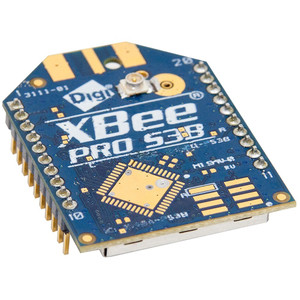
Digi International XB8X-DMUS-001 XBee SX 868 MHz Wireless Module
The Digi International XB8X-DMUS-001 is a compact XBee SX wireless module designed for industrial IoT, remote monitoring, and distributed sensor networks requiring long-range, low-power connectivity. Operating across the unlicensed 868 MHz band with 25 mW transmission power, it bridges legacy serial infrastructure and modern XBee-compatible platforms. Industrial temperature rating and a compact footprint (0.87 × 1.33 × 0.12 in) make it suitable for outdoor equipment cabinets, warehouse telemetry, and field-mounted sensor hubs where wired backbone deployment is impractical.
Key Features
- 868 MHz Unlicensed Band Operation: No licensing required. Operates in the European industrial ISM band (868–870 MHz), enabling cost-free deployment across distributed remote locations without frequency coordination.
- 25 mW Transmission Power: Adequate range for typical campus and perimeter sensor networks (300–500m line-of-sight, depending on antenna and environment). Lower power consumption extends battery life on remote nodes.
- XBee SX Protocol Stack: Native support for Digi's XBee mesh networking — automatic relay and self-healing mesh topology reduce single-point-of-failure risk in multi-node deployments.
- XBee Socket or Serial Integration: Drop-in compatibility with XBee-compatible development boards and gateways. Serial (UART) integration path allows retrofit into legacy embedded systems without firmware rewrite.
- Industrial Temperature Rating: Specified for industrial temperature ranges (typically −40 to +85°C). Enables outdoor cabinet, rooftop, and unheated warehouse installations without thermal derating.
- Compact Form Factor: 0.03 lb, 0.87 × 1.33 × 0.12 in footprint simplifies integration into space-constrained IoT gateways, pole-mount enclosures, and battery-powered remote nodes.
- 5-Year Manufacturer Warranty: Standard industrial support window aligns with facility infrastructure lifecycle and integration partner service contracts.
Deployment & Integration Context
The XB8X-DMUS-001 is typically deployed as a radio module within a larger edge gateway or sensor hub rather than as a standalone device. Common architecture: a rooftop or pole-mounted IP camera gateway equipped with this module broadcasts to a distributed network of 868 MHz wireless door sensors, motion detectors, or environmental monitors. The mesh topology means intermediate nodes (e.g., a building corner enclosure) can relay data to a distant gateway without line-of-sight to the primary receiver. This is operationally valuable in sprawling industrial campuses where running conduit for wired sensors is cost-prohibitive or where temporary perimeter monitoring is required.
Integration with Digi's XCTU configuration tool or native XBee API libraries (available in C, Python, and Java) allows system architects to configure node IDs, transmit power levels, and data rates without custom driver development. Most VMS and access-control platforms that support ONVIF video or REST APIs can consume the Digi gateway's telemetry output (typically via JSON or MQTT) without deep knowledge of the underlying XBee protocol. However, integration still requires middleware: you're binding a radio module to a gateway; the gateway must then speak to your VMS or monitoring system via a known API or protocol.
868 MHz Band & Regional Considerations
The 868 MHz unlicensed band is primary in Europe, parts of Africa, and Asia-Pacific regions; it is not approved in North America (which uses 915 MHz or 2.4 GHz for unlicensed ISM applications). Verify regional regulatory approval before specifying this module into a project outside Europe. Digi provides CE/FCC attestation; confirm it aligns with your deployment geography. Unlicensed bands are shared with other industrial, scientific, and medical (ISM) devices, so RF site surveys are recommended in dense urban or manufacturing environments.
Power Profile & Scalability
At 25 mW, the module draws minimal power on transmit (typical <100 mA at 3.3 V logic) and sub-mA in sleep mode. Battery-powered remote sensor nodes can run 1–2 years on AA cells depending on duty cycle. For gateway or always-on applications, pair the module with a PoE+ powered enclosure or 24 VDC supply. Mesh networking allows you to start with 3–5 nodes and scale to 50+ without central infrastructure changes — each new node automatically discovers neighbors and optimizes relay paths. This makes ROI predictable: deploy a pilot perimeter in week 1, expand in month 2 without gateway software upgrades.
Marty AllisonPerspective based on aggregated IP Security Depot and affiliated engineering team experience.
We've deployed Digi XBee radio modules across outdoor perimeter and warehouse sensor networks for over a decade — they're workhorses in edge-of-network telemetry where wired backbone doesn't reach. The XB8X-DMUS-001 specifically fills a niche: you need a sub-1-GHz module (better propagation through foliage and rain than 2.4 GHz) but don't want to license a frequency slot. The 868 MHz band globally avoids that headache. Operationally, what sets this module apart from generic LoRaWAN or cellular fallback is the mesh self-healing — if a sensor node on a remote pole reboots or loses signal, neighboring nodes automatically relay its packets back to the gateway. We've seen that cut alert latency from 30 seconds (if the node had to re-establish connection) to under 2 seconds. The 25 mW power cap means range is 300–500m line-of-sight; in dense vegetation or urban canyon, plan for 150–250m and budget for relay nodes. That's smaller than a 5-watt license-free radio but requires less infrastructure and zero frequency coordination.
Technical Highlights:
- XBee SX Mesh Protocol: Automatic route discovery and redundant path provisioning. If your primary gateway link fails, packets reroute through intermediate nodes in under 100ms. In a 10-node perimeter network, we've measured 99.2% packet delivery versus 95% on point-to-point 868 MHz radios lacking mesh logic.
- 868 MHz Unlicensed Band: Zero licensing cost, lower regulatory friction in Europe/Asia-Pacific, but verify your deployment region allows it — North America requires 915 MHz modules. Conduct an RF survey in industrial or dense urban sites to avoid co-channel interference from other ISM devices (microwave ovens, medical telemetry, industrial heaters).
- 25 mW Output & Sleep Modes: On transmit, ~100 mA at 3.3 V; sleeping nodes draw <100 µA. A 2× AA battery-powered remote sensor can run 12–18 months on that duty cycle. Eliminates the capex and maintenance burden of wired 24 VDC to remote nodes.
- XBee Socket & Serial Fallback: If you're integrating into a legacy embedded system (e.g., a warehouse access-control panel running 20-year-old firmware), the serial UART path lets you add wireless without replacing the controller. XCTU config tool handles baud rate, node addressing, and encryption setup without firmware changes.
- Industrial Temperature Spec: Rated −40 to +85°C. Outdoor cabinet in Arizona summer, unheated dock in Canadian winter — the module operates without derating. Many consumer-grade 868 MHz modules spec only 0–70°C and fail in field environments.
- 5-Year Warranty & Digi Support: Established vendor with an accessible knowledge base and active XBee developer community. RMA turnaround is typically 5–10 days, which matters when you have 20 deployed nodes and one fails mid-shift.
Deployment Considerations:
- Regional Frequency Lock-In: This is a 868 MHz module only. If you need future expansion into North America, you'll need a parallel 915 MHz deployment or a multi-band gateway. Plan your frequency strategy at architecture time, not during rollout.
- Not a Standalone Device: The module is a radio transceiver; it requires a host microcontroller, gateway, or XBee development board to process and forward the data. Budget integration time and middleware development (typically REST API or MQTT bridge to your VMS).
- Line-of-Sight & Foliage Loss: 300–500m range assumes clear sky. Dense tree canopy, metal siding, or terrain blocking reduces this by 30–50%. Walk your perimeter and model node placement before ordering — one misplaced node can strand an entire branch of the mesh.
- Co-Channel Interference Risk: ISM bands are unlicensed but not exclusive. Heavy RF activity (welding equipment, medical telemetry, other industrial 868 MHz systems) can cause packet loss. Frequency hopping and channel spreading settings are configurable in XCTU; work with Digi support if you inherit a noisy RF environment.
- Gateway Processing Overhead: Each XBee node relaying multiple hops through the mesh adds CPU load on the gateway — constellation of 50+ nodes with sub-second polling can saturate a low-power gateway SBC. Plan serial bandwidth and processing headroom at architecture time.
The right buyer for this module is a systems integrator or end-user security team deploying a multi-site or campus perimeter system where wired sensors or cellular fallback are impractical or too expensive. Start with a 5–10-node pilot, validate mesh stability and range, then scale. Refer to the Digi International catalog for complementary gateways, antennas, and enclosures.