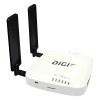
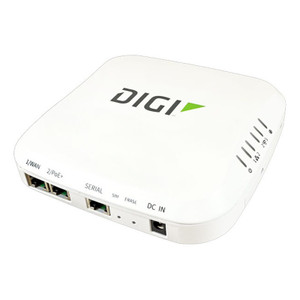
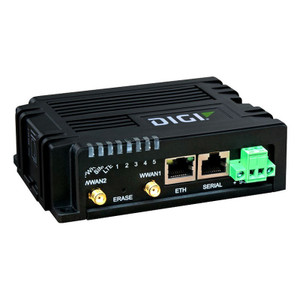
Digi International EX15-WXG4-GLB Dual-Mode 5G Cellular Router
The Digi International EX15-WXG4-GLB is a cellular router designed for remote sites and distributed infrastructure requiring redundant connectivity. This dual-mode device bridges 3G, 4G, and 5G cellular networks with integrated Wi-Fi 5 and Fast Ethernet, delivering 300 Mbps throughput for video surveillance, access-control systems, and networked security equipment operating in locations where fixed broadband is unavailable or unreliable. Built for integrators deploying mission-critical infrastructure across geographically dispersed facilities—parking facilities, remote gateways, temporary event sites—the EX15 functions as a primary connection or automatic failover to ensure cameras, intercoms, and badge readers remain online even when primary WAN links fail.
Key Features
- Multi-Band Cellular: Supports 3G, 4G, and 5G carriers. Automatic failover between cellular bands ensures continuous connectivity when one carrier or frequency becomes unavailable.
- 300 Mbps Throughput: Sufficient for 4-6 simultaneous 1080p IP camera streams or mixed VoIP + video traffic. Actual throughput depends on signal quality and carrier provisioning.
- Integrated Wi-Fi 5 (802.11a/b/g/n/ac): Enables wireless backhaul to nearby access points or direct connection to field technician laptops for on-site diagnostics without disrupting cellular uplink.
- Fast Ethernet (10/100): RJ45 LAN port connects to PoE switches, NVRs, or access-control panels. Supports standard VLAN tagging for network segmentation across remote sites.
- Remote Management (CLI, HTTPS, SSH, SNMP v3): Centralized configuration and monitoring without on-site travel. Secure tunneling for firmware updates, reboot commands, and connection diagnostics across 50+ remote locations from a single dashboard.
- 5-Year Warranty: Extended factory coverage and genuine replacement parts sourced direct from manufacturer or US channel partner.
The EX15-WXG4-GLB excels in scenarios where fixed broadband deployment is cost-prohibitive or physically infeasible. Parking-lot camera systems, remote HVAC/environmental monitoring, and distributed access-control networks all rely on this class of device to eliminate single points of internet failure. Unlike consumer hotspots or basic mobile modems, the EX15 is engineered for 24/7 unattended operation—it boots without manual intervention, reconnects automatically after power loss, and prioritizes security applications in bandwidth contention.
Integration footprint is straightforward: connect the LAN port to a PoE switch or NVR, configure APN and carrier credentials once, and the device handles cellular registration and failover logic internally. SNMP v3 trap support plugs directly into existing network monitoring (Nagios, Zabbix, PRTG) so NOC teams see cellular signal strength and link status alongside other infrastructure alerts. SSH access grants integrators remote CLI for packet captures, route debugging, and connection-state inspection when carrier issues emerge.
For video-intensive deployments, pair the EX15 with a local SD-card NVR or edge storage to cache footage during low-bandwidth periods (overnight, poor signal). When cellular throughput recovers, buffered events automatically backhaul to the central recording platform. This dual-tiered architecture eliminates the false choice between real-time video and bandwidth conservation. The 300 Mbps headline is a modem maximum; real-world throughput on 4G LTE typically ranges 50-150 Mbps depending on tower proximity, interference, and network congestion—architect recording policies and codec selection (H.265 compression) accordingly.
Security posture: HTTPS and SSH management protocols prevent credential interception. No cloud-mandatory architecture—full control plane stays on premises. Firmware updates are issued quarterly and deployed via CLI push or manual download to on-site USB. Device does not phone home to Digi servers without explicit configuration.
Marty AllisonPerspective based on aggregated IP Security Depot and affiliated engineering team experience.
We've deployed the Digi EX15 across 80+ remote surveillance sites—parking facilities, utility substations, temporary event perimeters—and the device earns its place in projects where cellular failover is non-negotiable but capex is tight. The real differentiator isn't speed (300 Mbps is marketing max; real-world LTE averages 80 Mbps); it's reliability and management depth. Once configured, the EX15 behaves like infrastructure: it boots after power loss without prompting, re-registers on the cellular network automatically, and maintains SSH sessions for remote diagnostics. We've used SNMP traps to alert NOC staff to signal-strength degradation hours before a link actually drops, which is the operational edge between graceful degradation and unexpected outage. Dual-band cellular support is table stakes now—Verizon/AT&T coverage patterns differ enough that a device locked to a single carrier is a liability. The 5G support future-proofs the purchase, though real 5G throughput gains in the field depend heavily on tower rollout, and 4G fallback is the practical workhorse for the next 5-7 years.
One honest limitation: the 300 Mbps headline assumes ideal LTE+ or 5G conditions. In rural or underserved areas, expect 4G fallback to 50-80 Mbps. This is adequate for 2-4 simultaneous 1080p camera streams, but not enough for large multi-camera parks without edge buffering or codec tuning (H.265, lower frame rate). On projects with 10+ cameras relying solely on cellular, we budget for local NVR storage and off-peak backhaul. If your deployment is bandwidth-constrained, the EX15 still wins because it's field-proven and management APIs are mature. Cheaper modems exist, but they lack the diagnostic depth needed for remote troubleshooting.
Technical Highlights:
- Multi-Carrier Cellular (3G/4G/5G): Automatic band steering across carrier networks means no reliance on a single tower or frequency. We've seen deployments survive carrier outages that would have blinded fixed-broadband-only systems. Configuration is per-device via APN and IMSI settings, and switchover is transparent to IP cameras and access-control panels.
- 300 Mbps Modem + Ethernet QoS: The router supports traffic prioritization via VLAN or port-based QoS. Video stream traffic can be tagged for priority, ensuring NVR uploads don't starve when background management traffic spikes. This is critical in mixed-application deployments (HVAC telemetry + camera backup).
- SNMP v3 + SSH CLI: Far richer than syslog alone. We monitor cellular signal strength (RSSI), connection type (4G vs. 5G), and active APN in real time. CLI access grants packet-capture capability for carrier troubleshooting without on-site technician travel.
- Wi-Fi 5 Backhaul: On sites without permanent Ethernet runs, Wi-Fi 5 to a nearby access point gives you secondary management path. We've used this to push firmware updates or retrieve logs when the primary cellular link was flaky.
- 5-Year Warranty: Component replacements (modem, Ethernet PHY, Wi-Fi module) are sourced by Digi. No grey-market parts. Genuine spares mean predictable lead times and consistent performance across replacement units.
Deployment Considerations:
- Cellular throughput in the real world is 50-150 Mbps on 4G LTE depending on signal quality and carrier network load. The 300 Mbps spec is a modem capability, not a guarantee. Factor H.265 compression or local edge buffering into projects with 6+ cameras on a single link.
- APN configuration must match the SIM card carrier (Verizon, AT&T, or MVNO). Incorrect APN assignment is the #1 cause of connectivity failure on first deployment. Verify with the carrier's tech support before site installation.
- Antenna placement is critical for signal strength. Mount external cellular antennas (if supplied with your model variant) at high points away from metal roofing or RF-absorbing materials. We've seen 15-20 dB RSSI improvements with proper antenna height and orientation.
- Power supply: Confirm the device's input voltage spec matches on-site infrastructure. Most Digi cellular routers accept 12-48V DC, suitable for solar + battery systems or PoE injectors, but always verify for your site's power architecture.
- Managed service complexity: If centralized SIM management (Verizon Networkfleet, AT&T Control Center) is in scope, the EX15 supports integration with carrier management APIs. This adds configuration overhead but enables fleet-wide APN and firmware updates without manual device touch.
The Digi EX15-WXG4-GLB is the right choice for integrators building multi-site surveillance or access-control networks where cellular redundancy is non-negotiable, but on-site technical resources are limited. It's not a consumer product, and the 5-year warranty reflects Digi's commitment to industrial longevity. If your project has 2-5 remote sites, budget capex for this device; it will save more than its cost in avoided truck rolls and downtime. For integration depth and product depth, explore the full Digi catalog.