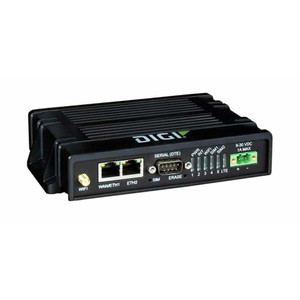
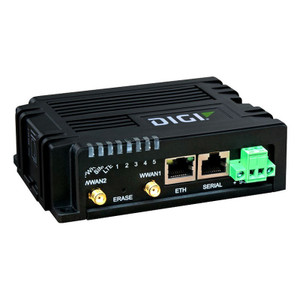
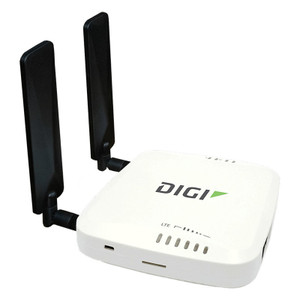
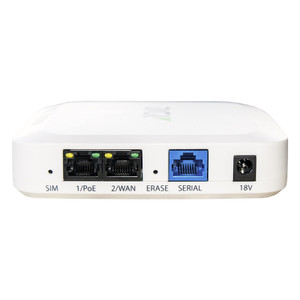
Digi International IX30-0EG4 3G/4G Cellular Router DIN Rail Mount
The Digi International IX30-0EG4 is a compact industrial cellular router designed for remote site connectivity where wired Ethernet infrastructure is unavailable or cost-prohibitive. This unit combines dual 10/100 Mbps Ethernet ports with integrated 3G/4G LTE cellular fallback, enabling surveillance systems, environmental sensors, and distributed monitoring nodes to maintain reliable uplink connectivity across geographically dispersed locations. The DIN rail form factor and 18VDC screw-terminal power input fit seamlessly into industrial control cabinets and outdoor equipment enclosures.
Key Features
- Dual 10/100 Mbps Ethernet Ports: Auto-sensing RJ-45 connectors for primary wired network access. Paired with 3G/4G LTE cellular fallback ensures continuous connectivity if the primary Ethernet link fails.
- 3G/4G LTE Cellular Connectivity: Integrated modem provides automatic fallback to cellular when Ethernet is unavailable, eliminating single points of failure in remote deployments.
- DIN Rail Mount, Compact Footprint: 1.1 lb unit mounts to standard DIN rail in control cabinets, reducing installation time and respecting space constraints in retrofit applications.
- 18VDC Screw Terminal Power: Industrial-grade 12-pin screw-down terminal block accepts 18VDC supply from standard industrial power sources or uninterruptible power supplies (UPS).
- CLI, SNMP, NTP Management: Full command-line configuration, remote monitoring via SNMP, and NTP clock synchronization enable centralized policy deployment and remote diagnostics across a fleet of routers.
- SMTP, SCP Protocol Support: Built-in email alerting and secure file transfer capabilities simplify integration with legacy NOC systems and event notification workflows.
- 5-Year Warranty: Extended coverage minimizes replacement cycles and provides supplier stability for long-lifecycle remote installations.
Remote surveillance sites—parking lots, utility substations, pipeline valve boxes, and rural cell tower cabinets—often lack fiber or broadband infrastructure. The IX30-0EG4 bridges that gap by combining wired Ethernet (for sites with backhaul) with automatic LTE fallback (for sites without). This dual-transport design eliminates the operational overhead of choosing between a cellular-only solution (high monthly airtime cost) and a wired-only solution (infrastructure dependency). The screw-terminal form factor is industry-standard in outdoor and industrial equipment; integrators familiar with panel-mount routers and industrial PLCs recognize this connector pattern immediately.
Integration with surveillance and monitoring platforms relies on standard networking protocols. The router presents itself as a transparent IP gateway—downstream VMS systems (Genetec, Milestone, Avigilon, or on-premise NVRs) see standard Ethernet connectivity and operate without modification. SNMP traps alert NOC staff to cellular link transitions, allowing rapid diagnosis of network issues. NTP synchronization keeps distributed recorders' timestamps aligned, a critical requirement for forensic timeline reconstruction. CLI access via SSH or serial console enables per-site policy customization (e.g., rate-limit video upload to 2 Mbps during peak cellular congestion).
Total cost of ownership spans three years. A site with no wired backhaul has two alternatives: (1) a cellular-only router (~$400–600 capital) plus $50–100/month per SIM card, or (2) a dual-transport IX30-0EG4 (~$800–1,200 capital) plus $30–60/month per SIM with dynamic fallback. The IX30-0EG4 wins on capex per Mbps and on operational resilience. A site with fiber backhaul but seasonal service disruptions uses the IX30-0EG4 as a secondary uplink, paying for a low-usage data plan ($15–25/month) and eliminating the cost of service-level agreement upgrades on the primary circuit. The 5-year warranty and industrial-grade screw terminals reduce field maintenance—no connector corrosion or intermittent power failures that plague consumer-grade equipment in unheated cabinets.
The IX30-0EG4 is compatible with cellular networks in North America and select international regions; confirm band support with your carrier before ordering. Power consumption is minimal during idle (under 2W), and the 18VDC input accepts wide voltage tolerance (12–24VDC typical for industrial supplies), simplifying supply-chain integration. Mounting requires only a standard DIN-rail installation tool; no chassis modifications or relay wiring are needed.
Marty AllisonPerspective based on aggregated IP Security Depot and affiliated engineering team experience.
We've deployed cellular routers across parking lots, remote substations, and pipeline monitoring cabinets for over a decade, and the IX30-0EG4 strikes a practical balance between capex discipline and operational resilience. The dual Ethernet + LTE fallback architecture is the real differentiator here—it eliminates the binary choice between wired and wireless. On a job where fiber is available but unreliable (seasonal construction, carrier maintenance), the IX30-0EG4 becomes a sub-$200/year insurance policy. On a job with no wired infrastructure, it cuts your monthly SIM cost in half compared to a cellular-only gateway because the link doesn't need to carry sustained traffic—it's backup only. The 18VDC screw terminal connector is industrial standard; you're not fighting with micro-USB or barrel connectors that corrode in unheated cabinets. The 5-year warranty is meaningful—field replacements on remote sites cost $500–1,500 in labor alone, so upfront durability matters.
Technical Highlights:
- Dual 10/100 Mbps Ethernet Auto-Sense: RJ-45 ports negotiate speed automatically with whatever switch or modem they encounter. No jumper settings, no mismatched duplex headaches. The router is transparent to downstream VMS and NVR systems—they see a standard IP network.
- 3G/4G LTE Fallback Logic: Cellular link activates only when primary Ethernet is unavailable, conserving airtime and preventing double-transport overhead. Failover is automatic; no manual intervention required on-site.
- SNMP Trap Alerting: Router emits SNMP traps on link transitions (Ethernet down, cellular up, etc.), allowing your NOC to log and alert on connectivity state changes. Integrates with any SNMP receiver—Solarwinds, Nagios, custom scripts.
- NTP Clock Synchronization: Keeps distributed recorders time-synchronized over cellular, eliminating the "timestamp drift" problem that plagues video forensics when you have multiple independent recorders on separate backhauls.
- CLI Configuration + SCP File Transfer: Manage the router via secure shell (SSH) or serial console. Push firmware updates and policy files via SCP without leaving your NOC. Critical for fleet-wide policy rollouts across 50+ remote sites.
- Compact DIN Rail Mount: 1.1 lb, fits any standard 35mm DIN rail. No custom mounting brackets, no chassis modifications. Typical installation time: 10 minutes including power and Ethernet wiring.
Deployment Considerations:
- Cellular band support varies by region and carrier. Confirm LTE bands (e.g., Band 4, Band 7, Band 13 in North America) are supported by your carrier before ordering. An incompatible band means the unit falls back to 3G, which is slower and increasingly phased out by carriers.
- Power budget: The IX30-0EG4 draws <2W at idle and <5W during cellular transmission. An 18VDC UPS or conditioned industrial supply is strongly recommended for sites with flaky AC power (rural utility cabinets). A 12V/7Ah battery provides >24 hours of backup for the router alone.
- Antenna placement matters for cellular signal. The router uses an internal antenna; for sites with poor signal (e.g., basement cabinets, dense urban metal structures), budget $100–200 for an external cellular antenna and extension cable. This is a common retrofit on second-generation deployments.
- SIM card provisioning is separate—order your carrier's industrial/IoT SIM plan independently. Confirm the carrier supports static IP (fixed APN) if your VMS requires inbound connections to the remote site. Some carriers restrict inbound access on standard consumer plans.
- Integration with legacy NVRs: The IX30-0EG4 acts as a transparent gateway. If your NVR uses proprietary cloud connectivity or dynamic DNS, no changes are needed. If you rely on manual port forwarding or static routes, test the failover scenario (unplug Ethernet, confirm cellular takes over) in a lab before field deployment.
The IX30-0EG4 is built for integrators and end-user IT teams managing distributed surveillance and sensor networks where uplink reliability and operational simplicity matter more than per-Mbps cost optimization. If you're balancing between a cellular-only solution and a fiber-dependent solution, this dual-transport router typically justifies itself within 18–24 months. See the Digi International catalog for complementary industrial networking products.