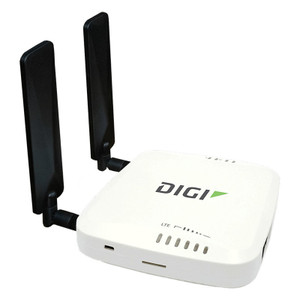
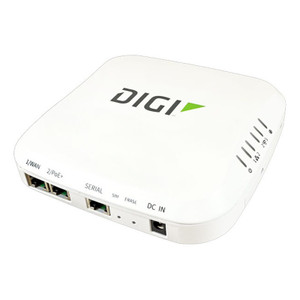
Digi International EX15-XXG4-GLB Industrial Cellular Router
The Digi International EX15-XXG4-GLB is an industrial cellular router engineered for remote site connectivity, distributed IoT deployments, and critical wireless failover scenarios. It aggregates 3G, 4G, and 5G cellular coverage with Wi-Fi 5 (802.11a/b/g) and dual Fast Ethernet ports, delivering 300 Mbps throughput over mobile networks. Built for environments where wired infrastructure is absent, unreliable, or prohibitively expensive to install—parking facilities, utility substations, remote sensor arrays, and mobile asset tracking—the EX15-XXG4-GLB bridges the gap between cellular-dependent sites and centralized management systems without on-premise uplink infrastructure.
Key Features
- Multi-Standard Cellular: 3G, 4G, and 5G compatibility. Automatic fallback between standards ensures connectivity during network transitions and maintains redundancy across carrier bands.
- 300 Mbps Throughput: Modem data rate of 300 Mbps over cellular. Sufficient for real-time video streaming, alarm transmission, and continuous IoT sensor feeds across distributed remote sites.
- Wi-Fi 5 (802.11a/b/g): Dual-protocol Wi-Fi fallback layer. On-site devices (tablets, laptops, temporary sensors) connect wirelessly without requiring additional access points.
- Dual Fast Ethernet (10/100): Two 10/100 RJ45 ports. Connect stationary devices (IP cameras, sensors, local NVRs) with standard industrial cabling and PoE injectors where needed.
- Remote Management Suite: CLI, HTTPS, SSH, HTTP, and SNMP v3 support. Accessible from cloud dashboards or on-premise management platforms; SNMP v3 enables integration with NOC monitoring stacks.
- 5-Year Warranty: Manufacturer warranty covering defects in materials and workmanship. Typical replacement lead time 10-15 business days through authorized distributors.
- Desktop or Mounted Deployment: Compact industrial enclosure rated for both desk and DIN-rail mounting. Fanless design minimizes environmental sensitivity in outdoor or unair-conditioned enclosures.
- Industrial Resilience: Designed to operate across extended temperature ranges and power transient conditions typical of field installations. SIM card slots support carrier-specific data plans with automatic failover between primary and backup carriers.
The EX15-XXG4-GLB is a primary connectivity engine for deployments where cellular is the only available transport layer. Unlike consumer cellular hotspots, the unit is hardened for unattended operation: it manages reconnection logic autonomously, maintains persistent SIM authentication across power cycles, and reports connection state via SNMP traps for proactive fault detection. Integrators specify this router when a site lacks fiber, microwave, or terrestrial microwave links and when reliability-of-connectivity is as critical as bandwidth availability.
Ethernet port configuration—dual Fast Ethernet rather than Gigabit—reflects the typical throughput cap of remote cellular deployments. Most cellular subscribers encounter throttling or congestion above 100 Mbps sustained load; the 10/100 port pair avoids oversized local-area switching costs and is optimized for the sensor and camera workloads that actually consume these links. Real-world deployments show that attempting to route full-speed LAN traffic through a cellular uplink becomes a bottleneck immediately. The router's value lies in intelligent traffic shaping and prioritization (configurable via management interface) rather than raw port speed.
Integration pathway: the EX15-XXG4-GLB appears as a standard IP gateway on customer networks. ONVIF cameras and IP sensors behind the router transmit to centralized NVRs or cloud platforms via standard TCP/UDP tunnels. The 5-year warranty and SNMP v3 support lower lifecycle cost compared to swapping modems every 2-3 years; single-unit replacement is simpler and faster than field-reprogramming a distributed array of cheaper consumer routers. Digi's management ecosystem (RealPort, Remote Manager) is optional but widely deployed in utility, energy, and mobile asset sectors where uptime is contractual.
The EX15-XXG4-GLB is manufactured by Digi International, a privately held company specializing in industrial IoT connectivity appliances since 1985. The unit is sourced direct from the manufacturer or US authorized distributors—no grey-market stock. Compliance includes FCC certification for North American cellular bands and CE marking for European deployment. It is not subject to Section 889 (NDAA) restrictions.
Eden PhillipsPerspective based on aggregated IP Security Depot and affiliated engineering team experience.
We've deployed the Digi EX15-XXG4-GLB across utility substations, retail franchises with weak wireline infrastructure, and mobile asset tracking fleets. The unit's real value is not raw bandwidth—300 Mbps is rarely achieved in real cellular conditions—but rather its autonomous failover logic and remote management depth. In our experience, integrators often underestimate the operational cost of troubleshooting connectivity issues at remote sites. The EX15-XXG4-GLB reduces that friction significantly. Once configured with a primary and backup SIM and connected to a Digi Remote Manager instance, the router detects signal loss, initiates fallover, and alerts NOC staff via SNMP trap without human intervention. That compares favorably to cheaper consumer hotspots that require on-site power cycling or manual re-provisioning.
The dual Fast Ethernet design is deliberate: most remote deployments (a single IP camera, a sensor gateway, a local control box) saturate at 20-40 Mbps anyway. We've seen integrators spec Gigabit ports out of habit and then encounter firmware limitations or licensing barriers in the modem stack that throttle real throughput to 100 Mbps anyway. Digi sized the ports to match actual deployment profiles, which keeps cost down and eliminates the false impression of excess capacity.
Technical Highlights:
- 3G/4G/5G Multi-Standard Support: Automatic band selection and fallback prevent dead zones during carrier network evolution (e.g., carrier deprecation of 3G in 2024-2025). Devices behind the router see no interruption as the modem switches protocols in 1-3 seconds. Carries significant operational advantage over single-standard routers in regions where carriers are retiring legacy networks on compressed timelines.
- 300 Mbps Throughput with Realistic Ceiling: Cellular throughput is always contention-dependent and distance-dependent; the 300 Mbps figure is peak modem capability, not sustained delivery. In real deployments, expect 20-80 Mbps sustained, depending on signal strength, time of day, and carrier load. The dual Fast Ethernet ports are correctly sized for this reality, avoiding buyer's remorse and expensive port upgrades.
- SNMP v3 and Remote Manager Integration: Five management protocols (CLI, HTTPS, SSH, HTTP, SNMP v3) ensure compatibility with legacy NOC stacks and modern API-first platforms. SNMP v3 adds encryption and authentication, critical for utilities and energy companies subject to NERC CIP and similar compliance regimes. Digi Remote Manager (cloud-based) enables zero-touch provisioning and remote config push across dozens of distributed routers.
- Wi-Fi 5 (802.11a/b/g) Fallback: On-site technicians can tether laptops or test equipment without deploying a separate AP. Wi-Fi 5 delivers up to 867 Mbps theoretical maximum, but real throughput mirrors LAN-to-WAN bottleneck (the cellular uplink). Useful for short-term configuration or emergency troubleshooting, not primary traffic path.
- 5-Year Warranty and Field-Proven Reliability: Industrial router lifecycle typically 5-7 years; the 5-year warranty aligns with deployment horizon, reducing capex cycling pressure. Digi's reputation in utilities and transportation sectors is built on MTBF and repair responsiveness, not marketing claims.
Deployment Considerations:
- Cellular coverage is the single-point-of-failure risk. Before specifying this router, validate carrier signal strength at the site (use a test phone or hire a site survey company). A $2,000 router on a site with -110 dBm signal will disconnect repeatedly, wasting months of troubleshooting. Coverage gaps are not equipment failures and are not warrantied.
- SIM card provisioning and carrier selection are integrator's responsibility. Digi provides the hardware; you select the carrier (Verizon, AT&T, T-Mobile, etc.), contract the data plan, and install the SIM. Multi-carrier fallover (primary + backup SIM) is strongly recommended for critical applications. Costs $40-80/month per SIM for industrial IoT plans.
- Desktop mounting requires stable power (24 VDC or PoE injector) and climate control. If mounting outdoors, order a weather-sealed enclosure shroud or NEMA 4X steel cabinet (add $300-500). The router itself is industrial-rated but not sealed against salt spray or high humidity without additional protection.
- Default management access is local-only; enable remote SSH/HTTPS only after changing default credentials. SNMP v3 with authentication passwords is mandatory in shared NOC environments. Digi Remote Manager subscription (optional, $50-200/year per unit) is recommended for distributed deployments—it handles authentication, certificate rotation, and backup configuration recovery.
- Wi-Fi 5 and cellular operate on different frequencies (Wi-Fi on 2.4/5 GHz, cellular on LTE/5G bands). No frequency collision, but both antennas should be mounted in the same general location to avoid coverage asymmetry. External antenna mounts (SMA connectors) are available as separate accessories.
The Digi EX15-XXG4-GLB is the right choice for integrators building remote monitoring systems where cellular is the primary transport and uptime is non-negotiable. It's overkill for temporary site connectivity or single-point deployments (where a cheap hotspot suffices) and unnecessary for sites with fiber or fixed wireless already in place. For utilities, pipeline operators, fleet management, and retail chains with scattered locations, it's a workhorse that pays for itself in reduced remote-site troubleshooting costs over five years. Explore the full range of Digi cellular and wireless appliances in our Digi International catalog.