
Wasp WDT950 vs Wasp 633809011559: Specification Comparison
Both the Wasp WDT950 (SKU 633809009808) and the Wasp DR6 (SKU 633809011559) are handheld Android mobile computers designed for warehouse and field data-capture workflows. Each carries dual IP65/IP67 ratings, runs on a Qualcomm octa-core SoC, and ships with a USB 3.1 Type-C interface. The comparison centers on connectivity generation, processing headroom, display size, and form-factor trade-offs — three dimensions that directly drive deployment decisions in mixed Wi-Fi/WAN environments with varying shift-length demands.

In This Guide
- Which device offers more future-proof wireless and WAN connectivity for mixed-infrastructure sites?
- How do processing power, memory configuration, and display size compare for scan-intensive or multi-app workflows?
- Which device is better suited to physically demanding environments and extended-shift battery demands?
- Which should you choose: the WDT950 or the 633809011559?
- Side-by-Side Specs
- FAQ
Which device offers more future-proof wireless and WAN connectivity for mixed-infrastructure sites?
The WDT950 supports Wi-Fi 802.11a/b/g/n/ac Wave 2 (with 802.11ax-ready notation) and LTE Advanced up to CAT4 across FDD Bands 1, 2, 3, and 4. Bluetooth is version 5.1. This positions it solidly for current-generation enterprise Wi-Fi deployments but limits WAN throughput to LTE CAT4 speeds.
The DR6 moves up a full connectivity generation: Wi-Fi 6E (2.4 GHz, 5 GHz, and 6 GHz) with Dual-Band Simultaneous (DBS) support, 5G Sub-6 GHz across bands N1/N2/N3/N5/N28/N41/N71/N77/N78/N79 with 4×4 MIMO, and Bluetooth 5.2. For sites deploying Wi-Fi 6E access points or requiring 5G WAN coverage, the DR6 provides the required radio stack; the WDT950 does not support either standard per its published specifications.
How do processing power, memory configuration, and display size compare for scan-intensive or multi-app workflows?
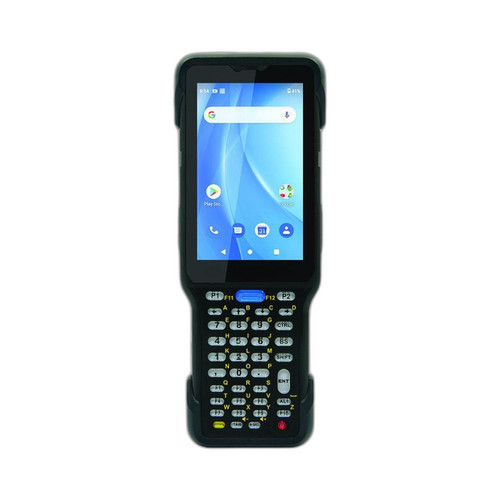
The WDT950 is built on a Qualcomm 720G octa-core running at 2.3 GHz, paired with 4 GB RAM and 64 GB Flash storage, expandable via Micro SD/TF. Its display is a 4-inch WVGA (480×800) capacitive touchscreen at 400 nits, glove-compatible. The compact 4-inch panel suits single-handed scan workflows but limits simultaneous app visibility.
The DR6 uses a Qualcomm Snapdragon 6490 octa-core at 2.7 GHz — a higher-tier SoC — with 6 GB RAM and 64 GB UFS Flash as standard, with a 128 GB option specified. Its 6.3-inch Color LCD at 2160×1080 resolution is protected by Gorilla Glass 3. The larger, higher-resolution display and additional RAM support more concurrent processes, richer WMS UI rendering, and reduced operator eye strain over extended shifts.
Which device is better suited to physically demanding environments and extended-shift battery demands?
Both units share IP65/IP67 ratings per IEC 60529. The WDT950 survives drops of 5.9 feet (1.8 m) bare and 7.8 feet (2.4 m) with an optional bumper attached. It weighs 13.93 oz (395 g) with standard battery and measures 7.68" × 2.83" × 1.34". No battery capacity figure is provided in the supplied specifications for the WDT950.
The DR6 is rated for drops of 4'11" (1.5 m) without bumper and 5'11" (1.8 m) with bumper — meaningfully lower than the WDT950's bumper-equipped 7.8 ft / 2.4 m rating. However, the DR6 is substantially lighter at 9.5 oz (270 g) and considerably slimmer at 0.7" thick versus 1.34". Its specifications note a hot-swappable 5100 mAh battery, enabling shift-change battery swaps without powering down — a specification not present for the WDT950. Buyers in high-drop-risk dock environments gain more mechanical protection with the WDT950; buyers prioritizing continuous uptime and ergonomics favor the DR6.
Which should you choose: the WDT950 or the 633809011559?
Our take: The WDT950 is the stronger choice when maximum drop resilience is the primary concern — its 7.8 ft / 2.4 m bumper-protected drop spec exceeds the DR6's 5'11" / 1.8 m bumper rating by a meaningful margin. The DR6, however, leads on three specification-driven dimensions: its Qualcomm Snapdragon 6490 at 2.7 GHz outclocks the WDT950's 720G at 2.3 GHz, its 6 GB RAM exceeds the WDT950's 4 GB, and its Wi-Fi 6E plus 5G Sub-6 radio stack is a full connectivity generation ahead of the WDT950's Wi-Fi 5 / LTE CAT4. Additionally, the DR6's hot-swappable 5100 mAh battery addresses shift-continuity requirements not covered by WDT950 specs. Buyers on current or planned Wi-Fi 6E infrastructure, or sites requiring 5G WAN, should select the DR6. Buyers in high-impact dock and yard environments where drop survival at maximum height is the governing requirement may prefer the WDT950, noting its heavier and thicker form factor.
Side-by-Side Comparison
Spec-for-spec, from manufacturer data.
| Specification | Wasp WDT950 | Wasp 633809011559 |
|---|---|---|
| Product Type | 2D Android Mobile Computer | Rugged 5G Mobile Computer |
| Form Factor | Handheld Mobile Computer | Handheld Mobile Computer |
| Operating System | Android 10 with GMS certification | Not specified in provided specs |
| Processor | Qualcomm 720G Octa-core 2.3 GHz | Qualcomm Snapdragon 6490 Octa-core 2.7 GHz |
| RAM | 4 GB | 6 GB |
| Storage | 64 GB Flash + Micro SD/TF | 64 GB UFS Flash (128 GB option) |
| Display | 4" WVGA 480×800, 400 nits, capacitive | 6.3" Color LCD 2160×1080, Gorilla Glass 3 |
| Wi-Fi | 802.11a/b/g/n/ac Wave 2 (ax-ready) | Wi-Fi 6E, 2.4/5/6 GHz, DBS |
| WAN | LTE Advanced CAT4 (FDD Bands 1/2/3/4) | 5G Sub-6 GHz (4×4 MIMO) + 4G LTE FDD |
| Bluetooth | 5.1 | 5.2 |
| GNSS | GLONASS, Galileo, BeiDou listed | Not specified in provided specs |
| IP Rating | IP65 / IP67 | IP65 / IP67 per IEC 60529 |
| Drop Spec (bare) | 5.9 ft (1.8 m) | 4'11" (1.5 m) |
| Drop Spec (with bumper) | 7.8 ft (2.4 m) | 5'11" (1.8 m) |
| Weight | 13.93 oz / 395 g | 9.5 oz / 270 g |
| Dimensions (L×W×D) | 7.68" × 2.83" × 1.34" | 6.6" × 3.0" × 0.7" |
| Battery | Not specified | 5100 mAh, hot-swappable |
| Interface | USB 3.1 Type-C; Ethernet/USB-Host via cradle | USB 3.1 Type-C; Ethernet via cradle |
| Audio | Microphone supported | Microphone supported |
Frequently Asked Questions
Which should you choose: the WDT950 or the 633809011559?
The WDT950 is the stronger choice when maximum drop resilience is the primary concern — its 7.8 ft / 2.4 m bumper-protected drop spec exceeds the DR6's 5'11" / 1.8 m bumper rating by a meaningful margin. The DR6, however, leads on three specification-driven dimensions: its Qualcomm Snapdragon 6490 at 2.7 GHz outclocks the WDT950's 720G at 2.3 GHz, its 6 GB RAM exceeds the WDT950's 4 GB, and its Wi-Fi 6E plus 5G Sub-6 radio stack is a full connectivity generation ahead of the WDT950's Wi-Fi 5 / LTE CAT4. Additionally, the DR6's hot-swappable 5100 mAh battery addresses shift-continuity requirements not covered by WDT950 specs. Buyers on current or planned Wi-Fi 6E infrastructure, or sites requiring 5G WAN, should select the DR6. Buyers in high-impact dock and yard environments where drop survival at maximum height is the governing requirement may prefer the WDT950, noting its heavier and thicker form factor.
Is the WDT950 or the DR6 better for a warehouse already deploying Wi-Fi 6E access points?
The DR6 is the appropriate choice. Its Wi-Fi 6E radio supports 2.4 GHz, 5 GHz, and the 6 GHz band with Dual-Band Simultaneous operation. The WDT950's specified wireless stack tops out at 802.11ac Wave 2 (Wi-Fi 5) and does not include 6 GHz band support per its published specifications.
Which device handles shift changes better in an operation that cannot afford device downtime for recharging?
The DR6 specification lists a hot-swappable 5100 mAh battery, which allows the battery to be replaced without powering the device down. No equivalent hot-swap or specific battery capacity specification is provided in the supplied WDT950 specs, so the DR6 has a documented advantage for continuous-shift operations.
If my workers frequently drop devices in a loading dock environment, which unit offers the better drop protection per spec?
The WDT950 specifies a 7.8 ft (2.4 m) drop rating when the optional bumper is attached, versus the DR6's 5'11" (1.8 m) bumper-equipped rating. Both units are IP65/IP67-rated. On drop height alone, the WDT950 provides the higher published tolerance for impact.
More Mobile Computer Comparisons
- Datalogic 944850001 vs Honeywell CK67-X0N-5EC1C2G
- Datalogic 944850001 vs Honeywell CK67-X1N-58A1B1G
- Datalogic 944850001 vs Honeywell CK67-X1N-58A1A1G
- Datalogic 944850001 vs Honeywell CK67-X1N-58A1C1G
- Datalogic 944850001 vs Datalogic 944950001
- Datalogic 944850001 vs Datalogic 944900004
Mobile Computer Buying Guides
Get a Second Opinion on Your Camera Choice
Share your site layout, coverage goals, and budget. Our team will validate the camera selection, flag anything we would change, and recommend products that match the use case.