
Datalogic 944850001 vs Honeywell CK67-X1N-58A1B1G: Specification Comparison
Both the Datalogic Memor 30 (944850001) and the Honeywell CK67-X1N-58A1B1G are Android-based handheld mobile computers designed for barcode scanning in demanding enterprise environments such as warehousing, logistics, and field service. Each runs a Qualcomm QCS4490 octa-core processor, supports Wi-Fi 6E and Bluetooth 5.2, carries IP65/IP68 ingress protection, and ships with 128 GB flash storage and microSD expansion. The comparison centers on display size and form factor, scan range and cellular capability, and battery and ruggedness trade-offs.
In This Guide
- Which device offers the right display size and barcode scanning range for your workflows?
- Does either device support cellular connectivity, and how do their wireless specifications compare?
- How do the battery capacity, drop rating, and operating environment specifications compare?
- Which should you choose: the 944850001 or the CK67-X1N-58A1B1G?
- Side-by-Side Specs
- FAQ
Which device offers the right display size and barcode scanning range for your workflows?
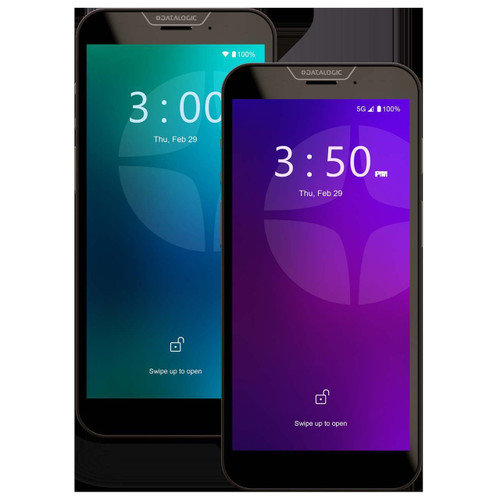
The Datalogic Memor 30 features a 6.0-inch Full HD+ (2160 × 1080) display protected by Corning Gorilla Glass 5, making it well suited to content-heavy tasks such as reading manifests, signing for deliveries, or navigating complex WMS interfaces. Its 1D/2D imager covers a scanning range of 10 cm to 10 m, which handles the majority of standard warehouse pick-and-pack and receiving scenarios.
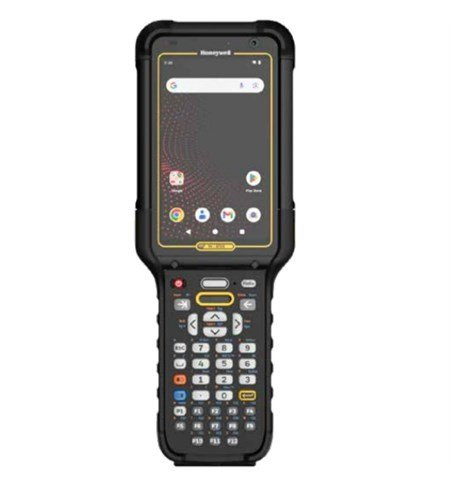
The Honeywell CK67 uses a smaller 4.3-inch (800 × 480) display with Gorilla Glass 7, trading screen real estate for a more compact, pistol-grip-friendly footprint typical of brick-style scanners. Its FlexRange XLR Imager is specified to reach beyond 20 meters, a significant advantage for high-bay racking, dock-door scanning, and any application where the user cannot approach the label. Buyers prioritizing long-range capture should weight this specification heavily.
Does either device support cellular connectivity, and how do their wireless specifications compare?
Cellular capability is a clear differentiator. The Honeywell CK67-X1N-58A1B1G includes 5G Sub-6 GHz and mmWave radios plus a Nano SIM and eSIM slot, enabling fully untethered operation across carrier networks—critical for yard management, cross-dock, or any site where Wi-Fi coverage is incomplete.
The Datalogic Memor 30 specifications provided do not list any WWAN or cellular radio. Both units support Wi-Fi 6E (802.11 a/b/g/n/ac/ax) and Bluetooth 5.2, placing them on equal footing inside a managed wireless LAN. The Memor 30 spec sheet also references an Ethernet interface and USB 3.2 Type-C, while the CK67 spec lists USB connectivity without specifying the generation. For deployments where all scanning occurs within existing Wi-Fi infrastructure, both devices are equivalent on wireless LAN; for mixed or outdoor environments requiring cellular fallback, only the CK67 provides that capability.
How do the battery capacity, drop rating, and operating environment specifications compare?
The Honeywell CK67 carries a 7,000 mAh Li-Ion battery, nearly 50 percent larger than the Memor 30's 4,680 mAh safe-swap pack. The CK67 is rated for multi-shift operation, and its storage temperature envelope extends from -30 °C to 70 °C (-22 °F to 158 °F) with an operating range of -20 °C to 50 °C (-4 °F to 122 °F)—no equivalent thermal specification is provided in the Datalogic Memor 30 specs supplied.
On mechanical ruggedness, both devices carry IP65/IP68 dual ingress ratings. The CK67 is drop-tested to 2.4 m (approximately 8 ft) on concrete. The Memor 30 is rated to MIL-STD-810H and its spec cites a 6 ft (approximately 1.8 m) drop to concrete. Both meet common warehouse drop requirements, but the CK67's 2.4 m rating and the extended cold-storage temperature range give it an edge in freezer warehouse or outdoor yard environments. The Memor 30's safe-swap battery feature—not mentioned in the CK67 specs—allows continuous operation during battery exchange without powering down the device, a meaningful uptime advantage in high-volume operations.
Which should you choose: the 944850001 or the CK67-X1N-58A1B1G?
Our take: The CK67-X1N-58A1B1G is the stronger choice when scanning range beyond 10 meters, 5G cellular connectivity, or extended cold-environment operation are deployment requirements. Its FlexRange XLR Imager reaches 20+ meters versus the Memor 30's 10-meter maximum—a 2× advantage for high-bay or dock-door scenarios. Its 7,000 mAh battery exceeds the Memor 30's 4,680 mAh by approximately 50 percent, and its -20 °C operating floor (with -30 °C storage) is suited to freezer or outdoor yard use where no equivalent Memor 30 thermal spec is provided. Conversely, the Datalogic Memor 30 is the stronger choice for content-intensive workflows benefiting from a 6.0-inch Full HD+ (2160 × 1080) display, for operations where safe-swap battery exchange must occur without device shutdown, and for sites fully covered by Wi-Fi 6E infrastructure where 5G cellular adds no value. Platform and MDM ecosystem compatibility—Honeywell ScanPal versus Datalogic's management suite—should also factor into any existing enterprise deployment.
Side-by-Side Comparison
Spec-for-spec, from manufacturer data.
| Specification | Datalogic 944850001 | Honeywell CK67-X1N-58A1B1G |
|---|---|---|
| Series / Family | Memor 30 | CK67 |
| Processor | Qualcomm QCS4490 Octa-Core 2.4 GHz | Qualcomm QCS4490 Octa-Core 2.0 GHz |
| RAM | 6 / 8 GB | 6 GB |
| Storage | 128 GB UFS Flash | 128 GB Flash |
| Storage Expansion | microSD up to 2 TB | microSD |
| Display | 6.0 in Full HD+ (2160 × 1080), Gorilla Glass 5 | 4.3 in (800 × 480), Gorilla Glass 7 |
| Operating System | Android 13 with GMS | Android with GMS |
| Scan Engine | 1D/2D Imager | FlexRange XLR Imager (1D/2D) |
| Scan Range | 10 cm to 10 m | Up to 20+ meters |
| Wi-Fi | 802.11 a/b/g/n/ac/ax (Wi-Fi 6/6E) | 802.11 a/b/g/n/ac/ax (Wi-Fi 6E) |
| Bluetooth | 5.2 | 5.2 |
| WWAN / Cellular | — | 5G Sub-6 GHz / mmWave |
| SIM | — | Nano SIM + eSIM |
| NFC | Yes | Yes |
| IP Rating | IP65 / IP68 | IP65 / IP68 |
| Drop Rating | 1.8 m / 6 ft to concrete (MIL-STD-810H) | 2.4 m (8 ft) |
| Operating Temperature | — | -20 °C to 50 °C |
| Storage Temperature | — | -30 °C to 70 °C |
| Battery | 4,680 mAh safe-swap with wireless charging | 7,000 mAh Li-Ion |
| Weight | 313 g (0.69 lb) | 516 g (18.2 oz / 1.14 lb) |
| Camera (Rear) | 13 MP | 13 MP |
| Camera (Front) | 8 MP | — |
Frequently Asked Questions
Which should you choose: the 944850001 or the CK67-X1N-58A1B1G?
The CK67-X1N-58A1B1G is the stronger choice when scanning range beyond 10 meters, 5G cellular connectivity, or extended cold-environment operation are deployment requirements. Its FlexRange XLR Imager reaches 20+ meters versus the Memor 30's 10-meter maximum—a 2× advantage for high-bay or dock-door scenarios. Its 7,000 mAh battery exceeds the Memor 30's 4,680 mAh by approximately 50 percent, and its -20 °C operating floor (with -30 °C storage) is suited to freezer or outdoor yard use where no equivalent Memor 30 thermal spec is provided. Conversely, the Datalogic Memor 30 is the stronger choice for content-intensive workflows benefiting from a 6.0-inch Full HD+ (2160 × 1080) display, for operations where safe-swap battery exchange must occur without device shutdown, and for sites fully covered by Wi-Fi 6E infrastructure where 5G cellular adds no value. Platform and MDM ecosystem compatibility—Honeywell ScanPal versus Datalogic's management suite—should also factor into any existing enterprise deployment.
Is the Memor 30 or the CK67 better for scanning items stored in high warehouse racking?
Based on the provided specifications, the Honeywell CK67 is better suited for high-racking environments. Its FlexRange XLR Imager is specified to capture barcodes at distances beyond 20 meters, while the Datalogic Memor 30's imager is specified to a maximum range of 10 meters. If operators must scan labels on upper pallet positions without repositioning, the CK67's range specification is the decisive factor.
Can either device be used in a freezer warehouse or cold-storage environment?
The Honeywell CK67 specifies an operating temperature down to -20 °C and a storage temperature down to -30 °C, which covers most walk-in freezer environments. The Datalogic Memor 30 specifications provided do not include an operating or storage temperature range, so a cold-environment suitability determination cannot be made from the available data. Buyers with cold-storage requirements should request the full Memor 30 environmental specification sheet before purchasing.
Which device is better for workers who need to replace batteries without interrupting their session?
The Datalogic Memor 30 specifies a 'safe-swap' battery design, meaning the battery can be exchanged without powering down the device—a feature that maintains application state and eliminates reboot time during shift changes or mid-shift swaps. The Honeywell CK67 specifications provided do not describe a hot-swap or safe-swap capability for its 7,000 mAh battery. If continuous uptime during battery changes is a requirement, the Memor 30's safe-swap feature is the differentiating specification.
More Mobile Computer Comparisons
- Datalogic 944850001 vs Honeywell CK67-X0N-5EC1C2G
- Datalogic 944850001 vs Honeywell CK67-X1N-58A1A1G
- Datalogic 944850001 vs Honeywell CK67-X1N-58A1C1G
- Datalogic 944850001 vs Datalogic 944950001
- Datalogic 944850001 vs Datalogic 944900004
- Datalogic 944950001 vs Honeywell CK67-X0N-5EC1C2G
Mobile Computer Buying Guides
Get a Second Opinion on Your Camera Choice
Share your site layout, coverage goals, and budget. Our team will validate the camera selection, flag anything we would change, and recommend products that match the use case.