
Vivotek ND9426P vs Hanwha ARD-1610: Specification Comparison
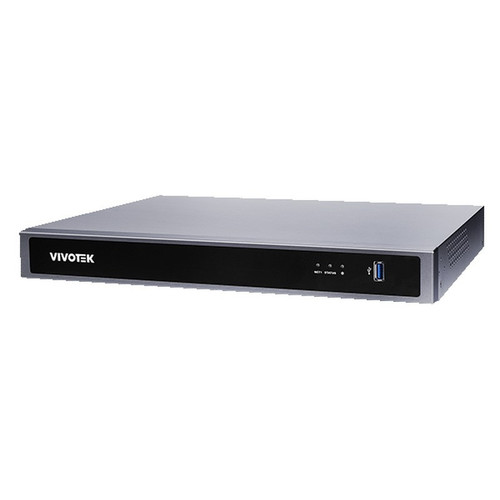
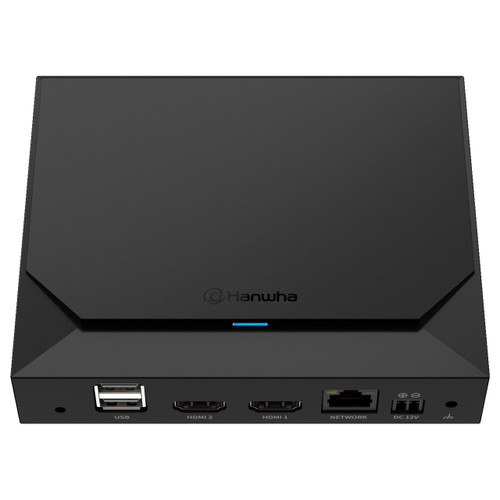
Both the Vivotek ND9426P and the Hanwha ARD-1610 are 16-channel NVRs in a 1U rack form factor, targeting small-to-mid enterprise video surveillance deployments. The ND9426P is a pure-IP PoE+ NVR designed around IP cameras only, while the ARD-1610 is a hybrid recorder accepting analog coaxial inputs (AHD/TVI/CVI/CVBS) plus additional IP channels. Buyers cross-shopping these units are typically weighing a clean IP migration against a hybrid transition that preserves existing analog infrastructure, making channel architecture, recording throughput, and integration ecosystem the defining decision axes.
In This Guide
- How do channel capacity, camera compatibility, and recording throughput compare?
- What are the storage capacity, redundancy options, and power requirements?
- Which unit offers broader analytics, cybersecurity, and software ecosystem integration?
- Which should you choose: the ND9426P or the ARD-1610?
- Side-by-Side Specs
- FAQ
How do channel capacity, camera compatibility, and recording throughput compare?
The ND9426P supports 16 pure-IP channels powered via onboard PoE+ (802.3at), with a recording throughput of 192 Mbps and network input/output totaling 224 Mbps across dual Gigabit Ethernet ports. Hardware H.265/H.264 decoding reaches up to 3840×2160 at 120 fps or 1920×1080 at 480 fps, and the unit accepts ONVIF Profile S cameras for third-party compatibility.
The ARD-1610 accepts 16 analog BNC inputs (AHD/TVI/CVI/CVBS) plus an additional 2 IP channels for a maximum of 18 channels total. IP cameras are supported via ONVIF and Hanwha's SUNAPI protocol. Recording bandwidth is capped at 100 Mbps — roughly half the ND9426P's 192 Mbps ceiling. Analog record rates top out at 5MP @ 12 fps or 2MP @ 15 fps per channel. The ARD-1610 does not provide onboard PoE; analog cameras are powered separately and IP cameras require an external PoE switch.
For pure-IP deployments prioritizing throughput and resolution headroom, the ND9426P's 192 Mbps ceiling and integrated PoE+ distribution represent a meaningful infrastructure advantage. The ARD-1610's value lies in its hybrid analog+IP architecture, making it the only option here for sites retaining coaxial-wired cameras.
What are the storage capacity, redundancy options, and power requirements?
The ND9426P houses two internal 3.5-inch SATA bays and adds RAID 0 and RAID 1 support, providing either capacity doubling or drive-level redundancy. External storage is available via USB 3.0 (front), and scheduled backup to FTP is supported. The unit draws up to 270 W maximum — the majority attributable to PoE+ delivery across 16 ports — and accepts universal 100–240 V AC input.
The ARD-1610 also has two SATA bays and supports drives up to 6 TB each, yielding a maximum raw capacity of 12 TB. No RAID mode is specified in the provided datasheet. The unit is DC-powered (12 V DC input jack) and draws only 40.8 W maximum with dual 6 TB drives installed, making it significantly more power-efficient. No AC-to-DC adapter specification is provided in the supplied data.
If drive redundancy is operationally required, the ND9426P's documented RAID 0/1 is a direct differentiator; the ARD-1610's spec sheet does not list RAID support. Maximum raw capacity is equivalent (12 TB with two 6 TB drives in each unit, per the ARD-1610 spec and ND9426P's two-bay design). Power draw difference — 270 W vs 40.8 W — reflects the ND9426P's integrated PoE+ budget rather than unit inefficiency.
Which unit offers broader analytics, cybersecurity, and software ecosystem integration?
The ND9426P includes onboard smart analytics: object search (people, vehicle), scene search (line crossing, intrusion, loitering), and attribute search covering gender, age, clothing color, accessories, vehicle type, and color. VCA counting, VCA event search, Smart Search II, and Trend Micro IoT Security are all listed as supported. Cybersecurity features include a dedicated Cybersecurity Management module. Compatible software includes Vivotek's Shepherd and VSS (VAST Security Station) VMS platforms, plus mobile apps iViewer, VIVOCloud, and VORTEX (iOS and Android). Web browser access is Chrome only.
The ARD-1610 supports motion detection, tampering, video loss, and face detection as event triggers. Smart search covers virtual line with direction and enter/exit detection. Playback supports up to 18 channels locally and via CMS. The unit integrates with Hanwha's SUNAPI ecosystem, supports ONVIF Profile-S, and offers Wisenet DDNS. Security features include IP address filtering, user access log, 802.1x authentication, recording/transmission/backup encryption, and Hanwha Techwin Root CA device certificates. Compatible management clients include Wisenet Viewer and the Wisenet mobile app (iOS/Android). Web viewer supports Chrome, Edge, and Safari on Windows 10 and macOS 11+.
The ND9426P provides deeper AI-driven analytics (attribute-level people and vehicle search, VCA counting) and named cybersecurity tooling via Trend Micro integration. The ARD-1610 offers stronger authentication and encryption specifications (802.1x, device certificates, multi-layer encryption) and broader web browser compatibility. Each unit is tightly coupled to its own VMS ecosystem — Vivotek VSS vs Hanwha Wisenet — which should be evaluated against any existing platform commitment.
Which should you choose: the ND9426P or the ARD-1610?
Our take: The ND9426P is the stronger choice when deploying a new all-IP camera system requiring high throughput, onboard PoE+, and advanced AI analytics. Its 192 Mbps recording bandwidth outpaces the ARD-1610's 100 Mbps ceiling by nearly 2×, its integrated PoE+ eliminates the need for an external switch for 16 cameras, and RAID 0/1 adds drive-level redundancy not documented on the ARD-1610. The ARD-1610 is the correct selection when the installation must support existing analog coaxial cameras (AHD/TVI/CVI/CVBS) alongside IP sources — a capability the ND9426P lacks entirely — and where low power draw (40.8 W vs 270 W) and Hanwha Wisenet ecosystem alignment are requirements. Buyers standardized on Vivotek VSS or Hanwha Wisenet VMS should treat platform lock-in as the overriding factor before evaluating feature deltas.
Side-by-Side Comparison
Spec-for-spec, from manufacturer data.
| Specification | Vivotek ND9426P | Hanwha ARD-1610 |
|---|---|---|
| Product Type | Pure-IP PoE+ NVR | Hybrid Analog+IP NVR |
| Total Max Channels | 16 IP | 18 (16 analog + 2 IP) |
| Analog Input Support | None | 16× BNC (AHD/TVI/CVI/CVBS) |
| Onboard PoE | PoE+ (802.3at), 16 ports | None |
| Recording Throughput | 192 Mbps | 100 Mbps |
| Video Outputs | HDMI (4K) + VGA | HDMI (4K) + VGA + BNC Spot Out |
| Max Decode Resolution | 7680×2560 | Not specified |
| HDD Bays / Max Capacity | 2× 3.5" SATA / not specified per-drive | 2× SATA / 12 TB (2× 6 TB) |
| RAID Support | RAID 0, 1 | Not specified |
| Alarm Inputs / Outputs | 4 In / 1 Out | 4 In / 1 Out (Relay NO/NC/COM) |
| Audio I/O | 3.5 mm jack In × 1, Out × 1 | 4 Line In (RCA) / 1 Line Out (RCA) |
| AI Analytics | People/vehicle attribute search, VCA counting, scene search | Face detection, virtual line, enter/exit |
| Cybersecurity Features | Trend Micro IoT Security, Cybersecurity Management module | 802.1x, device certificate (Hanwha Root CA), encryption (ID/PW, recording, transmission, backup) |
| Operating Temperature | -10°C to 55°C | 0°C to 40°C |
| Max Power Draw | 270 W | 40.8 W (with 2× 6 TB HDD) |
| Input Voltage | 100–240 V AC, 50/60 Hz | DC 12 V |
Frequently Asked Questions
Which should you choose: the ND9426P or the ARD-1610?
The ND9426P is the stronger choice when deploying a new all-IP camera system requiring high throughput, onboard PoE+, and advanced AI analytics. Its 192 Mbps recording bandwidth outpaces the ARD-1610's 100 Mbps ceiling by nearly 2×, its integrated PoE+ eliminates the need for an external switch for 16 cameras, and RAID 0/1 adds drive-level redundancy not documented on the ARD-1610. The ARD-1610 is the correct selection when the installation must support existing analog coaxial cameras (AHD/TVI/CVI/CVBS) alongside IP sources — a capability the ND9426P lacks entirely — and where low power draw (40.8 W vs 270 W) and Hanwha Wisenet ecosystem alignment are requirements. Buyers standardized on Vivotek VSS or Hanwha Wisenet VMS should treat platform lock-in as the overriding factor before evaluating feature deltas.
Can the ARD-1610 replace analog cameras with IP cameras over time?
Yes. The ARD-1610 supports up to 16 analog BNC inputs (AHD/TVI/CVI/CVBS) and an additional 2 IP channels (maximum 18 total), so a site can run existing analog cameras while adding IP cameras incrementally. The ND9426P does not accept analog BNC inputs at all; it is an IP-only recorder.
Does either NVR include a built-in PoE switch to power cameras?
Only the ND9426P includes integrated PoE+ (802.3at) for all 16 IP camera ports. The ARD-1610 does not provide onboard PoE; analog cameras are powered via coaxial or separate supplies, and any IP cameras added to its 2 IP ports require an external PoE switch or injector.
Which unit supports RAID for drive redundancy?
The ND9426P explicitly supports RAID 0 and RAID 1 across its two internal 3.5-inch HDD bays. The ARD-1610's provided specifications do not list any RAID mode; its dual SATA bays are documented for capacity (up to 12 TB total) but no redundancy mode is stated.
Get a Second Opinion on Your Camera Choice
Share your site layout, coverage goals, and budget. Our team will validate the camera selection, flag anything we would change, and recommend products that match the use case.