
Ubiquiti U7-LR-US vs TP-Link EAP775-WALL: Specification Comparison
Both the Ubiquiti U7-LR-US and the TP-Link EAP775-WALL are Wi-Fi 7 (802.11be) wireless access points targeting enterprise and commercial deployments, making them legitimate cross-shop candidates. The comparison centers on form factor—ceiling-mount long-range versus in-wall plate—alongside differences in spatial streams, power requirements, throughput ratings, and management ecosystems. Buyers evaluating either unit are typically weighing coverage area and density needs against physical installation constraints, so understanding where each product's specifications diverge is critical before committing to a deployment architecture.
In This Guide
- Which access point delivers higher throughput and how many spatial streams does each support?
- Where and how does each unit mount, and what are the power and cabling requirements?
- How are these APs managed, what security standards do they support, and are there compliance or certification differences?
- Which should you choose: the U7-LR-US or the EAP775-WALL?
- Side-by-Side Specs
- FAQ
Which access point delivers higher throughput and how many spatial streams does each support?
The U7-LR-US specifies 5 spatial streams under the Wi-Fi 7 (802.11be) standard, operating across 2.4 GHz and 5 GHz bands. No aggregate throughput figure (in Gbps) is listed in the provided specs for the U7-LR-US, though the antenna gain field references BW160 channel width. The specs do not state a maximum rated speed for this unit.
The EAP775-WALL carries a BE11000 throughput rating at 11 Gbps aggregate across its dual-band (2.4 GHz and 5 GHz) and—implied by the BE11000 designation—tri-band configuration, though the third band is not explicitly broken out in the provided spec fields. Spatial stream count is not stated in the EAP775-WALL specs. The max range is listed as 100 m.
Buyers prioritizing raw throughput will find a concrete number only for the EAP775-WALL (11 Gbps / BE11000). Spatial stream count is documented only for the U7-LR-US (5 streams). Neither figure can be directly compared to the other without the missing counterpart data.
Where and how does each unit mount, and what are the power and cabling requirements?
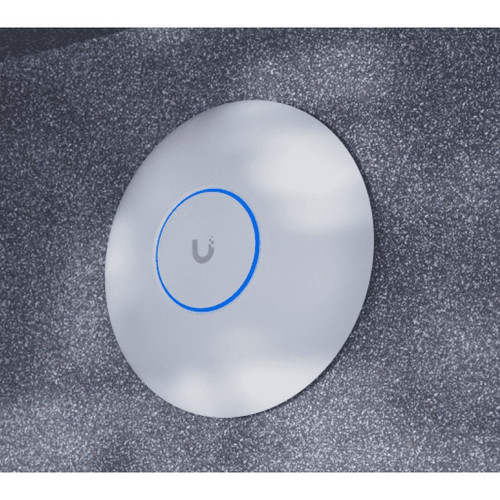
The U7-LR-US is a compact ceiling-mount AP (Ø175.7 × 43 mm) with ceiling and wall mounting options via a plastic mounting plate. It weighs 3.55 lb. It is powered by PoE 802.3af (42.5–57V DC) and draws up to 14W. It provides a single 2.5 GbE RJ45 uplink port—a meaningful cabling advantage for high-density or backhaul-demanding environments. The enclosure is polycarbonate and aluminum alloy.
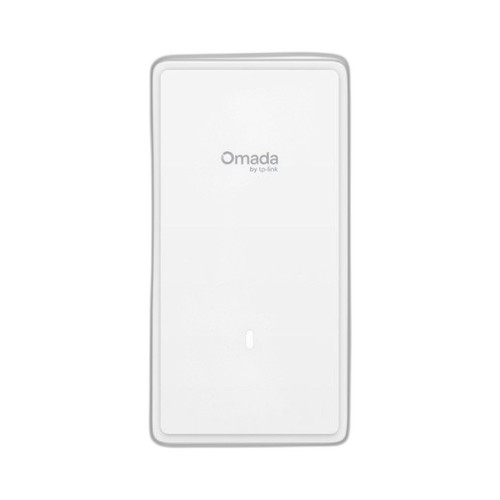
The EAP775-WALL is a wall-plate form factor, designed for in-wall gang-box installation where ceiling mounting is impractical—typical in hospitality corridors, offices, or residential MDU deployments. PoE is confirmed but the specific PoE standard (802.3af/at/bt) and wattage are not stated in the provided specs. Port configuration and uplink speed are also not specified. Weight and physical dimensions are absent from the provided data.
For ceiling-mount infrastructure runs with 2.5 GbE switching already in place, the U7-LR-US is the more precisely specified option. The EAP775-WALL fills a distinct physical niche but lacks power and port detail in the provided specs, which limits pre-deployment planning confidence.
How are these APs managed, what security standards do they support, and are there compliance or certification differences?
The U7-LR-US is managed via Ubiquiti's UniFi controller ecosystem (Management Interface: Ethernet). It is certified CE, FCC, and IC, and is listed as NDAA compliant—a material consideration for U.S. federal, state, or government-adjacent deployments. Country of origin is China. Backward compatibility spans 802.11a/b/g/n/ac/ax/be. No explicit WPA version is listed in the provided specs.
The EAP775-WALL is managed through TP-Link's Omada SDN platform and supports Access Point and Mesh operating modes. WPA3 encryption is explicitly stated. Omada enables centralized cloud or on-premises controller management, which suits multi-site SMB and enterprise deployments already in the Omada ecosystem. NDAA compliance status, country of origin, FCC/CE certification, and backward Wi-Fi compatibility details are not present in the provided specs.
The U7-LR-US has a clear compliance advantage for NDAA-sensitive projects. The EAP775-WALL's explicit WPA3 callout and dual operating modes (AP + Mesh) offer documented security and topology flexibility that the U7-LR-US specs do not explicitly address. Management platform lock-in (UniFi vs. Omada) is likely the primary decision filter for buyers already invested in either ecosystem.
Which should you choose: the U7-LR-US or the EAP775-WALL?
Our take: The U7-LR-US is the stronger choice when ceiling-mount deployment, NDAA compliance, and tight integration with an existing UniFi infrastructure are the primary requirements. It specifies 5 spatial streams—no equivalent figure exists for the EAP775-WALL—a 2.5 GbE uplink port versus no stated uplink speed for the EAP775-WALL, and a defined PoE 802.3af power draw of 14W versus unspecified power requirements for the EAP775-WALL. The EAP775-WALL's BE11000 / 11 Gbps aggregate throughput rating and explicit WPA3 support are advantages the U7-LR-US specs do not counter with equivalent figures. The EAP775-WALL also uniquely suits in-wall gang-box installations where ceiling mounting is physically impractical. Choose the U7-LR-US for ceiling-mount, NDAA-sensitive, UniFi-managed environments; choose the EAP775-WALL for wall-plate deployments within an Omada SDN infrastructure where higher aggregate throughput ratings are a procurement requirement.
Side-by-Side Comparison
Spec-for-spec, from manufacturer data.
| Specification | Ubiquiti U7-LR-US | TP-Link EAP775-WALL |
|---|---|---|
| Wi-Fi Standard | Wi-Fi 7 (802.11be) | Wi-Fi 7 (802.11be) |
| Aggregate Throughput | — | BE11000 / 11 Gbps |
| Spatial Streams | 5 | — |
| Frequency Bands | 2.4 GHz & 5 GHz | 2.4 GHz & 5 GHz |
| Form Factor | Compact ceiling-mount | Wall plate (in-wall gang-box) |
| Dimensions | Ø175.7 × 43 mm (Ø6.9 × 1.7") | — |
| Weight | 3.55 lb | — |
| Uplink Port | 1× 2.5 GbE RJ45 | — |
| PoE Standard | 802.3af (42.5–57V DC) | PoE (standard not specified) |
| Power Consumption | 14W | — |
| Mount Options | Ceiling, Wall | Wall plate |
| Management Platform | UniFi (Ubiquiti) | Omada SDN (TP-Link) |
| Operating Modes | — | Access Point, Mesh |
| Encryption | — | WPA3 |
| Operating Temp | -30 to 50°C (-22 to 122°F) | Industrial (range not specified) |
| NDAA Compliant | Yes | — |
| Certifications | CE, FCC, IC | — |
| Backward Compatibility | 802.11a/b/g/n/ac/ax/be | — |
| Country of Origin | CN | — |
| Max Range | — | 100 m |
Frequently Asked Questions
Which should you choose: the U7-LR-US or the EAP775-WALL?
The U7-LR-US is the stronger choice when ceiling-mount deployment, NDAA compliance, and tight integration with an existing UniFi infrastructure are the primary requirements. It specifies 5 spatial streams—no equivalent figure exists for the EAP775-WALL—a 2.5 GbE uplink port versus no stated uplink speed for the EAP775-WALL, and a defined PoE 802.3af power draw of 14W versus unspecified power requirements for the EAP775-WALL. The EAP775-WALL's BE11000 / 11 Gbps aggregate throughput rating and explicit WPA3 support are advantages the U7-LR-US specs do not counter with equivalent figures. The EAP775-WALL also uniquely suits in-wall gang-box installations where ceiling mounting is physically impractical. Choose the U7-LR-US for ceiling-mount, NDAA-sensitive, UniFi-managed environments; choose the EAP775-WALL for wall-plate deployments within an Omada SDN infrastructure where higher aggregate throughput ratings are a procurement requirement.
Is the U7-LR-US or EAP775-WALL better for larger open-area deployments like warehouses or auditoriums?
Based on available specs, the U7-LR-US is a ceiling-mount form factor with a tagline referencing medium-to-large coverage and 5 documented spatial streams, which generally supports denser multi-client environments. The EAP775-WALL is a wall-plate design optimized for corridor or room-edge placement rather than open-area overhead coverage. The EAP775-WALL's 100 m max range is stated, but no equivalent range figure is provided for the U7-LR-US. For large open areas, the ceiling-mount orientation of the U7-LR-US is typically the more appropriate form factor.
Can either access point be powered by a standard PoE switch, and do they require a PoE+ or PoE++ injector?
The U7-LR-US specifies PoE 802.3af (up to 13W budget per the spec, 14W consumption noted), meaning a standard 802.3af-capable switch port or injector is sufficient—no PoE+ (802.3at) or PoE++ (802.3bt) requirement is indicated. The EAP775-WALL confirms PoE support but does not specify the PoE standard (802.3af/at/bt) or wattage in the provided specs, so buyers should consult the full datasheet before selecting switch infrastructure to avoid under-powering the unit.
Does either access point require a separate controller, and which is easier to manage without a dedicated server?
The U7-LR-US uses Ubiquiti's UniFi management platform (controller-based). Ubiquiti offers both cloud-hosted and self-hosted controller options, but the provided specs do not confirm standalone mode availability. The EAP775-WALL uses TP-Link's Omada SDN, which also supports cloud-based, hardware-controller, and software-controller management, plus a Mesh operating mode noted in the specs. Neither unit's specs explicitly confirm or deny a standalone/controller-free mode, so buyers should verify controller requirements directly with each manufacturer's documentation before assuming either can operate fully independently.
Get a Second Opinion on Your Camera Choice
Share your site layout, coverage goals, and budget. Our team will validate the camera selection, flag anything we would change, and recommend products that match the use case.