
Speco Technologies O4KT1 vs Speco Technologies O4TDD2: Specification Comparison
Both the Speco Technologies O4KT1 and O4TDD2 are 4MP fixed-lens IP turret cameras designed for outdoor surveillance, making them direct cross-shop candidates for installers evaluating Speco's mid-range line. The O4KT1 is a straightforward IP67-rated turret with built-in mic and 98 ft IR, while the O4TDD2 adds AI-based object analytics, extended 164 ft IR, and a wider compression suite. This comparison covers imaging performance, installation requirements, and VMS/analytics integration to help buyers match the right model to their deployment.
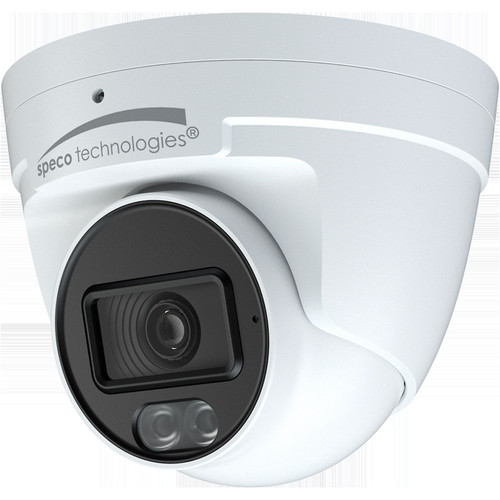
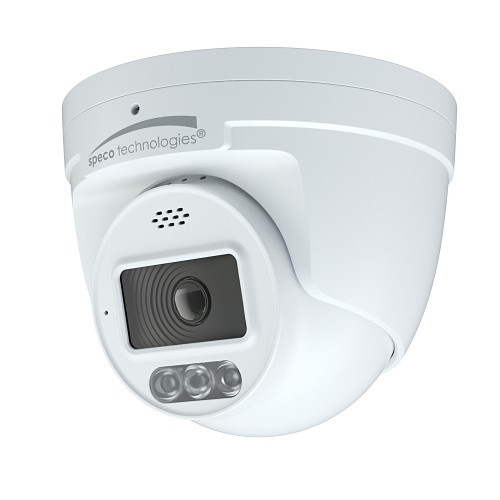
In This Guide
How do the imaging specs compare?
Both cameras share a 1/3" CMOS sensor and a 2.8 mm fixed lens, but they differ at the pixel level and in frame rate. The O4KT1 resolves at 2560×1440 (4MP) and tops out at 20 fps, while the O4TDD2 steps up to 2592×1520 (also marketed as 4MP) and delivers 30 fps — a 50% increase in frame rate that benefits motion-heavy scenes such as entrances or vehicle lanes. Both support WDR, though the O4TDD2 spec sheet labels it "True WDR" without a published dB figure for either model.
IR performance separates the two more significantly. The O4KT1 is rated to 98 ft with a minimum illumination of 0.005 lux at F1.6 (AGC ON) and 0 lux with IR active. The O4TDD2 extends IR coverage to 164 ft — a 67% increase — but no minimum illumination figure is provided in the supplied specs, so a direct lux-to-lux comparison cannot be made. Buyers prioritizing documented low-light sensitivity should note this gap in O4TDD2 published data.
What about installation and environment?
The O4KT1 carries an IP67 rating (dust-tight, immersion-resistant to 1 m), while the O4TDD2 is rated IP66 (dust-tight, high-pressure water jet resistant but not immersion-rated). For most outdoor wall and ceiling installations the difference is minor, but in wash-down environments or locations prone to standing water, IP67 provides an additional margin. The O4TDD2 specifies an operating temperature range of -40°F to 140°F; no operating temperature range is published for the O4KT1 in the supplied specs.
Both cameras are PoE-powered via 802.3af and accept DC 12V, drawing under 13 W, so either fits a standard PoE switch port without a PoE+ upgrade. The O4KT1 lists Wall, Ceiling, Pole, and Corner mount types. No mount-type list is provided for the O4TDD2 in the supplied specs. The O4TDD2 weighs 1.48 lbs; weight is not specified for the O4KT1. Neither model lists an IK impact rating in the provided specifications.
Which fits your VMS and analytics better?
The O4KT1 declares ONVIF compliance (profile not specified in supplied specs) and lists RTSP and HTTPS alongside ONVIF for VMS connectivity. It includes on-board microSD storage up to 256 GB, a built-in microphone with a dedicated audio input, and cybersecurity features including user ID/password, IP/MAC filtering, 802.1X, and digest authentication. Edge analytics are not listed for the O4KT1 beyond standard motion detection implied by its VMS compatibility notes.
The O4TDD2 is certified to ONVIF Profile G, which adds on-board recording and playback interoperability — a meaningful distinction for recorderless or hybrid deployments. Its AI analytics suite covers Motion Detection, Line Crossing, Intrusion Detection, Face Detection, and Vehicle Detection, making it suited for access-control overlays and perimeter tripwire rules without a separate analytics server. The O4TDD2 also includes a built-in speaker in addition to a microphone, enabling two-way audio. On-board edge storage capacity and specific cybersecurity feature details are not provided in the O4TDD2 supplied specs. Compression on the O4TDD2 extends to H.265+, H.264+, and MJPEG versus the O4KT1's H.265 and H.264, with the "+" variants offering additional bitrate reduction through predictive encoding.
Which should you choose: the O4KT1 or the O4TDD2?
Our take: The O4TDD2 is the stronger choice when the deployment requires AI-based object classification, longer IR coverage, or ONVIF Profile G edge recording. Its AI analytics suite — Line Crossing, Intrusion Detection, Face Detection, and Vehicle Detection — eliminates the need for a separate analytics engine, its IR reaches 164 ft versus the O4KT1's 98 ft (a 67% increase), and its 30 fps capture rate versus 20 fps better handles moving subjects. Conversely, the O4KT1 holds the edge in published environmental protection (IP67 vs. IP66), specifies 256 GB on-board microSD storage where the O4TDD2 does not publish an edge-storage capacity, and includes documented low-light sensitivity (0.005 lux). Its 5-year warranty also exceeds the O4TDD2's 3-year coverage. Choose the O4KT1 for cost-sensitive fixed scenes where documented storage capacity, IP67 sealing, and warranty length matter; specify the O4TDD2 where AI perimeter analytics, extended IR throw, or ONVIF Profile G compatibility drive the requirement.
Side-by-Side Comparison
Spec-for-spec, from manufacturer data.
| Specification | Speco Technologies O4KT1 | Speco Technologies O4TDD2 |
|---|---|---|
| Resolution | 2560×1440 (4MP) | 2592×1520 (4MP) |
| Image Sensor | 1/3" CMOS | 1/3" CMOS |
| Lens / Focal Length | 2.8 mm fixed | 2.8 mm fixed |
| Min Illumination | 0.005 lux @ F1.6 (AGC ON); 0 lux (IR on) | — |
| IR Range | 98 ft | 164 ft |
| WDR | WDR | True WDR |
| Max Frame Rate | 20 fps | 30 fps |
| Video Compression | H.265, H.264 | H.265+, H.264+, MJPEG |
| IP Rating | IP67 | IP66 |
| Operating Temperature | — | -40°F to 140°F |
| Power Input / PoE Class | PoE 802.3af, DC 12V (<13W) | PoE 802.3af, DC 12V (12.0W) |
| Edge Storage | microSD up to 256 GB | — |
| Audio | Built-in mic, audio input | Microphone, speaker (two-way) |
| ONVIF | ONVIF (profile not specified) | ONVIF Profile G |
| AI / Edge Analytics | — | Motion Detection, Line Crossing, Intrusion Detection, Face Detection, Vehicle Detection |
| Weight | — | 1.48 lbs |
| Warranty | 5 years | 3 years |
Frequently Asked Questions
Which should you choose: the O4KT1 or the O4TDD2?
The O4TDD2 is the stronger choice when the deployment requires AI-based object classification, longer IR coverage, or ONVIF Profile G edge recording. Its AI analytics suite — Line Crossing, Intrusion Detection, Face Detection, and Vehicle Detection — eliminates the need for a separate analytics engine, its IR reaches 164 ft versus the O4KT1's 98 ft (a 67% increase), and its 30 fps capture rate versus 20 fps better handles moving subjects. Conversely, the O4KT1 holds the edge in published environmental protection (IP67 vs. IP66), specifies 256 GB on-board microSD storage where the O4TDD2 does not publish an edge-storage capacity, and includes documented low-light sensitivity (0.005 lux). Its 5-year warranty also exceeds the O4TDD2's 3-year coverage. Choose the O4KT1 for cost-sensitive fixed scenes where documented storage capacity, IP67 sealing, and warranty length matter; specify the O4TDD2 where AI perimeter analytics, extended IR throw, or ONVIF Profile G compatibility drive the requirement.
Is the O4KT1 or O4TDD2 better for low-light performance?
The O4KT1 publishes a minimum illumination of 0.005 lux at F1.6 (AGC ON) and 0 lux with IR active. The O4TDD2 does not provide a minimum illumination figure in the supplied specifications, so a direct comparison cannot be made. The O4TDD2 does offer a longer IR range — 164 ft versus 98 ft — which extends detection distance in zero-light conditions, but buyers who require a documented lux rating should note that only the O4KT1 supplies one.
Can either camera record locally without an NVR?
The O4KT1 supports microSD cards up to 256 GB for on-board edge storage. The O4TDD2 is certified to ONVIF Profile G, which standardizes on-camera recording and retrieval, but its maximum edge-storage capacity is not stated in the supplied specifications. If confirmed microSD capacity is a requirement, the O4KT1 is the only model with a published figure.
Does either camera support two-way audio?
The O4TDD2 lists both a microphone and a speaker, indicating two-way audio capability. The O4KT1 lists a built-in microphone and an audio input but does not list a built-in speaker in the supplied specifications, so two-way audio cannot be confirmed for the O4KT1 based on available data.
More IP Camera Comparisons
Get a Second Opinion on Your Camera Choice
Share your site layout, coverage goals, and budget. Our team will validate the camera selection, flag anything we would change, and recommend products that match the use case.