
Speco Technologies O4FT1M vs Speco Technologies O4TDD2: Specification Comparison
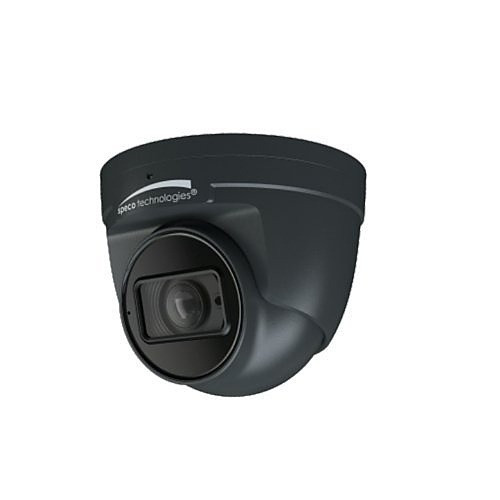
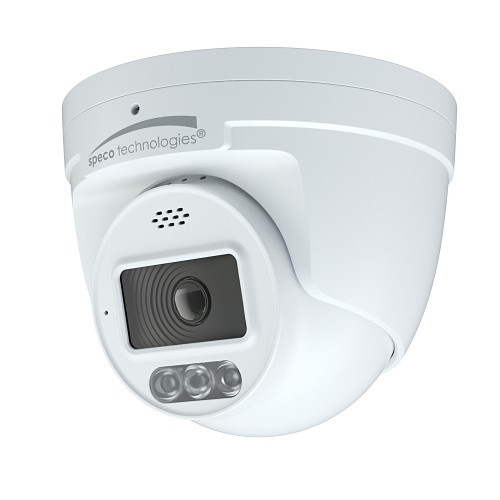
Both the Speco Technologies O4FT1M and O4TDD2 are 4MP outdoor IP turret cameras powered via PoE or DC 12V, targeting commercial surveillance installations where AI-driven edge analytics and H.265+ compression are required. The O4FT1M adds a motorized varifocal lens and a larger 1/1.8" sensor under the Flexible Intensifier branding, while the O4TDD2 pairs a fixed 2.8mm lens with a dedicated IR illuminator reaching 164 ft. This comparison examines imaging capability, installation fit, and VMS integration to help integrators select the right unit for a given deployment.
In This Guide
How do the imaging specs compare?
The O4FT1M uses a 1/1.8" CMOS sensor and records at up to 2576×1452 (approximately 3.74MP active pixels at that resolution), while the O4TDD2 uses a smaller 1/3" CMOS sensor and records at 2592×1520 (approximately 3.94MP). Both are rated 4MP and deliver 30fps; the O4TDD2's pixel count is marginally higher, but the O4FT1M's physically larger sensor collects more light per pixel, which is the primary low-light advantage of the Flexible Intensifier platform. Neither spec sheet provides a minimum illumination figure in lux for either model, so a direct low-light lux comparison cannot be made from the provided data.
On optics, the O4FT1M carries a motorized 2.8–12mm varifocal lens, enabling remote focus adjustment and scene-framing flexibility without physical access to the camera. The O4TDD2 uses a fixed 2.8mm lens, which provides a wide field of view but no remote zoom capability. For IR night vision, the O4TDD2 specifies a 164 ft (50m) IR range; the O4FT1M lists no dedicated IR distance in the provided specifications, referencing instead its Flexible Intensifier and True WDR capabilities. Both cameras include True WDR.
What about installation and environment?
The O4FT1M carries an IP67 ingress rating, meaning it is fully dust-tight and withstands temporary immersion in up to 1 meter of water. The O4TDD2 is rated IP66, which is fully dust-tight and protected against powerful water jets but does not cover immersion. Both units operate across an identical -40°F to 140°F temperature range, suiting harsh outdoor deployments in either extreme cold or heat.
Power consumption differs meaningfully: the O4FT1M draws 7.0W, comfortably within IEEE 802.3af PoE (15.4W budget), while the O4TDD2 draws 12.0W, also within 802.3af per the provided specs (listed as <13W). Neither specifies PoE class explicitly. The O4FT1M weighs 1.45 lbs versus the O4TDD2 at 1.48 lbs—effectively identical for mounting purposes. No IK impact ratings are provided for either model.
Which fits your VMS and analytics better?
The O4FT1M declares ONVIF Profile T compliance, which covers streaming, PTZ control, and metadata—including analytics event notifications—making it the stronger choice for VMS platforms that leverage Profile T metadata streams. The O4TDD2 declares ONVIF Profile G compliance, which adds on-board recording and edge storage playback to the baseline streaming profile. Neither spec sheet lists Profile S, and no SD card or edge storage specification is provided for the O4FT1M; Profile G on the O4TDD2 implies edge storage capability but no capacity or slot details are given in the supplied data.
Both cameras share the same five AI analytics engines as specified: motion detection, line crossing, intrusion detection, face detection, and vehicle detection. On audio, the O4TDD2 includes both a microphone and a built-in speaker, enabling two-way audio or automated audio response; the O4FT1M lists only a microphone, providing listen-only audio. Integrators requiring on-site voice-down or audio deterrence must account for this difference.
Which should you choose: the O4FT1M or the O4TDD2?
Our take: The O4FT1M is the stronger choice when scene coverage must be adjusted remotely or when maximizing low-light sensitivity matters more than a dedicated IR throw distance. Its motorized 2.8–12mm varifocal lens eliminates physical re-aiming after install—a concrete labor advantage the fixed-lens O4TDD2 cannot match. Its 1/1.8" sensor is meaningfully larger than the O4TDD2's 1/3" sensor, offering greater light-gathering area per pixel. It also draws 7.0W versus the O4TDD2's 12.0W, reducing PoE switch budget consumption and heat load. Conversely, the O4TDD2 is the correct selection when a specified 164 ft IR range is required, when two-way audio (built-in speaker) is part of the design, when ONVIF Profile G edge-recording is a VMS dependency, or when budget favors a fixed-lens unit. Both carry identical IP67/IP66 outdoor ratings, temperature ranges, analytics sets, and 3-year warranties.
Side-by-Side Comparison
Spec-for-spec, from manufacturer data.
| Specification | Speco Technologies O4FT1M | Speco Technologies O4TDD2 |
|---|---|---|
| Resolution | 4MP (2576×1452) | 4MP (2592×1520) |
| Image Sensor | 1/1.8" CMOS | 1/3" CMOS |
| Lens / Focal Length | Motorized varifocal 2.8–12mm | Fixed 2.8mm |
| IR Range | — | 164 ft (50m) |
| True WDR | Yes | Yes |
| Max Frame Rate | 30fps | 30fps |
| Video Compression | H.265+, H.264+, MJPEG | H.265+, H.264+, MJPEG |
| IP Rating | IP67 | IP66 |
| Operating Temperature | -40°F to 140°F | -40°F to 140°F |
| Power Input | PoE, DC 12V | PoE, DC 12V |
| Power Consumption | 7.0W | 12.0W |
| ONVIF Profile | Profile T | Profile G |
| Edge Analytics | Motion Detection, Line Crossing, Intrusion, Face, Vehicle | Motion Detection, Line Crossing, Intrusion, Face, Vehicle |
| Audio | Microphone only | Microphone + Speaker |
| Weight | 1.45 lbs | 1.48 lbs |
| Warranty | 3-year | 3-year |
Frequently Asked Questions
Which should you choose: the O4FT1M or the O4TDD2?
The O4FT1M is the stronger choice when scene coverage must be adjusted remotely or when maximizing low-light sensitivity matters more than a dedicated IR throw distance. Its motorized 2.8–12mm varifocal lens eliminates physical re-aiming after install—a concrete labor advantage the fixed-lens O4TDD2 cannot match. Its 1/1.8" sensor is meaningfully larger than the O4TDD2's 1/3" sensor, offering greater light-gathering area per pixel. It also draws 7.0W versus the O4TDD2's 12.0W, reducing PoE switch budget consumption and heat load. Conversely, the O4TDD2 is the correct selection when a specified 164 ft IR range is required, when two-way audio (built-in speaker) is part of the design, when ONVIF Profile G edge-recording is a VMS dependency, or when budget favors a fixed-lens unit. Both carry identical IP67/IP66 outdoor ratings, temperature ranges, analytics sets, and 3-year warranties.
Is the O4FT1M or O4TDD2 better for low-light performance?
Based on the provided specifications, the O4FT1M uses a larger 1/1.8" CMOS sensor compared to the O4TDD2's 1/3" CMOS sensor. A larger sensor generally collects more light per pixel, which benefits low-light image quality. The O4TDD2 compensates with a specified 164 ft IR illuminator range. Neither spec sheet provides a minimum illumination figure in lux, so a precise lux-based comparison cannot be made from the available data. For environments relying on IR illumination, the O4TDD2's documented IR range is an advantage; for ambient low-light scenes, the O4FT1M's larger sensor is the specified differentiator.
Can I adjust the field of view on these cameras without climbing a ladder?
Only the O4FT1M supports remote field-of-view adjustment. Its motorized 2.8–12mm varifocal lens allows focus and zoom to be set electronically after physical mounting. The O4TDD2 uses a fixed 2.8mm lens; once installed, the field of view is fixed and cannot be adjusted without physically replacing the lens or repositioning the camera.
Which camera supports two-way audio for voice-down or audio deterrence?
The O4TDD2 includes both a microphone and a built-in speaker per the provided specifications, enabling two-way audio. The O4FT1M lists only a microphone, supporting audio capture but not audio output from the camera itself. If your deployment requires on-site announcements, automated audio responses, or operator voice-down, the O4TDD2 is the specified choice.
More IP Camera Comparisons
Get a Second Opinion on Your Camera Choice
Share your site layout, coverage goals, and budget. Our team will validate the camera selection, flag anything we would change, and recommend products that match the use case.