
Speco Technologies N32NRN80TB vs Speco Technologies N32NRN20TB: Specification Comparison
Both the Speco Technologies N32NRN80TB and N32NRN20TB are 32-channel 4K H.265 NVRs in the same rackmount form factor, targeting mid-to-large IP camera deployments requiring simultaneous full-resolution recording. They share the same channel capacity, codec support, physical chassis dimensions, power supply, frame rate, and NDAA compliance. The sole differentiating specification is internal storage capacity — 80TB versus 20TB — making this a straightforward capacity-tier decision within a single product line rather than a feature-set comparison.
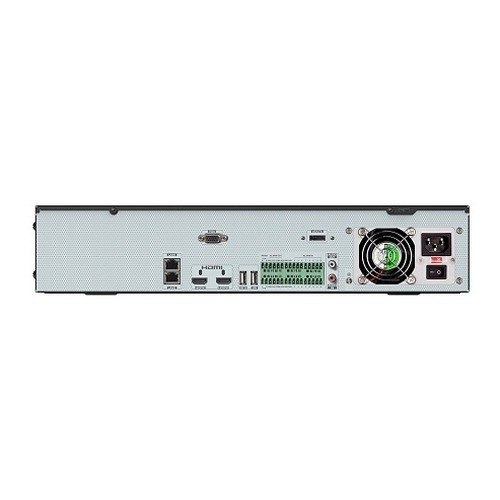
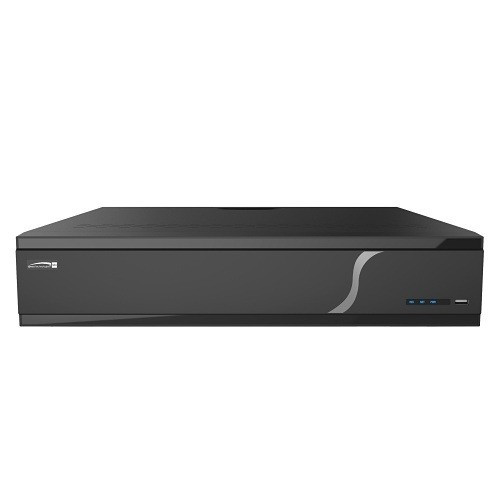
In This Guide
- How much onboard storage do you actually get, and what does that mean for retention?
- Do both units record all 32 channels simultaneously at full 4K resolution with the same codec support?
- Are the connectivity, compliance, and camera integration capabilities identical across both models?
- Which should you choose: the N32NRN80TB or the N32NRN20TB?
- Side-by-Side Specs
- FAQ
How much onboard storage do you actually get, and what does that mean for retention?
The N32NRN80TB ships with 80TB of internal storage. The N32NRN20TB ships with 20TB of internal storage. That is a 4× difference in raw capacity. At standard surveillance bitrates for 32 channels of 4K H.265 video, the 80TB unit can sustain proportionally longer continuous retention — roughly four times the recording window of the 20TB unit under identical camera and quality settings. Both units use a Serial ATA interface internally. Neither spec sheet discloses the number of drive bays, maximum bay count, or whether the units are field-expandable via external storage; buyers requiring expansion beyond rated internal capacity should confirm with Speco directly before specifying. The N32NRN20TB spec notes an estimated 7–14 days retention at standard rates, which provides a practical baseline for calculating whether 20TB or 80TB fits a given retention policy.
Do both units record all 32 channels simultaneously at full 4K resolution with the same codec support?
Yes — both units are specified for simultaneous 32-channel recording at 4K resolution. The N32NRN80TB lists 4K (UHD) native and 12MP resolution. The N32NRN20TB lists 4K (8MP) per channel and also 12MP resolution; note that 4K UHD equates to 8MP (3840×2160), so these descriptors are consistent. Both support H.265 and H.264 compression. The N32NRN20TB additionally lists MJPEG in its codec set; the N32NRN80TB spec does not explicitly mention MJPEG — this may reflect a spec omission rather than a hardware difference, but it cannot be confirmed from the provided data. Both units record at 20fps. H.265 is cited by both as delivering approximately 50% bandwidth and storage savings versus H.264, which directly amplifies the effective capacity of each unit's storage tier.
Are the connectivity, compliance, and camera integration capabilities identical across both models?
Both units are NDAA Section 889 compliant, ONVIF-compatible (the N32NRN20TB explicitly states ONVIF Profile S & T), support two-way audio, PoE (802.3af), and include Speco's auto-discovery for Speco IP cameras. Both share identical physical dimensions (15" W × 2.83" H × 13.4" D), gross weight (12 lbs.), power supply (12VDC, 5A), and a white rackmount housing in a 19-inch 2U form factor. The N32NRN20TB explicitly lists Gigabit Ethernet network connectivity; the N32NRN80TB spec does not call this out separately, though it is not listed as absent. Both share the same bundle ID set (21279, 21287, 7004, 21286), indicating identical accessory and FBT pairings in the catalog. No software platform, remote management application, or NVR firmware version differences are disclosed in either spec.
Which should you choose: the N32NRN80TB or the N32NRN20TB?
Our take: The N32NRN80TB is the stronger choice when retention depth is the primary deployment requirement. The single concrete differentiator between these two models is internal storage: 80TB versus 20TB — a 4× capacity advantage that translates directly into a proportionally longer recording window at identical camera counts, resolutions, and bitrates. Both units record 32 channels simultaneously at 4K with H.265 at 20fps, share the same physical chassis, power draw, ONVIF compatibility, NDAA compliance, and 3-year warranty. The N32NRN20TB is the appropriate specification for sites where a 7–14 day retention window is sufficient and minimizing upfront hardware cost or rack weight is a priority. The N32NRN80TB is indicated for deployments with extended retention mandates — 30-day, 60-day, or longer — or high-density camera environments where per-channel bitrates are elevated. Neither unit's spec discloses expandability, so buyers should treat rated internal capacity as the ceiling.
Side-by-Side Comparison
Spec-for-spec, from manufacturer data.
| Specification | Speco Technologies N32NRN80TB | Speco Technologies N32NRN20TB |
|---|---|---|
| Channel Capacity | 32 channels | 32 channels |
| Simultaneous 4K Recording | Yes — all 32 channels | Yes — all 32 channels |
| Internal Storage | 80TB | 20TB |
| Video Resolution (per channel) | 4K (UHD) / 12MP | 4K (8MP) / 12MP |
| Frame Rate | 20fps | 20fps |
| Primary Codec | H.265 | H.265 |
| Additional Codecs | H.264 (MJPEG not listed) | H.264, MJPEG |
| ONVIF | Yes | Profile S & T |
| Network Connectivity | — | Gigabit Ethernet |
| PoE Standard | 802.3af | 802.3af |
| Audio | Two-way | Two-way |
| NDAA Compliance | Yes | Section 889 |
| Form Factor | 19" Rackmount | 19" Rackmount |
| Dimensions (W × H × D) | 15" × 2.83" × 13.4" | 15" × 2.83" × 13.4" |
| Gross Weight | 12 lbs. | 12 lbs. |
| Warranty | 3 years | 3 years |
Frequently Asked Questions
Which should you choose: the N32NRN80TB or the N32NRN20TB?
The N32NRN80TB is the stronger choice when retention depth is the primary deployment requirement. The single concrete differentiator between these two models is internal storage: 80TB versus 20TB — a 4× capacity advantage that translates directly into a proportionally longer recording window at identical camera counts, resolutions, and bitrates. Both units record 32 channels simultaneously at 4K with H.265 at 20fps, share the same physical chassis, power draw, ONVIF compatibility, NDAA compliance, and 3-year warranty. The N32NRN20TB is the appropriate specification for sites where a 7–14 day retention window is sufficient and minimizing upfront hardware cost or rack weight is a priority. The N32NRN80TB is indicated for deployments with extended retention mandates — 30-day, 60-day, or longer — or high-density camera environments where per-channel bitrates are elevated. Neither unit's spec discloses expandability, so buyers should treat rated internal capacity as the ceiling.
Is the N32NRN80TB or N32NRN20TB better for larger deployments needing long retention?
The N32NRN80TB is better suited for larger or longer-retention deployments. Its 80TB of internal storage provides four times the recording capacity of the N32NRN20TB's 20TB. Both units handle the same 32 channels at 4K simultaneously, so the decision comes down to how many days of footage must be retained on-device. If your retention policy exceeds the 7–14 day estimate associated with 20TB at standard 4K bitrates, the 80TB model is the appropriate choice.
Are the N32NRN80TB and N32NRN20TB compatible with the same cameras and accessories?
Yes, based on the provided specifications. Both units share identical ONVIF compatibility, Speco IP camera auto-discovery, PoE (802.3af) support, two-way audio, and the same bundle ID set — indicating the same recommended accessory pairings. Both are NDAA Section 889 compliant. No camera compatibility differences are disclosed between the two models.
Do the N32NRN80TB and N32NRN20TB have the same physical footprint and power requirements?
Yes. Both units have identical dimensions (15" W × 2.83" H × 13.4" D), identical gross weight (12 lbs.), and the same power supply specification (12VDC, 5A). Both mount in a standard 19-inch rack. There are no disclosed differences in physical installation requirements between the two models — the only difference is the internal storage capacity.
Get a Second Opinion on Your Camera Choice
Share your site layout, coverage goals, and budget. Our team will validate the camera selection, flag anything we would change, and recommend products that match the use case.