
Speco Technologies N32NRN48TB vs Speco Technologies N32NRN20TB: Specification Comparison
Both the N32NRN48TB and N32NRN20TB are Speco Technologies 32-channel 4K NVRs sharing the same physical chassis, power supply, codec support, and compliance posture. The sole purchasing decision pivots on one axis: integrated storage capacity. The N32NRN48TB ships with 48TB of built-in HDD, while the N32NRN20TB ships with 20TB. This comparison examines how that 2.4× storage delta affects retention depth, deployment suitability, and total-cost-of-ownership for integrators and IT buyers selecting a recorder for a 32-camera 4K installation.
In This Guide
- How much footage can each NVR store, and what retention depth does that deliver at 32 channels of 4K?
- Are the two NVRs physically identical in form factor, power draw, and mounting requirements?
- Do the two models differ in camera compatibility, codec support, compliance certifications, or network integration?
- Which should you choose: the N32NRN48TB or the N32NRN20TB?
- Side-by-Side Specs
- FAQ
How much footage can each NVR store, and what retention depth does that deliver at 32 channels of 4K?
The N32NRN48TB ships with 48TB of integrated HDD storage. The N32NRN20TB ships with 20TB of integrated HDD storage. That is a 28TB difference — 2.4× more raw capacity on the 48TB model.
Both units record at 4K (8MP per channel per the N32NRN20TB spec; 4K UHD 3840×2160 per the N32NRN48TB spec) across all 32 channels simultaneously at up to 20fps, using H.265 compression. H.265 is cited by both products as reducing storage requirements roughly 50% versus H.264.
The N32NRN20TB product sheet explicitly states 7–14 days retention at standard recording rates. No equivalent retention estimate appears in the N32NRN48TB spec sheet; integrators should calculate retention using their own bitrate assumptions. At a fixed bitrate, the 48TB model extends retention proportionally — approximately 2.4× the duration of the 20TB model under identical camera and quality settings.
Neither spec sheet discloses the number of drive bays, maximum raw storage ceiling, or whether additional drives can be added post-deployment. Buyers requiring storage expansion beyond the factory-installed capacity should verify bay count and maximum supported HDD size with Speco directly before specifying either model.
Are the two NVRs physically identical in form factor, power draw, and mounting requirements?
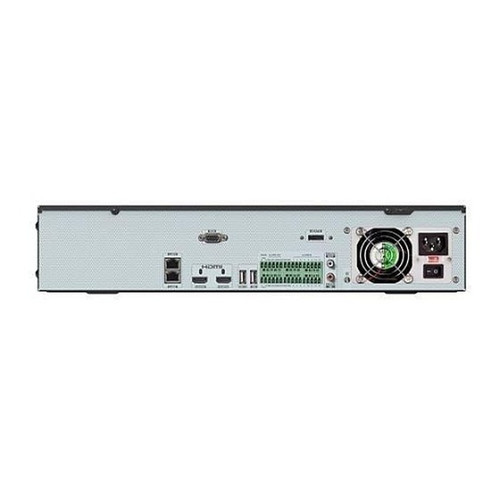
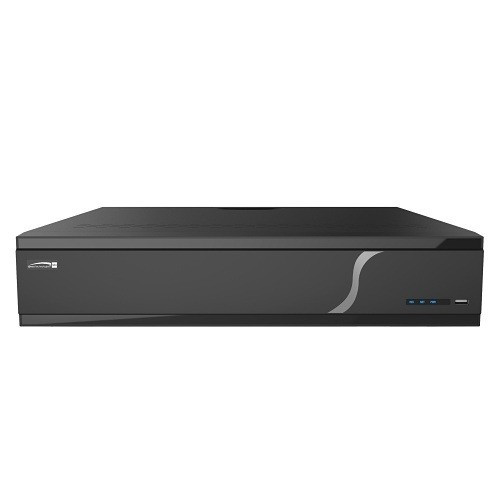
Both models share identical published dimensions: 15" (W) × 2.83" (H) × 13.4" (D), a 1U rack-mount form factor. Both are specified with a white housing and rack mount type.
Gross weight is listed as 12 lbs. for both models. Note that the N32NRN48TB carries 28TB more HDD mass than the N32NRN20TB; if both gross weights are accurate as published, this either reflects rounding or the difference is absorbed within the same stated weight. Installers should confirm actual shipping weights before rack-load planning.
Both units specify the same power supply: 12VDC, 5A. No idle or maximum power consumption figure is provided in either spec sheet. The storage interface is Serial ATA on both.
Rack rail compatibility, depth clearance requirements beyond the stated 13.4", and thermal/ventilation specifications are not disclosed in either product's spec data.
Do the two models differ in camera compatibility, codec support, compliance certifications, or network integration?
Both NVRs are NDAA Section 889 compliant. The N32NRN20TB spec sheet explicitly cites 'NDAA Section 889 compliant'; the N32NRN48TB spec sheet states 'NDAA compliant.' Both carry the same NDAA-flag treatment for government and federally funded deployments.
ONVIF compatibility is present on both. The N32NRN20TB spec additionally specifies ONVIF Profile S & T and Gigabit Ethernet network connectivity. The N32NRN48TB spec sheet does not enumerate ONVIF profiles or specify network port speed; those details are not confirmed from the provided data.
Codec support: the N32NRN20TB spec lists H.265, H.264, and MJPEG. The N32NRN48TB spec lists H.265 and H.264 from the compression field; MJPEG support is not confirmed in the provided spec data for the 48TB model.
Both units support two-way audio, PoE (802.3af) camera-side connectivity, IR low-light camera integration, and are described as capable of quickly discovering and installing Speco IP cameras. Frame rate ceiling is 20fps on both. Maximum resolution is listed as 12MP in the shared spec fields and 4K UHD / 4K 8MP in the marketing fields — consistent across both models.
No VMS software version, mobile app name, remote access protocol details, or cybersecurity hardening specifications are provided in either product's spec data.
Which should you choose: the N32NRN48TB or the N32NRN20TB?
Our take: The N32NRN48TB is the stronger choice when retention depth is the primary constraint — specifically for deployments where 7–14 days of 4K footage across 32 cameras is insufficient. The 48TB model delivers 28TB more integrated storage (2.4× the capacity of the 20TB model), directly extending retention under identical camera counts, resolutions, and bitrate settings without adding external storage or additional hardware. Both units are physically identical at 1U rack-mount, share the same 12VDC 5A power supply, and carry equivalent NDAA compliance and ONVIF compatibility. The N32NRN20TB holds a specification advantage on two documented points: confirmed ONVIF Profile S & T support and MJPEG codec availability — neither of which is confirmed in the N32NRN48TB spec data. For installations requiring 30+ day retention, high-security sites with extended evidence-hold mandates, or any 32-camera 4K deployment where re-recording frequency is operationally problematic, specify the N32NRN48TB. For cost-sensitive installations where 7–14 day retention satisfies policy requirements, the N32NRN20TB achieves the same channel count and resolution at lower storage overhead.
Side-by-Side Comparison
Spec-for-spec, from manufacturer data.
| Specification | Speco Technologies N32NRN48TB | Speco Technologies N32NRN20TB |
|---|---|---|
| SKU | N32NRN48TB | N32NRN20TB |
| Channel Capacity | 32 IP cameras | 32 channels simultaneous 4K |
| Integrated Storage | 48TB HDD | 20TB HDD |
| Max Resolution per Channel | 4K UHD (3840×2160) | 4K (8MP) |
| Frame Rate | 20fps | 20fps |
| Video Compression | H.265, H.264 | H.265, H.264, MJPEG |
| ONVIF Compatibility | ONVIF compatible | ONVIF Profile S & T |
| Network Connectivity | — | Gigabit Ethernet |
| NDAA Compliance | NDAA compliant | NDAA Section 889 compliant |
| Audio | Two-way | Two-way |
| PoE Support | 802.3af | 802.3af |
| Mount Type | Rack (1U) | Rack (1U) |
| Dimensions (W × H × D) | 15" × 2.83" × 13.4" | 15" × 2.83" × 13.4" |
| Gross Weight | 12 lbs. | 12 lbs. |
| Power Supply | 12VDC, 5A | 12VDC, 5A |
| Warranty | 3 years | 3 years |
Frequently Asked Questions
Which should you choose: the N32NRN48TB or the N32NRN20TB?
The N32NRN48TB is the stronger choice when retention depth is the primary constraint — specifically for deployments where 7–14 days of 4K footage across 32 cameras is insufficient. The 48TB model delivers 28TB more integrated storage (2.4× the capacity of the 20TB model), directly extending retention under identical camera counts, resolutions, and bitrate settings without adding external storage or additional hardware. Both units are physically identical at 1U rack-mount, share the same 12VDC 5A power supply, and carry equivalent NDAA compliance and ONVIF compatibility. The N32NRN20TB holds a specification advantage on two documented points: confirmed ONVIF Profile S & T support and MJPEG codec availability — neither of which is confirmed in the N32NRN48TB spec data. For installations requiring 30+ day retention, high-security sites with extended evidence-hold mandates, or any 32-camera 4K deployment where re-recording frequency is operationally problematic, specify the N32NRN48TB. For cost-sensitive installations where 7–14 day retention satisfies policy requirements, the N32NRN20TB achieves the same channel count and resolution at lower storage overhead.
Is the N32NRN48TB or N32NRN20TB better for larger deployments requiring extended footage retention?
The N32NRN48TB is the better fit for extended retention. It provides 48TB of integrated storage versus 20TB on the N32NRN20TB — a 2.4× difference. The N32NRN20TB spec sheet cites 7–14 days retention at standard recording rates across 32 channels of 4K. The N32NRN48TB provides proportionally longer retention under the same conditions. Neither spec sheet discloses maximum expandable storage, so if retention requirements exceed what 48TB can cover, verify expansion options with Speco before specifying.
Do these two NVRs require different rack space or power infrastructure?
No — based on published specifications, both models are physically identical: 15" × 2.83" × 13.4" (1U rack-mount), white housing, and the same 12VDC 5A power supply. Gross weight is listed as 12 lbs. for both, though integrators should confirm actual weights given the significant HDD mass difference. No power consumption figures are provided in either spec sheet.
Does the N32NRN20TB support more codecs or camera protocols than the N32NRN48TB?
Based on the provided spec data, yes — the N32NRN20TB spec explicitly lists MJPEG in addition to H.265 and H.264, and specifies ONVIF Profile S & T plus Gigabit Ethernet. The N32NRN48TB spec data confirms H.265 and H.264 and ONVIF compatibility, but does not enumerate ONVIF profiles, network speed, or MJPEG support. If MJPEG camera compatibility or a specific ONVIF profile is required, verify N32NRN48TB support directly with Speco, as the spec data is silent on those points.
Get a Second Opinion on Your Camera Choice
Share your site layout, coverage goals, and budget. Our team will validate the camera selection, flag anything we would change, and recommend products that match the use case.