
SDC PTH-4Q vs Axis A1711: Specification Comparison
Both the SDC PTH-4Q and the Axis A1711 are 4-door access controllers targeted at commercial and campus deployments where a single panel must manage multiple entry points. The PTH-4Q is a standalone wired controller emphasizing high user-record capacity and OSDP-encrypted reader communication. The A1711 is a network-based kit integrating a controller, regulated power supply, and steel enclosure in one UL-listed assembly. Buyers evaluating either product are solving the same problem—centralizing four-door credential management—but arrive at meaningfully different architectures and integration models.
In This Guide
Which controller supports more users and credential types?
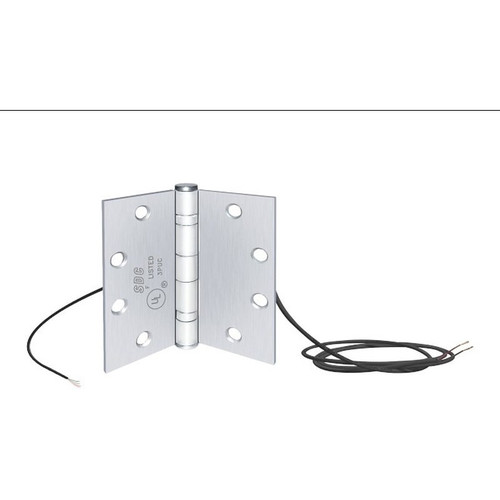
The PTH-4Q specifies an onboard user capacity of 250,000 records, explicitly removing the need for an external directory service in mid-sized campus deployments. Its listed credential type is HID, and it supports OSDP for encrypted reader communication—a protocol designed to protect credential data in transit between reader and controller.
The A1711 kit specification does not state a maximum user or credential record count. Its network integration relies on ONVIF-capable platforms and PoE connectivity, with VMS compatibility listed as ONVIF-capable platforms. No specific credential format (HID, MIFARE, etc.) is cited in the provided specs. Buyers requiring a confirmed user ceiling or specific card technology must consult the A1711 datasheet directly before specifying.
How do the two controllers differ in power, enclosure, and installation footprint?
The PTH-4Q operates at 30 VDC input, weighs 1.2 lbs, and measures 4½" × 4½". Its small physical footprint suits installations where panel real estate is constrained. The spec lists wired connectivity only; no onboard power supply or enclosure is described, meaning the installer must provide a separate power source and housing.
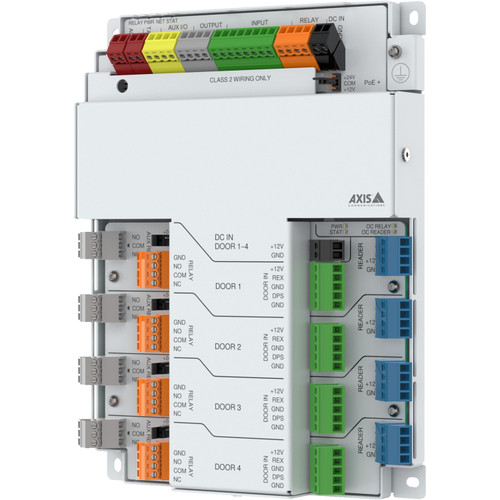
The A1711 is sold as a kit that bundles the AXIS A1710-B Network Door Controller inside a tamper-protected steel enclosure (AXIS TA1202) with a 150 W regulated DC power supply that includes battery charging capability. This integrated approach reduces field assembly time and consolidates BOM items. The kit is UL Listed, which simplifies approval by North American authorities having jurisdiction (AHJ). The PTH-4Q does not carry a UL listing in the provided specifications.
Which controller integrates more broadly with VMS and access-control platforms?
The PTH-4Q lists TCP/IP and OSDP as its communication interfaces. The spec explicitly names Genetec and Milestone as compatible platforms, giving integrators running those VMS environments a confirmed integration path. OSDP support further enables compatibility with a wide range of OSDP-compliant readers without relying on proprietary Wiegand wiring.
The A1711 specifies ONVIF-capable platforms as its VMS compatibility target and is PoE compatible. ONVIF integration provides broad interoperability across the physical security ecosystem, though the spec does not call out individual named platforms. No OSDP listing appears in the A1711 specs. Network-native design via PoE simplifies cabling in structured-cabling environments where dedicated power runs are undesirable.
Which should you choose: the PTH-4Q or the A1711?
Our take: The PTH-4Q is the stronger choice when the deployment demands a verified 250,000-user onboard capacity, named VMS compatibility with Genetec or Milestone, and OSDP-encrypted reader communication—all confirmed in its spec sheet. The A1711 kit holds the advantage where an integrated 150 W power supply with battery charging, a tamper-protected steel enclosure, and UL listing are required to satisfy AHJ approvals or reduce field-assembly complexity; none of those three attributes appear in the PTH-4Q specification. A third key delta is installation completeness: the A1711 ships as an enclosure-plus-power kit while the PTH-4Q requires a separately sourced supply and housing. For a Genetec- or Milestone-driven enterprise campus prioritizing maximum user scale, the PTH-4Q is well-suited; for a new build or retrofit where a self-contained, code-compliant panel assembly is the priority, the A1711 kit is the more practical specification.
Side-by-Side Comparison
Spec-for-spec, from manufacturer data.
| Specification | SDC PTH-4Q | Axis A1711 |
|---|---|---|
| Product Type | 4-Door Access Controller | 4-Door Network Access Control Kit |
| Door Capacity | 4 doors | 4 doors simultaneous |
| Max Users (Onboard) | 250,000 | — |
| Communication Protocol | OSDP; TCP/IP | ONVIF; PoE |
| Credential Type | HID | — |
| Input Voltage | 30 VDC | — |
| Integrated Power Supply | — | 150 W regulated DC with battery charging |
| Enclosure | — | Tamper-protected steel (AXIS TA1202) |
| Connectivity | Wired | Wired (PoE) |
| UL Listing | — | UL Listed |
| Named VMS Compatibility | Genetec; Milestone | ONVIF-capable platforms |
| OSDP Support | Yes | — |
| Dimensions | 4½" × 4½" | — |
| Weight | 1.2 lbs | — |
| Warranty | Lifetime | — |
| MPN | PTH-4Q | 03336-004 |
Frequently Asked Questions
Which should you choose: the PTH-4Q or the A1711?
The PTH-4Q is the stronger choice when the deployment demands a verified 250,000-user onboard capacity, named VMS compatibility with Genetec or Milestone, and OSDP-encrypted reader communication—all confirmed in its spec sheet. The A1711 kit holds the advantage where an integrated 150 W power supply with battery charging, a tamper-protected steel enclosure, and UL listing are required to satisfy AHJ approvals or reduce field-assembly complexity; none of those three attributes appear in the PTH-4Q specification. A third key delta is installation completeness: the A1711 ships as an enclosure-plus-power kit while the PTH-4Q requires a separately sourced supply and housing. For a Genetec- or Milestone-driven enterprise campus prioritizing maximum user scale, the PTH-4Q is well-suited; for a new build or retrofit where a self-contained, code-compliant panel assembly is the priority, the A1711 kit is the more practical specification.
Is the PTH-4Q or the A1711 better for a large university campus with 200,000 cardholders?
The PTH-4Q specifies a 250,000-user onboard record capacity, directly addressing that scale without an external directory dependency. The A1711 spec does not state a user-record limit, so its suitability at that cardholder count cannot be confirmed from the available data alone.
Does either controller ship with its own power supply and enclosure ready to mount?
The A1711 is sold as a kit that includes a 150 W regulated DC power supply with battery charging and a tamper-protected steel enclosure (AXIS TA1202). The PTH-4Q specification lists no integrated power supply or enclosure; the installer must supply those components separately.
Which controller is the better fit for a Genetec Security Center deployment?
The PTH-4Q spec explicitly lists Genetec (and Milestone) as compatible platforms. The A1711 spec references ONVIF-capable platforms generically but does not name Genetec. Integrators running Genetec Security Center should verify A1711 compatibility with Axis and Genetec directly before specifying.
More Access Controller Comparisons
- SDC 101-KDENA vs Axis A1711
- SDC 101-KDENA vs SDC MC-4PAK
- SDC 101-KDENA vs SDC PTH-4Q
- SDC MC-4PAK vs Axis A1711
- SDC 400U-RMB vs Axis A1711
- SDC 400U-RMB vs SDC 101-KDENA
Access Controller Buying Guides
Get a Second Opinion on Your Camera Choice
Share your site layout, coverage goals, and budget. Our team will validate the camera selection, flag anything we would change, and recommend products that match the use case.