
Access Control Panel & Door Controller Buying Guide
How to choose a door controller / access control panel — door count and scalability, on-prem vs cloud, reader compatibility (OSDP/Wiegand), inputs/outputs and power.

Jerry Tildsen
Access Control & Intercoms Specialist · Working integrator
Bottom line
Door count and protocol compatibility are the two decisions that cascade into everything else — get those right first, then match power, enclosure, and connectivity to your site constraints. A single PoE controller dropped in a closet handles a branch office; a multi-reader hub with DIN-rail mounting handles a floor of doors; and a 630-door networked panel handles a campus without a controller-per-door sprawl. Size for where you'll be in three years, not where you are today.
How to Choose
Access control panels vary more than almost any other physical security component — the right choice depends on door count, protocol, power infrastructure, environmental exposure, and how the system will be managed day-to-day. Work through these factors before comparing part numbers.
- Door count and growth headroom: Every panel has a hard door/reader-port ceiling. A 1-door controller is right for a single entry point, but if you're likely to add adjacent doors within 18 months, step up to a 2- or 4-door unit now. Daisy-chaining single-door controllers later adds management complexity and hardware cost that a multi-door panel would have avoided.
- Reader protocol — OSDP vs. Wiegand: Wiegand is the legacy standard and remains widely deployed, but it transmits credential data in the clear with no mutual authentication. OSDP v2 adds encrypted, bi-directional communication, supervised line tamper detection, and remote reader firmware updates. If you're spec'ing new readers alongside a new panel, OSDP is the forward-compatible choice wherever the controller supports it.
- Power delivery to the panel and to the door hardware: PoE and PoE++ controllers draw power from the network switch, eliminating a dedicated power supply at each door — a real labor and material saving in retrofit work. AC/DC-powered panels require a local power supply and battery backup but are independent of network infrastructure, which matters in environments with long cable runs, unreliable PoE budgets, or strict power isolation requirements.
- Inputs, outputs, and ancillary I/O: Count your request-to-exit (REX) loops, door position switches, alarm shunts, and auxiliary relay outputs before you spec a panel. A controller with five ports handles a reader, REX, door contact, lock output, and one spare; more complex doors — with dual-tech readers, breakglass, or elevator control — need more I/O or an expander.
- Environmental rating and temperature range: Panels installed in uncontrolled spaces — parking garages, loading docks, server rooms running hot — need a wider operating temperature range and, where moisture or dust is present, an appropriate IP rating. An IP54-rated outdoor-capable unit survives a vestibule; an indoor box-format unit does not.
- Enclosure and mounting form factor: DIN-rail mount suits a populated electrical or low-voltage panel. Surface-mount box format works in a wiring closet or above a ceiling tile. Larger multi-door systems often ship as complete enclosures with power supply, battery charger, and bus termination already integrated — significantly reducing field labor on large deployments.
- On-premises vs. cloud-managed architecture: Some panels (particularly those in ecosystem platforms like Ubiquiti UniFi Access) are designed around a cloud or local-server management layer. Others are standalone or integrate into third-party PACS software via OSDP, Wiegand, or open APIs. Confirm software licensing costs, offline-operation behavior, and credential database limits before committing to a platform — not just the hardware.
Models to Consider
Selected from our catalog by spec-fit. All channel-direct and factory-new — not ranked by price.
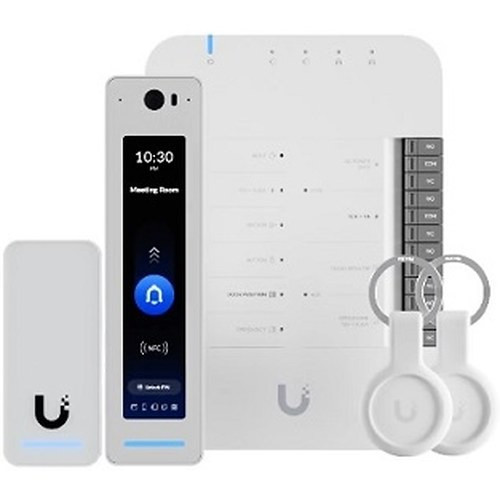
Ubiquiti UA-G3-SK-PRO
1-Door
Well-suited for single-door deployments inside the Ubiquiti UniFi Access ecosystem where PoE is already available — the IP54 rating and -10 to 45 °C operating range make it a practical choice for semi-exposed vestibule or exterior-lobby installations that still land within a structured-cabling run.
View product →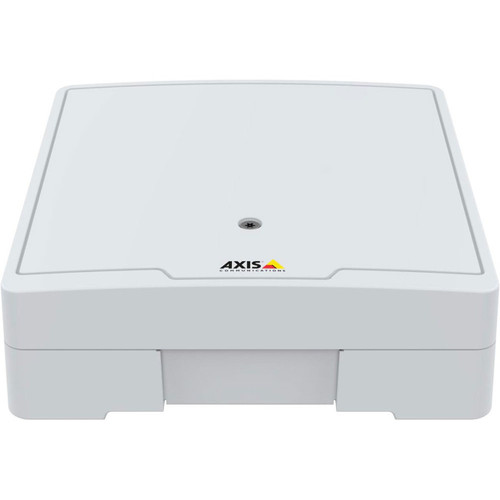
Axis A1610
2-Door
A strong fit for 2-door applications requiring wide temperature tolerance (-40 to 70 °C) — the Axis A1610's industrial-grade range makes it well-suited for doors in unheated stairwells, loading docks, or outdoor-adjacent enclosures where most PoE-powered panels would be out of spec.
View product →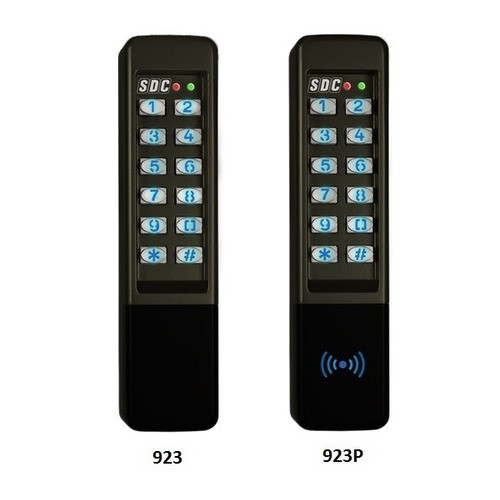
SDC 423MUL1G
10-Door
Well-suited for mid-size facilities needing centralized control of up to 10 doors from a single panel — the SDC 423MUL1G reduces controller count and management overhead compared to deploying ten independent single-door units, making it a sensible fit for a full floor, a small building, or a multi-tenant suite buildout.
View product →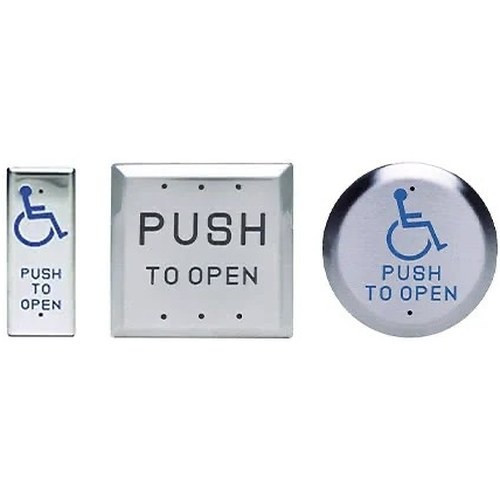
SDC 482R-KIT
630-Door
A strong fit when a single access control system needs to span a large campus or multi-building deployment — supporting up to 630 doors from a single panel in a complete housing kit, the SDC 482R-KIT is suited for integrators spec'ing enterprise or government facilities where minimizing controller nodes and centralizing credential management are hard requirements.
View product →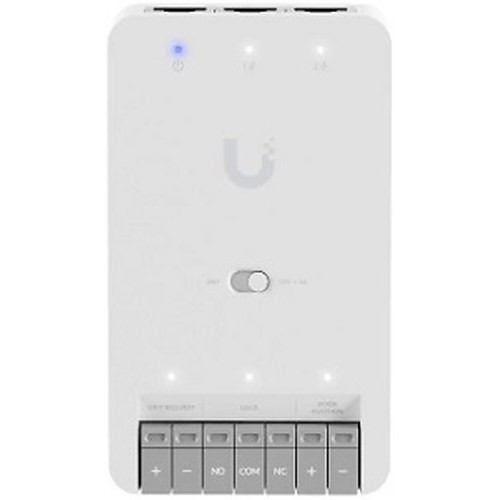
Ubiquiti UA-HUB-DOOR-MINI
1-Door
Well-suited for single-door nodes that need to live inside a populated electrical enclosure — the DIN-rail form factor and PoE++ power input make the UA-HUB-DOOR-MINI a clean fit for structured panel builds within the UniFi Access platform, and the three GbE RJ45 ports allow downstream device connections without a separate switch.
View product →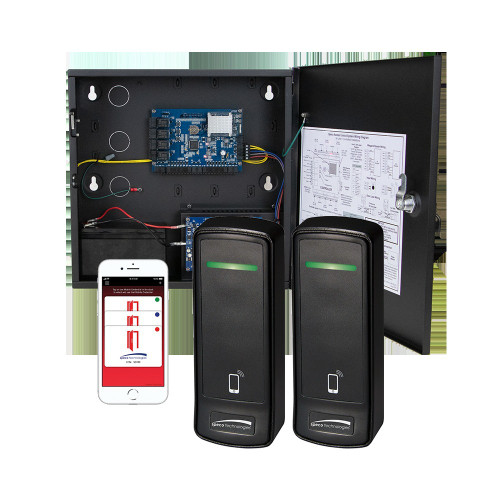
Speco Technologies A1
1-Door
A practical fit for single-door retrofits or sites where PoE infrastructure is unavailable — the Speco A1's AC/DC power input means it can be wired to an existing local power supply, and the box format suits a standard low-voltage closet or above-ceiling installation without requiring network switch upgrades.
View product →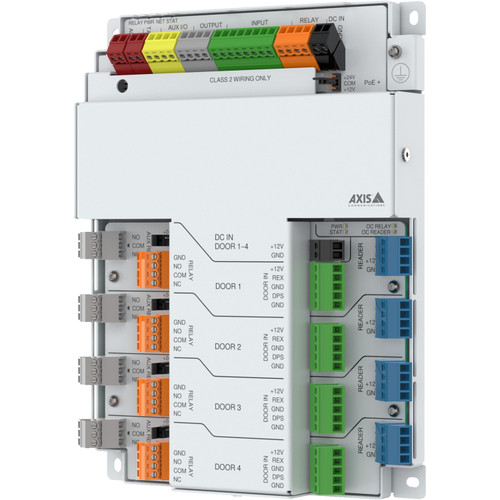
Axis A1711
4-Door
Well-suited for 4-door deployments where a factory-assembled enclosure reduces field labor — the Axis A1711 ships as a complete access control enclosure with AC/DC power, making it a strong fit for small commercial buildings or interior zones that need multi-door control without the cost or complexity of a larger networked panel.
View product →Frequently Asked Questions
What is the difference between OSDP and Wiegand for access control readers?
Wiegand is a one-way, unencrypted signaling standard that sends credential data as a simple pulse train — it has no tamper detection and the data can be intercepted with off-the-shelf hardware. OSDP (Open Supervised Device Protocol) v2 is a bi-directional, encrypted RS-485 protocol that supports mutual authentication between the panel and reader, supervised wiring that detects cable cuts or shorts, and remote reader firmware updates. For new installations or anywhere credential security is a compliance requirement, OSDP is the more defensible architecture; Wiegand remains viable in low-risk applications or when reusing existing readers.
Can I mix single-door and multi-door controllers on the same access control system?
That depends entirely on the software platform, not the hardware in isolation. Most enterprise PACS platforms (Lenel, Genetec, Software House, etc.) support heterogeneous hardware through driver libraries or OSDP, so a 1-door panel and a 10-door panel can appear as nodes in the same system. Closed-ecosystem platforms like Ubiquiti UniFi Access are designed around their own controller family — mixing in third-party panels requires a different management layer. Nail down the software architecture before mixing controller families.
Do PoE-powered access controllers still work during a network outage?
It depends on the controller's local credential store and offline behavior. Most enterprise-grade PoE controllers cache a credential database locally and continue making grant/deny decisions during a network outage as long as power is maintained (i.e., the PoE switch is on a UPS). The panel will typically queue events and sync them when connectivity is restored. Confirm the local database limit — some platforms cap offline credentials — and verify that the PoE switch feeding the panel is backed up if uninterrupted access is a life-safety requirement.
How do I size a multi-door access control panel for future expansion?
A practical rule of thumb: size for 1.5× your current door count if expansion is planned within three years, and verify that the panel's software license (not just its hardware ports) covers that count. Many multi-door controllers expose all ports at the hardware level but gate additional doors behind a license key — confirm total licensed capacity, not just the panel's physical I/O, before purchasing. Also check whether the panel supports reader expanders or sub-panels on an RS-485 bus, which can extend capacity without replacing the head-end hardware.
What inputs and outputs should I verify before specifying a door controller?
At minimum, confirm: one reader input per controlled door (or two for dual-credential/anti-passback), a door position switch (DPS) input, a request-to-exit (REX) input, and a lock output relay rated for your hardware — electric strikes typically draw 500 mA to 1 A, magnetic locks up to 1.5 A. Beyond that, count auxiliary inputs for glass-break or motion zones you want to monitor through the access panel, and auxiliary relay outputs for elevator control, door-prop alarms, or interlock sequences. If your door count exceeds the panel's native I/O, look for a controller that supports an expansion bus rather than a parallel standalone panel.
Is an IP-rated access controller necessary for outdoor or semi-outdoor installation?
If the controller itself will be mounted in a location exposed to condensation, hosing, dust, or temperatures outside the rated range, then yes — or you need to provide a suitably rated enclosure around it. A general-purpose indoor panel in a damp parking-structure conduit room is a warranty and reliability problem. Review both the IP ingress rating and the operating temperature range independently: a panel rated IP54 may still be limited to 0–40 °C, which is inadequate for an unheated northern climate. When conditions are marginal, mounting the controller in a NEMA-rated enclosure with a thermostatically controlled heater is often more cost-effective than specifying a higher-rated panel.
Related Resources
Speccing this for a project?
Send us your requirements and our senior specialists will confirm specs, compatibility, availability and pricing — free, usually within one business day. Channel-direct, factory-new, serving commercial integrators since 2014.
Get a Free QuoteComparing for a project?
Send us the models you are weighing and our team will confirm specs, compatibility, availability, and pricing — free, usually within one business day.