
SDC 400U-RMB vs SDC 101-KDENA: Specification Comparison
Both the SDC 400U-RMB and the SDC 101-KDENA are wired, 4-door access controllers from SDC Security Door Controls, targeting the same enterprise and commercial access-control segment. Each supports 250,000 HID credentials on-device, communicates over OSDP and TCP/IP, and operates on 24VDC. The key differentiators lie in their override/annunciator mechanisms, physical form factor, mounting options, and a single listed power-delivery distinction—factors that determine fit across specific installation environments and operational requirements.
In This Guide
- How do the 400U-RMB and 101-KDENA compare on door capacity and credential handling?
- What built-in override or annunciator features distinguish the 400U-RMB from the 101-KDENA?
- How do the two controllers differ in physical size, mounting options, and power input?
- Which should you choose: the 400U-RMB or the 101-KDENA?
- Side-by-Side Specs
- FAQ
How do the 400U-RMB and 101-KDENA compare on door capacity and credential handling?
Both controllers manage exactly 4 independent door zones and store up to 250,000 HID-compatible credentials locally on-device. Neither model requires a central authentication server for credential lookup at the door level, which supports resilient offline operation. Communication protocols are identical—OSDP and TCP/IP—on both units, meaning reader interoperability and network integration capabilities are equivalent at this tier. No spec difference exists between the two on door count, max user records, credential type, or communication protocol; buyers should not use these axes to differentiate the models.
What built-in override or annunciator features distinguish the 400U-RMB from the 101-KDENA?
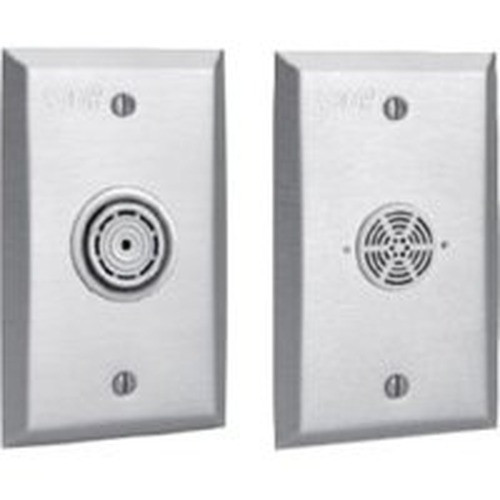
The 400U-RMB includes an integrated buzzer mounted on a 1-gang wall plate, serving as a local audible annunciator—useful for door-prop alarms, access-granted/denied tones, or alert conditions without a separate sounder. Its cable category is listed as 'Door Prop Alarms & Annunciators,' confirming this annunciator role in the product design.
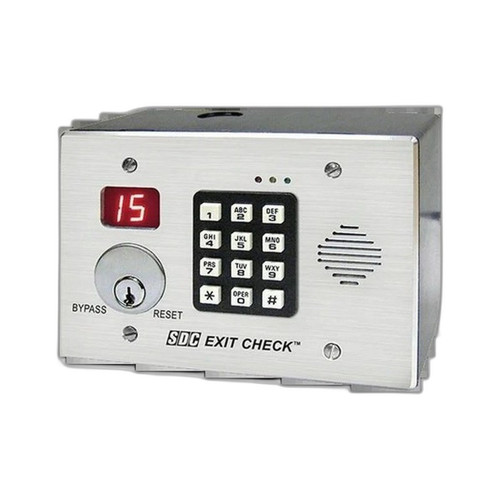
The 101-KDENA instead integrates a key switch override, enabling emergency or manual bypass of the electronic lock control. Its strike type is listed as Magnetic Lock, and the reader type is Keypad, indicating the unit is designed around a keypad-plus-key-switch credential and override workflow. The 101-KDENA also lists PoE (802.3af) as a power delivery option—no equivalent PoE spec appears for the 400U-RMB. These distinctions make override methodology and annunciator needs the primary functional differentiators between the two units.
How do the two controllers differ in physical size, mounting options, and power input?
The 400U-RMB is the smaller unit at 2½" × 4½" and 1 lb, formatted as a 1-gang wall plate. Its spec sheet lists both 24VDC (primary) and 12VDC under voltage entries; no rack-mount option is specified.
The 101-KDENA is larger at 4½" × 6-7/16" × 2" and 2 lbs, with explicit support for both wall and rack mounting—useful in IDF/MDF closet deployments or equipment rooms where rack integration is preferred. The 101-KDENA also lists PoE (802.3af) as an available power source, which can eliminate a dedicated power supply run in some structured-cabling environments. Package contents for the 101-KDENA note certain accessories must be ordered separately. Both units carry a lifetime warranty.
Which should you choose: the 400U-RMB or the 101-KDENA?
Our take: The 400U-RMB is the stronger choice when the installation requires an integrated audible annunciator at the controller location—its built-in buzzer on a 1-gang wall plate covers door-prop and alert signaling without a separate device. The 101-KDENA is the stronger choice when emergency manual override capability, keypad-based credential entry, or rack-mount installation is required: it adds an integrated key switch (not present on the 400U-RMB), supports both wall and rack mounting versus wall-only on the 400U-RMB, and lists PoE 802.3af power delivery as an option—eliminating a dedicated 24VDC supply run where PoE infrastructure exists. At 2 lbs and 4½" × 6-7/16" × 2", the 101-KDENA is physically larger than the 400U-RMB (1 lb, 2½" × 4½"). On credential capacity, door count, protocols, and warranty, the two models are identical. Select the 400U-RMB for surface-mount annunciator deployments; select the 101-KDENA for rack-integrated or PoE-powered installations requiring manual override.
Side-by-Side Comparison
Spec-for-spec, from manufacturer data.
| Specification | SDC 400U-RMB | SDC 101-KDENA |
|---|---|---|
| Product Type | Controller | Controller |
| Door Capacity | 4 doors | 4 doors |
| Max User / Credential Records | 250,000 | 250,000 |
| Credential Type | HID compatible | HID compatible |
| Communication Protocols | OSDP, TCP/IP | OSDP, TCP/IP |
| Connectivity | Wired | Wired |
| Input Voltage | 24VDC (12VDC also listed) | 24VDC |
| PoE Support | — | PoE 802.3af |
| Built-in Buzzer / Annunciator | Yes, 1-gang wall plate | — |
| Override Mechanism | — | Integrated key switch |
| Reader Type | — | Keypad |
| Strike Type Compatibility | — | Magnetic Lock |
| Mount Type | Wall (1-gang plate) | Wall; Rack |
| Dimensions | 2½" × 4½" | 4½" × 6-7/16" × 2" |
| Weight | 1 lb | 2 lbs |
| Warranty | Lifetime | Lifetime |
Frequently Asked Questions
Which should you choose: the 400U-RMB or the 101-KDENA?
The 400U-RMB is the stronger choice when the installation requires an integrated audible annunciator at the controller location—its built-in buzzer on a 1-gang wall plate covers door-prop and alert signaling without a separate device. The 101-KDENA is the stronger choice when emergency manual override capability, keypad-based credential entry, or rack-mount installation is required: it adds an integrated key switch (not present on the 400U-RMB), supports both wall and rack mounting versus wall-only on the 400U-RMB, and lists PoE 802.3af power delivery as an option—eliminating a dedicated 24VDC supply run where PoE infrastructure exists. At 2 lbs and 4½" × 6-7/16" × 2", the 101-KDENA is physically larger than the 400U-RMB (1 lb, 2½" × 4½"). On credential capacity, door count, protocols, and warranty, the two models are identical. Select the 400U-RMB for surface-mount annunciator deployments; select the 101-KDENA for rack-integrated or PoE-powered installations requiring manual override.
Is the 400U-RMB or 101-KDENA better for larger deployments where audible alerts at the door are needed?
The 400U-RMB is the specified choice for integrated audible alerting—it includes a built-in buzzer on a 1-gang wall plate, which the 101-KDENA does not list. Both handle up to 250,000 credentials across 4 doors, so credential scale is equal; the annunciator function is what differentiates the 400U-RMB in alert-driven installations.
Can the 101-KDENA be powered over Ethernet, and does the 400U-RMB support that?
The 101-KDENA lists PoE (802.3af) as a power option, which can simplify cabling in structured-cabling environments by eliminating a dedicated 24VDC supply. The 400U-RMB spec does not list PoE; it specifies 24VDC (with a 12VDC entry also appearing in its spec data). Buyers relying on PoE infrastructure should select the 101-KDENA.
Which controller is better suited for an equipment room or IDF closet with rack-mounted hardware?
The 101-KDENA explicitly supports both wall and rack mounting and has a physical depth dimension listed (2"), making it suitable for rack-integrated deployments. The 400U-RMB is designed as a 1-gang wall-plate unit with no rack-mount option specified in its provided specs. For IDF/MDF closet or rack installations, the 101-KDENA is the appropriate choice.
More Access Controller Comparisons
- SDC 101-KDENA vs Axis A1711
- SDC 101-KDENA vs SDC MC-4PAK
- SDC 101-KDENA vs SDC PTH-4Q
- SDC MC-4PAK vs Axis A1711
- SDC PTH-4Q vs Axis A1711
- SDC 400U-RMB vs Axis A1711
Access Controller Buying Guides
Get a Second Opinion on Your Camera Choice
Share your site layout, coverage goals, and budget. Our team will validate the camera selection, flag anything we would change, and recommend products that match the use case.