
Best Door Controllers for a Small Business
Door controllers for 1-2 door small-business access control — onboard vs cloud management, reader compatibility, and lock/REX wiring.

Jerry Tildsen
Access Control & Intercoms Specialist · Working integrator
Bottom line
For a small business securing one or two doors, the right access controller comes down to three things: how many doors you need to manage, whether you want cloud-managed or on-premises control, and what your power and wiring infrastructure looks like. PoE-powered controllers simplify installation by eliminating separate power supplies, while industrial-rated hardware pays off in unconditioned spaces like warehouses or entry vestibules. Match the controller to your reader type, lock output, and long-term management preference before buying on price alone.
What This Setup Needs
Small-business access control looks simple on the surface—one or two doors, a handful of credentials—but the controller you choose locks in your reader ecosystem, your management platform, and your wiring approach for years. Here's what actually drives the decision:
- Door count: A 1-door controller is cheaper and simpler for a single entry point, but if you anticipate adding a second door within 12–18 months, a 2-door controller avoids a full hardware swap. Verify the controller's licensed door capacity matches your plan, not just today's need.
- Power source: PoE (802.3af/at) controllers draw power directly from your network switch—no local AC outlet, no separate power supply, cleaner installation. PoE++ (802.3bt) delivers higher wattage for controllers with more downstream devices. AC/DC-powered units offer independence from your network infrastructure but require a local power source and often a separate lock power supply.
- Reader compatibility: Most commercial controllers support Wiegand and/or OSDP readers. OSDP (Open Supervised Device Protocol) adds encrypted, bidirectional communication and tamper detection—preferred for higher-security deployments. Confirm your chosen reader protocol matches the controller's interface before purchasing.
- Lock output and REX wiring: Check how many relay outputs the controller provides (door strike, magnetic lock, request-to-exit) and whether it supports fail-safe vs. fail-secure lock types. Some compact controllers have limited auxiliary I/O, which matters if you need door position sensors, alarm shunting, or REX motion detector inputs.
- Management platform—cloud vs. on-premises: Cloud-managed controllers (like Ubiquiti's UniFi Access ecosystem) offer remote credential management, mobile apps, and automatic firmware updates with no server to maintain. On-premises or standalone systems keep data local and work without internet, which matters for compliance-sensitive environments or sites with unreliable connectivity.
- Environmental rating: If the controller mounts in an unconditioned space—a mechanical room, outdoor enclosure, or cold-storage entry—check the operating temperature range. Industrial-grade controllers rated to -40°C handle environments that will destroy consumer-grade hardware. IP ratings matter if moisture or dust are a concern.
- Form factor and mounting: Panel-mount, DIN rail, and surface-mount box formats each suit different enclosure strategies. DIN rail mounting simplifies integration into a standard electrical panel. Standalone box units are more flexible but require their own enclosure planning for a clean, tamper-resistant install.
Our Picks
Selected from our catalog by spec-fit. All channel-direct and factory-new — not ranked by price.
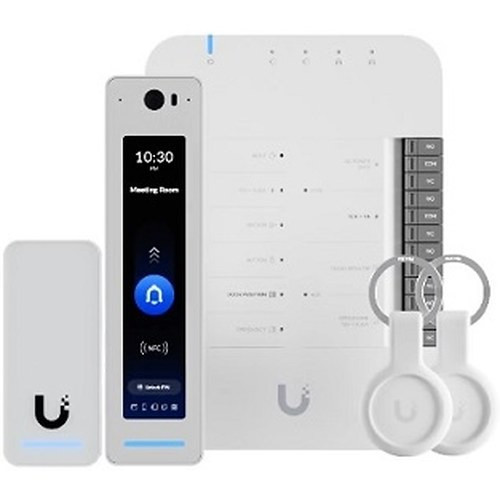
Ubiquiti UA-G3-SK-PRO
1-Door
A strong fit for small businesses already running or planning a UniFi network stack—this PoE-powered, IP54-rated 1-door controller integrates natively into the UniFi Access cloud-managed ecosystem, and its 5-port switch fabric means you can daisy-chain readers and peripherals at the door without running separate network drops. The -10 to 45°C operating range covers most interior and semi-protected vestibule installs.
View product →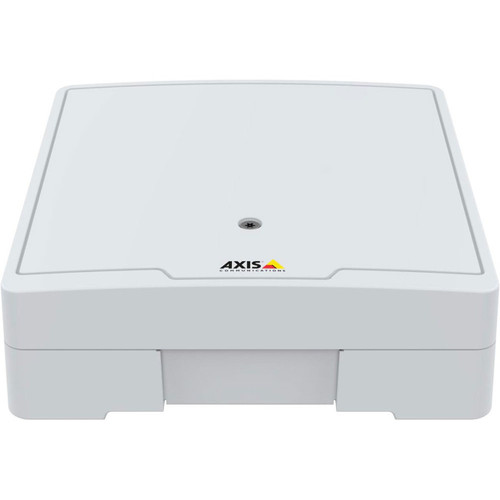
Axis A1610
2-Door
Well-suited for small businesses that need 2-door coverage in a single unit and require wide environmental tolerance—the Axis A1610's -40 to 70°C rated operating range makes it a serious consideration for entry points near loading docks, cold storage, or unconditioned utility spaces where most compact controllers would fail. It fits into the broader AXIS Camera Station or AXIS Access Control ecosystem for on-premises or hybrid management.
View product →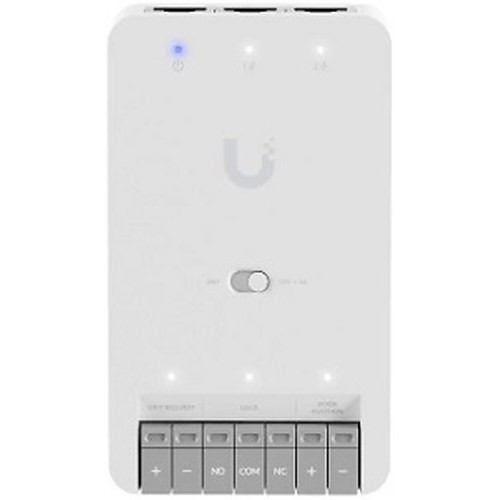
Ubiquiti UA-HUB-DOOR-MINI
1-Door
A natural fit when you want a compact, DIN rail-mountable 1-door controller that draws PoE++ for higher-wattage downstream needs—the three onboard GbE RJ45 ports reduce homerun cabling back to the IDF, and DIN mounting lets it slot cleanly into a standard panel enclosure. Best evaluated alongside the broader UniFi Access ecosystem it's designed to live in; the 0–40°C range keeps it to conditioned interior spaces.
View product →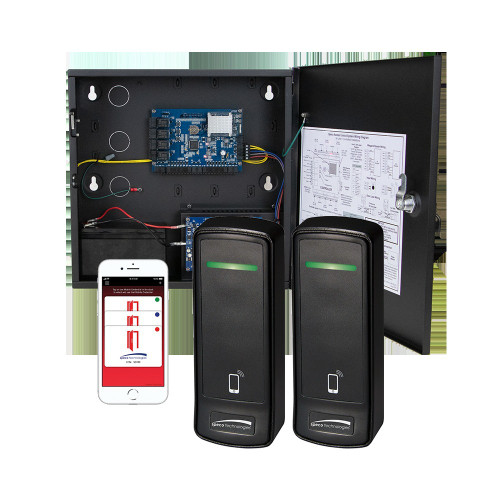
Speco Technologies A1
1-Door
Worth considering for installations where network PoE infrastructure is unavailable or where an integrator prefers AC/DC-powered, standalone 1-door hardware that doesn't depend on a cloud platform or managed switch—the Speco A1's box form factor and conventional power input make it straightforward to retrofit into an existing panel enclosure with a local power supply, suiting small businesses with simpler IT environments.
View product →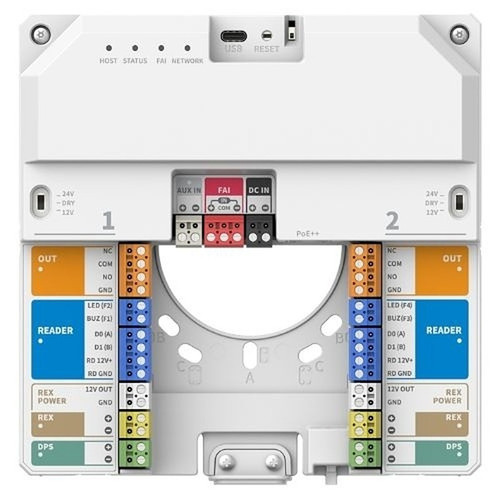
Hanwha P200
2-Door
A strong fit when a small business needs to control two doors under a single Hanwha-ecosystem deployment—the P200's 2-door IP controller class means it can cover a paired entry/exit or two distinct access points from one device, making it well-suited for Hanwha Wave or Wisenet WAVE integrated sites that want access control and video on a unified platform.
View product →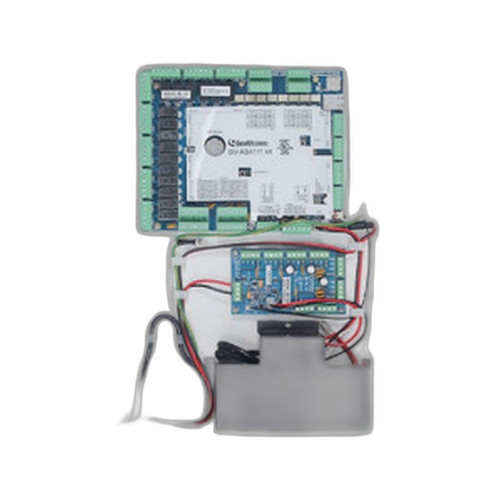
Geovision AS1620
1-Door
Well-suited for integrators building out Geovision-centric installations who need a PoE-powered 1-door access control panel that ties natively into GV-ASManager or a broader GV-IP surveillance deployment—the access control panel form factor means it's designed to mount inside a dedicated enclosure alongside lock power and wiring terminations, following a traditional panel-based installation approach that many commercial integrators prefer.
View product →Frequently Asked Questions
Do I need a cloud subscription to use a PoE access controller?
It depends entirely on the ecosystem. Ubiquiti UniFi Access controllers are designed around the UniFi platform and work best with a local UniFi OS console (such as a Cloud Key or Dream Machine)—there's no mandatory recurring cloud fee, but the management software is tightly coupled to Ubiquiti's ecosystem. Axis and Geovision controllers can be managed with on-premises software without ongoing subscription costs. Always confirm the management software licensing model before you buy, since some platforms charge per-door annually.
Can I use my existing Wiegand card readers with these controllers?
Most commercial access controllers—including the units listed here—support standard 26-bit Wiegand, which is the most common protocol for legacy proximity and smart card readers. If you're deploying newer OSDP readers for encrypted communication, verify the specific controller supports OSDP RS-485 as well, since not every compact controller does. When in doubt, confirm reader protocol compatibility with the controller's datasheet before mixing brands.
What kind of lock can I connect to a door controller?
Most single- and two-door controllers provide one or more dry-contact relay outputs rated for door strikes and electromagnetic locks—typically 12V or 24V DC at a few amps. Magnetic locks (maglocks) and electric strikes are both common; fail-safe (power to lock) vs. fail-secure (power to unlock) is a life-safety decision that should be coordinated with your local fire code requirements. Many controllers also include auxiliary inputs for a request-to-exit (REX) sensor and a door position switch, which you'll want to wire for proper alarm and audit-log functionality.
How many users or credentials can a small-business access controller handle?
Credential capacity varies widely by platform and is often a software or licensing limit rather than a hardware constraint. Cloud-managed systems like UniFi Access typically scale credential counts through the management platform rather than the controller itself. On-premises controllers often store credentials locally (commonly 500–10,000+ cards depending on the model). For a small business with under 50 employees, capacity is rarely a limiting factor—but confirm the number if you anticipate rapid headcount growth or multi-site credential sharing.
Is PoE enough to power both the controller and the door lock?
No—PoE powers the controller itself, not the lock. Door strikes and magnetic locks require a separate lock power supply (typically 12V or 24V DC), because the inrush current of an electric lock exceeds what the controller's relay output and PoE budget can safely deliver. Plan for a dedicated lock power supply in your enclosure, and size it for the lock's holding force and current draw plus a safety margin. Some controllers include auxiliary power outputs to help supervise lock power, but the supply itself is always a separate component.
What's the difference between a 1-door and 2-door access controller for a small office?
A 1-door controller manages a single entry point—one reader input, one lock output, one REX input. A 2-door controller doubles that capacity in a single hardware footprint, which reduces cost-per-door and simplifies management when you have two access points (for example, a front door and a server room). If your site has exactly one door today with no expansion planned, a 1-door unit keeps costs down. If you have or anticipate two doors, a 2-door controller like the Axis A1610 or Hanwha P200 often delivers better value than buying two separate 1-door units and managing them independently.
Related Resources
- Access Controller comparisons — head-to-head spec matchups
- Access Control Panel & Door Controller Buying Guide
- Best Access Control Panels for Multi-Door Sites
- All product comparisons
Speccing this for a project?
Send us your requirements and our senior specialists will confirm specs, compatibility, availability and pricing — free, usually within one business day. Channel-direct, factory-new, serving commercial integrators since 2014.
Get a Free QuoteComparing for a project?
Send us the models you are weighing and our team will confirm specs, compatibility, availability, and pricing — free, usually within one business day.