
SDC MC-4PAK vs Axis A1711: Specification Comparison
Both the SDC MC-4PAK and the Axis A1711 are 4-door access controllers targeting commercial and light-enterprise installations where a single unit must manage up to four independent entry points. The MC-4PAK is a standalone controller emphasizing high local credential storage and dual-protocol reader communication, while the A1711 is a packaged kit built around the AXIS A1710-B controller housed in a tamper-resistant steel enclosure with an integrated 150 W power supply. Buyers cross-shopping these products are typically evaluating controller capacity, power architecture, compliance posture, and ecosystem fit.
In This Guide
- How do credential capacity and door management compare between the MC-4PAK and the A1711?
- How do the power architecture and physical enclosure differ between the two controllers?
- Which controller offers stronger protocol support, compliance credentials, and ecosystem integration?
- Which should you choose: the MC-4PAK or the A1711?
- Side-by-Side Specs
- FAQ
How do credential capacity and door management compare between the MC-4PAK and the A1711?
Both controllers support exactly 4 simultaneous doors, making them capacity-equivalent at the door level. The SDC MC-4PAK, however, specifies a local user database of up to 250,000 HID credentials stored on the controller itself, which eliminates dependency on a continuously available server and is a meaningful advantage for high-throughput facilities such as universities, hospitals, or large corporate campuses.
The Axis A1711 specification does not state a maximum credential or user count. Buyers requiring a documented, on-board credential limit for system sizing or compliance documentation will find the MC-4PAK's 250,000-credential figure directly useful, while the A1711's capacity ceiling remains unspecified based on the provided data.
How do the power architecture and physical enclosure differ between the two controllers?
The SDC MC-4PAK operates at 30 VDC input voltage and is supplied as a controller unit only, with no enclosure or integrated power supply specified in the provided data. Installers must plan for a separate power source and housing, which adds procurement and design steps but also provides flexibility to match an existing panel infrastructure.
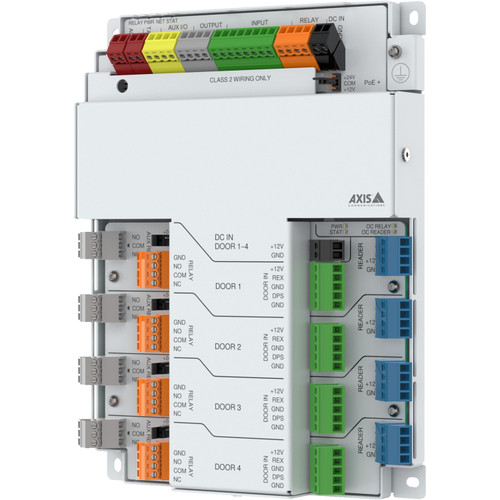
The Axis A1711 ships as a complete kit: the AXIS A1710-B controller is pre-integrated inside an AXIS TA1202 tamper-protected steel enclosure with a 150 W regulated DC power supply that includes battery charging capability. For greenfield installations, this bundled approach reduces field assembly time and ensures component compatibility. The enclosure's tamper protection is a relevant physical-security factor that is not addressed in the MC-4PAK specification.
Which controller offers stronger protocol support, compliance credentials, and ecosystem integration?
The SDC MC-4PAK explicitly supports two communication protocols: OSDP (Open Supervised Device Protocol), which provides encrypted, bidirectional reader communication, and TCP/IP for direct LAN integration. It is credential-format compatible with HID. No third-party certifications or VMS compatibility statements are provided in the available specification data.
The Axis A1711 carries a UL Listing, which is a documented compliance credential relevant to North American Authority Having Jurisdiction (AHJ) approvals and insurance requirements. It is described as PoE compatible and integrates with ONVIF-capable VMS platforms, linking it directly into the broader IP video and access ecosystem. OSDP support is not specified for the A1711 in the provided data, and no HID credential format compatibility is stated.
Which should you choose: the MC-4PAK or the A1711?
Our take: The MC-4PAK is the stronger choice when a project demands a documented high-capacity local credential store, OSDP-encrypted reader communication, and HID credential compatibility within a flexible, panel-agnostic power architecture. Its 250,000-credential on-board database is unmatched by any stated A1711 figure, and dual OSDP plus TCP/IP protocol support directly addresses encrypted reader bus requirements. The A1711 is the stronger choice when a project requires a UL-Listed, all-in-one kit with integrated 150 W power and battery charging inside a tamper-protected steel enclosure, particularly where ONVIF VMS integration and AHJ compliance documentation are primary procurement criteria. Warranty also diverges: the MC-4PAK specifies a Lifetime warranty; no warranty term is stated for the A1711 in the provided data. Specifiers on Axis-ecosystem VMS platforms will favor the A1711; those standardized on HID credentials or requiring OSDP will favor the MC-4PAK.
Side-by-Side Comparison
Spec-for-spec, from manufacturer data.
| Specification | SDC MC-4PAK | Axis A1711 |
|---|---|---|
| Product Type | Controller | Controller (Kit) |
| Door Capacity | 4 doors | 4 doors |
| Max Credential Storage | 250,000 HID credentials | — |
| Credential Format | HID compatible | — |
| Communication Protocols | OSDP, TCP/IP | TCP/IP (PoE), ONVIF |
| OSDP Support | Yes | — |
| VMS Compatibility | — | ONVIF-capable platforms |
| Input Voltage | 30 VDC | — |
| Integrated Power Supply | — | 150 W regulated DC |
| Battery Charging | — | Yes (included in kit) |
| Enclosure | — | AXIS TA1202 tamper-protected steel |
| UL Listed | — | Yes |
| PoE Compatible | — | Yes |
| Connectivity | Wired | Wired |
| Housing Color | White | White |
| Warranty | Lifetime | — |
Frequently Asked Questions
Which should you choose: the MC-4PAK or the A1711?
The MC-4PAK is the stronger choice when a project demands a documented high-capacity local credential store, OSDP-encrypted reader communication, and HID credential compatibility within a flexible, panel-agnostic power architecture. Its 250,000-credential on-board database is unmatched by any stated A1711 figure, and dual OSDP plus TCP/IP protocol support directly addresses encrypted reader bus requirements. The A1711 is the stronger choice when a project requires a UL-Listed, all-in-one kit with integrated 150 W power and battery charging inside a tamper-protected steel enclosure, particularly where ONVIF VMS integration and AHJ compliance documentation are primary procurement criteria. Warranty also diverges: the MC-4PAK specifies a Lifetime warranty; no warranty term is stated for the A1711 in the provided data. Specifiers on Axis-ecosystem VMS platforms will favor the A1711; those standardized on HID credentials or requiring OSDP will favor the MC-4PAK.
Is the MC-4PAK or A1711 better for a large facility with tens of thousands of cardholders?
Based on the provided specifications, the MC-4PAK explicitly supports up to 250,000 local HID credentials, making it documentably suited for high-cardholder environments. The A1711 specification does not state a maximum credential count, so its capacity ceiling cannot be confirmed from the available data alone.
Does either controller ship ready to install without sourcing additional power or enclosure hardware?
The Axis A1711 ships as a kit that includes the AXIS A1710-B controller, a tamper-protected AXIS TA1202 steel enclosure, and a 150 W regulated DC power supply with battery charging — everything needed for the control panel itself. The SDC MC-4PAK is specified as a controller unit only; a separate power supply and enclosure must be sourced and planned by the installer.
Which controller is better suited to projects that require UL Listing for AHJ approval?
The Axis A1711 is specified as UL Listed, which directly supports North American AHJ approval processes. No UL Listing or equivalent third-party certification is stated in the MC-4PAK specification data provided, so buyers with a hard UL requirement should confirm certification status directly with SDC before specifying the MC-4PAK.
More Access Controller Comparisons
- SDC 101-KDENA vs Axis A1711
- SDC 101-KDENA vs SDC MC-4PAK
- SDC 101-KDENA vs SDC PTH-4Q
- SDC PTH-4Q vs Axis A1711
- SDC 400U-RMB vs Axis A1711
- SDC 400U-RMB vs SDC 101-KDENA
Access Controller Buying Guides
Get a Second Opinion on Your Camera Choice
Share your site layout, coverage goals, and budget. Our team will validate the camera selection, flag anything we would change, and recommend products that match the use case.