
SDC IPRW300 vs Comelit 909020113: Specification Comparison
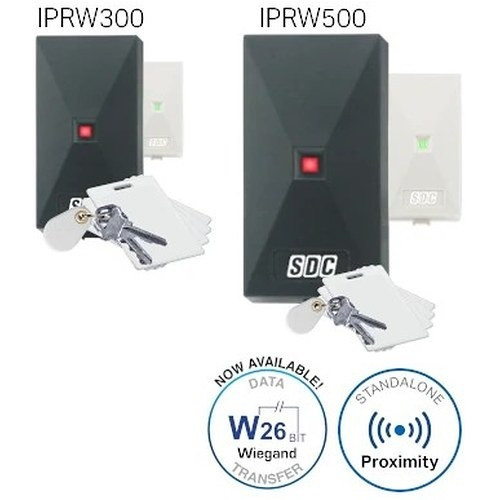
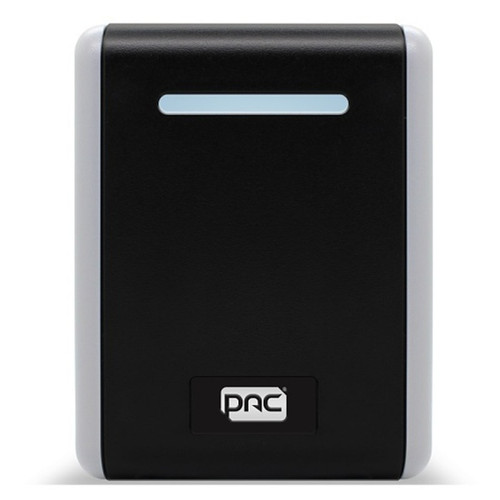
Both the SDC IPRW300 and the Comelit 909020113 (GS3-MT) are wired proximity readers designed for physical access control deployments, each outputting Wiegand signals to a host controller. The IPRW300 targets high-capacity enterprise installations using HID 125 kHz credentials, while the GS3-MT is a PoE-powered multi-credential reader optimized for IP-based access infrastructures, particularly PAC-ecosystem controllers. This comparison evaluates the two across credential and system capacity, power and environmental specifications, and integration compatibility.
In This Guide
Which reader supports more credentials and larger deployments?
The SDC IPRW300 is specified for up to 250,000 user credentials distributed across a maximum of 63 doors when used with SDC IPPro controllers. This enterprise-scale capacity is a defining spec and directly stated in the product data.
The Comelit 909020113 spec set does not state a maximum user count or door capacity. It is described as a single-reader unit compatible with PAC OPS™, KeyPAC, and third-party Wiegand credentials, meaning credential ceiling is dictated by the paired controller (e.g., PAC 512) rather than the reader itself.
For deployments where raw credential ceiling or door-count scale is a procurement criterion, the IPRW300 provides a concrete, auditable number (250,000 users / 63 doors). The 909020113 leaves that question to the controller tier.
How do the two readers differ in power source and environmental resilience?
The SDC IPRW300 requires a dedicated 16 VDC supply and uses conventional wired power over a separate cable run. It is rated IP67 and operates across a wide thermal range of -40°F to +149°F (-40°C to +65°C), making it suited to harsh or outdoor industrial environments.
The Comelit 909020113 is powered via PoE (IEEE 802.3af), consolidating power and data on a single Ethernet cable — a meaningful wiring simplification in new-build or retrofit IP infrastructure. Its environmental rating is IP65, sufficient for indoor and outdoor weatherproof use but one step below IP67 on ingress protection. No operating temperature range is listed in the provided specifications.
The IPRW300's IP67 rating and -40°F floor give it a clear edge in extreme-environment deployments. The 909020113's PoE power model reduces home-run cabling cost where a PoE switch infrastructure already exists, but buyers should confirm the 13 W minimum per port and note the absence of a rated temperature floor.
Which reader offers broader or more flexible integration with access control platforms?
The IPRW300 outputs a standard Wiegand signal and is explicitly listed as compatible with the SDC IPPro Single Door Controller and 'most access control systems.' Its credential type is HID 125 kHz proximity only; no multi-technology or smart-card support is stated in the provided specs.
The Comelit 909020113 is also Wiegand-protocol compatible and is designed to accept PAC OPS™, KeyPAC, and third-party Wiegand credentials on a single reader head. The tamper circuit and reader line tamper function become configurable when paired with PAC 512 controllers, adding supervised-line capability in that ecosystem. The encryption field in the provided spec is partially concatenated and not cleanly parseable, so encryption specifics cannot be confirmed from the available data.
Both readers present a Wiegand output to the downstream controller, so either will integrate with most legacy and current access control panels. The 909020113's multi-credential acceptance is an advantage in mixed-technology environments. The IPRW300's explicit SDC IPPro compatibility and 250,000-user ceiling make it the default choice when the SDC ecosystem is already installed.
Which should you choose: the IPRW300 or the 909020113?
Our take: The IPRW300 is the stronger choice when deploying at scale within an SDC or HID 125 kHz infrastructure that demands a verified credential ceiling and extreme-environment durability. Key spec deltas: the IPRW300 documents 250,000 max users and 63-door capacity while the 909020113 states neither; the IPRW300 is rated IP67 versus IP65 on the 909020113; and the IPRW300 operates to -40°F versus no stated temperature floor on the 909020113. Conversely, the 909020113's PoE 802.3af power model eliminates a separate 16 VDC power run and its multi-credential head (PAC OPS™, KeyPAC, third-party Wiegand) suits mixed-technology card environments. Choose the IPRW300 for SDC IPPro ecosystems, large enterprise deployments, or harsh outdoor installations. Choose the 909020113 where a PoE Ethernet infrastructure is preferred and PAC-ecosystem controller integration or multi-credential flexibility is required.
Side-by-Side Comparison
Spec-for-spec, from manufacturer data.
| Specification | SDC IPRW300 | Comelit 909020113 |
|---|---|---|
| Product Type | Proximity Reader (Wiegand Output) | Proximity Reader (Wiegand Output) |
| SKU | IPRW300 | 909020113 |
| Credential Type | HID 125 kHz Proximity | PAC OPS™, KeyPAC, third-party Wiegand |
| Communication Protocol | Wiegand Output | Wiegand Output |
| Power Source | 16 VDC (dedicated supply) | PoE (IEEE 802.3af) |
| Max User Credentials | 250,000 | — |
| Door Capacity | 63 doors | — |
| IP Rating | IP67 | IP65 |
| Operating Temperature | -40°F to +149°F | — |
| Mount Type | Surface or Mullion | Wall |
| Housing Material | — | UL-rated Polycarbonate |
| Housing Color | — | White |
| Weight | 2 lbs (0.907 kg) | 0.290 kg (0.639 lb) |
| Dimensions | — | 89(w) x 115(h) x 28(d) mm |
| Tamper Circuit | — | Integral tamper circuit (PAC 512 configurable) |
| Warranty | Lifetime | 2 Years |
Frequently Asked Questions
Which should you choose: the IPRW300 or the 909020113?
The IPRW300 is the stronger choice when deploying at scale within an SDC or HID 125 kHz infrastructure that demands a verified credential ceiling and extreme-environment durability. Key spec deltas: the IPRW300 documents 250,000 max users and 63-door capacity while the 909020113 states neither; the IPRW300 is rated IP67 versus IP65 on the 909020113; and the IPRW300 operates to -40°F versus no stated temperature floor on the 909020113. Conversely, the 909020113's PoE 802.3af power model eliminates a separate 16 VDC power run and its multi-credential head (PAC OPS™, KeyPAC, third-party Wiegand) suits mixed-technology card environments. Choose the IPRW300 for SDC IPPro ecosystems, large enterprise deployments, or harsh outdoor installations. Choose the 909020113 where a PoE Ethernet infrastructure is preferred and PAC-ecosystem controller integration or multi-credential flexibility is required.
Is the IPRW300 or 909020113 better for larger deployments?
The IPRW300 is specified for up to 250,000 user credentials across 63 doors — a concrete, auditable capacity. The 909020113 does not state a user or door limit in its provided specifications; capacity in that case is determined by the paired PAC or Wiegand controller. For deployments where reader-level capacity is a direct procurement requirement, the IPRW300 provides the verifiable number.
Can I power either reader from a PoE switch instead of running a separate power supply?
Only the Comelit 909020113 supports PoE (IEEE 802.3af), consolidating power and data on one Ethernet cable. The SDC IPRW300 requires a dedicated 16 VDC supply; PoE powering is not listed in its specifications. Ensure any PoE switch port supplying the 909020113 delivers at least 13 W minimum.
Which reader is more suitable for outdoor or harsh-environment installation?
The IPRW300 is rated IP67 and specifies an operating range of -40°F to +149°F, making it the documented choice for extreme cold, dust, or high-pressure wash-down environments. The 909020113 is rated IP65 (weatherproof, but lower ingress protection than IP67) and no operating temperature range is provided in its available specifications.
More Access Control Reader Comparisons
- HID 5365EGP00 vs Comelit 909020116
- HID 5365EGP00 vs Speco Technologies AP500HA
- HID 5365EGP00 vs Comelit 909020113
- HID 5365EGP00 vs HID 20NKS-00-000000
- HID 5365EGP00 vs HID 40NKS-00-000000
- Comelit 909020116 vs Speco Technologies AP500HA
Access Control Reader Buying Guides
Get a Second Opinion on Your Camera Choice
Share your site layout, coverage goals, and budget. Our team will validate the camera selection, flag anything we would change, and recommend products that match the use case.