
SDC 923P vs SDC 920P: Specification Comparison
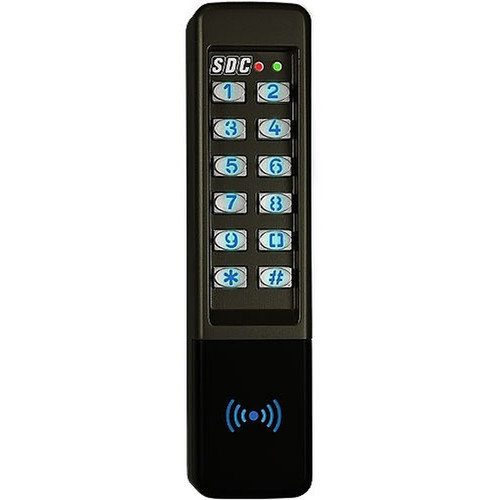
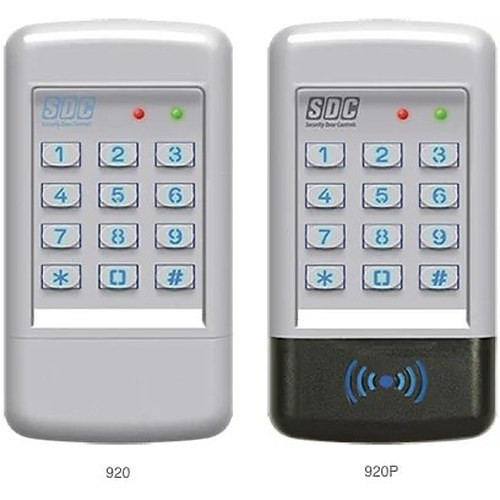
The SDC 923P and 920P are both wired, dual-credential access control readers from Security Door Controls, combining HID proximity card reading with a 12-key PIN keypad and communicating over OSDP. Both target commercial and light-industrial door control applications and share the same user capacity and credential ecosystem. The primary differentiator is form factor: the 923P is a narrow-profile unit optimized for space-constrained door frames, while the 920P is a standard-body indoor/outdoor reader suited to general-purpose deployments.
In This Guide
Which reader fits your door hardware and mounting constraints?
The 923P is explicitly specified as a narrow-profile unit measuring 1¾"W × 7½"H × 1¾"D with a 1½" wall projection and weighing 1.65 lbs. This geometry is purpose-built for narrow door stiles, mullions, or any frame where a standard-width reader would not physically fit or would look disproportionate. The die-cast metal housing supports both indoor and outdoor deployment.
The 920P is described as an indoor/outdoor reader but no dimensional or weight data is present in the provided specifications. Buyers requiring precise cutout dimensions, gang-box compatibility, or stile-width clearance for the 920P must consult the manufacturer datasheet at /content/product-datasheets/920P.pdf before specifying. The absence of published dimensions in the available specs is a real planning risk for retrofit installations.
What are the environmental and power requirements for each reader?
The 923P carries a published operating temperature range of -4°F to +140°F (-20°C to +60°C) and an input voltage of 30VDC. These figures allow installers to confirm compatibility with their panel power supplies and to assess suitability for unheated vestibules, parking structures, or outdoor canopy locations without additional enclosures.
The 920P carries an outdoor-rated environment designation and shares the OSDP wired communication topology, but no operating temperature range and no input voltage figure appear in the provided specifications. Installers cannot verify cold-weather or high-heat suitability from available data alone. The outdoor rating is noted, but the absence of a temperature spec and voltage spec for the 920P is a meaningful gap when designing for extreme climates or verifying panel power budgets.
How do these readers handle credentials, user capacity, and panel integration?
Both the 923P and 920P support HID proximity credentials paired with keypad PIN entry, communicate via OSDP (Open Supervised Device Protocol), and are rated for up to 500 user profiles. OSDP provides encrypted, supervised communication and is compatible with a broad range of enterprise access control panels. The 923P spec explicitly notes compatibility with enterprise access panels; the 920P's OSDP implementation implies the same panel ecosystem.
Neither model lists Wiegand as an alternative protocol in the provided specs, so integrators committed to legacy Wiegand-only panels should verify compatibility before specifying either unit. The 923P's 12-key illuminated, moisture-resistant keypad is explicitly documented; the 920P's keypad construction details are not described in the available specifications beyond the reader-type designation. Both carry a lifetime warranty, equalizing long-term support risk.
Which should you choose: the 923P or the 920P?
Our take: The 923P is the stronger choice when installation geometry is constrained or when environmental spec certainty is required at the design stage. It provides the only published dimensions (1¾"W × 7½"H × 1¾"D), a confirmed operating temperature range (-4°F to +140°F), and a specified input voltage (30VDC) — three data points absent from the 920P's available specifications. On shared attributes, both units are equivalent: 500-user capacity, HID proximity + PIN credentials, OSDP communication, wired connectivity, and a lifetime warranty. The 920P carries an outdoor-rated designation and may be the appropriate standard-body choice for general-purpose lobbies or loading-dock doors, but installers cannot confirm temperature limits or power draw from current spec data and must reference the manufacturer datasheet before finalizing a 920P design. Specify the 923P for narrow-stile retrofits or any project requiring verified environmental and power figures at bid time.
Side-by-Side Comparison
Spec-for-spec, from manufacturer data.
| Specification | SDC 923P | SDC 920P |
|---|---|---|
| Product Type | Narrow Keypad + Prox Reader | Indoor/Outdoor Keypad + Prox Reader |
| Form Factor | Narrow profile | Standard (dimensions not specified) |
| Dimensions | 1¾"W × 7½"H × 1¾"D (1½" wall projection) | — |
| Weight | 1.65 lbs | — |
| Communication Protocol | OSDP | OSDP |
| Connectivity | Wired | Wired |
| Credential Type | HID Proximity + PIN | HID Proximity + PIN |
| Reader Type | Proximity + Keypad | Proximity + Keypad |
| Keypad | 12-key illuminated, moisture-resistant | — |
| Max Users | 500 | 500 |
| Input Voltage | 30VDC | — |
| Operating Temperature | -4°F to +140°F (-20°C to +60°C) | — |
| Environment Rating | Indoor/Outdoor (die-cast metal housing) | Outdoor rated |
| Warranty | Lifetime | Lifetime |
| Compatible Panels | Enterprise access panels | — |
| Datasheet | /content/product-datasheets/923P.pdf | /content/product-datasheets/920P.pdf |
Frequently Asked Questions
Which should you choose: the 923P or the 920P?
The 923P is the stronger choice when installation geometry is constrained or when environmental spec certainty is required at the design stage. It provides the only published dimensions (1¾"W × 7½"H × 1¾"D), a confirmed operating temperature range (-4°F to +140°F), and a specified input voltage (30VDC) — three data points absent from the 920P's available specifications. On shared attributes, both units are equivalent: 500-user capacity, HID proximity + PIN credentials, OSDP communication, wired connectivity, and a lifetime warranty. The 920P carries an outdoor-rated designation and may be the appropriate standard-body choice for general-purpose lobbies or loading-dock doors, but installers cannot confirm temperature limits or power draw from current spec data and must reference the manufacturer datasheet before finalizing a 920P design. Specify the 923P for narrow-stile retrofits or any project requiring verified environmental and power figures at bid time.
Can either reader be used outdoors in cold climates?
The 923P is confirmed rated from -4°F to +140°F (-20°C to +60°C) based on published specs, making it documentably suitable for most North American outdoor climates without supplemental heating. The 920P carries an outdoor-rated designation but no operating temperature range appears in the available specifications, so cold-climate suitability cannot be confirmed from current data — consult the 920P datasheet at /content/product-datasheets/920P.pdf before specifying for freezing environments.
Is the 923P or 920P better for larger deployments?
Neither unit has an advantage on user capacity — both support up to 500 user profiles and both communicate via OSDP, which is the same panel integration path. For deployments exceeding 500 users, neither reader as specified would be sufficient and an alternative model would need to be evaluated. For multi-door deployments where door hardware varies in stile width, the 923P's narrow form factor adds flexibility; the 920P's standard body suits conventional frame widths.
Do both readers work with my existing HID cards and access control panel?
Yes, both the 923P and 920P support HID proximity credentials and communicate over OSDP, which is broadly compatible with enterprise-class access control panels. The 923P spec explicitly notes enterprise panel compatibility. Neither model lists Wiegand output in the provided specifications, so if your panel requires Wiegand-only input, verify protocol support with SDC before ordering either unit.
More Access Control Reader Comparisons
- SDC 923P vs Ubiquiti UA-G3-FLEX-B
- SDC 923P vs Kantech KT-SIG-20KTKS-01
- SDC 923P vs Speco Technologies AP620HA
- SDC 923P vs DMP 7463-W
- Ubiquiti UA-G3-FLEX-B vs Kantech KT-SIG-20KTKS-01
- Ubiquiti UA-G3-FLEX-B vs Speco Technologies AP620HA
Access Control Reader Buying Guides
Get a Second Opinion on Your Camera Choice
Share your site layout, coverage goals, and budget. Our team will validate the camera selection, flag anything we would change, and recommend products that match the use case.