
Sato WWHC04041-NHR vs Zebra ZD4A043-D01X01EZ: Specification Comparison
Both the Sato WWHC04041-NHR CT4-LX-HC and the Zebra ZD4A043-D01X01EZ are thermal label printers targeting professional labeling workflows, placing them in the same general product class. The Sato is a healthcare-focused desktop unit supporting both direct thermal and thermal transfer printing, while the Zebra is a direct-thermal-only printer with an integrated 2D scan engine and battery for cordless operation. This comparison examines print performance, form factor and power, and connectivity and scanning capabilities across both models.
In This Guide
- Which printer delivers higher resolution and faster output for demanding label applications?
- How do the two printers differ in physical design, power source, and operating environment?
- Which unit offers broader connectivity and workflow integration, including scanning capability?
- Which should you choose: the WWHC04041-NHR or the ZD4A043-D01X01EZ?
- Side-by-Side Specs
- FAQ
Which printer delivers higher resolution and faster output for demanding label applications?
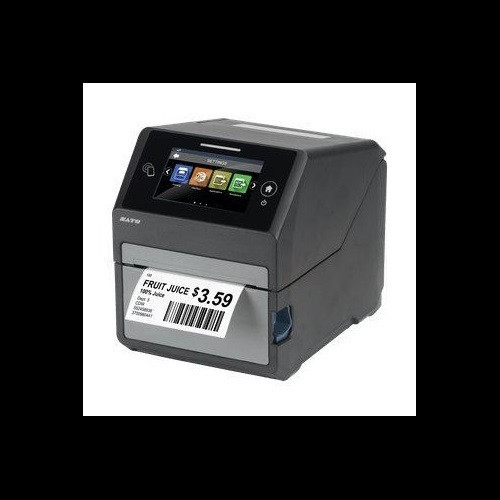
The Sato WWHC04041-NHR prints at 305 dpi and 8 ips with a maximum print width of 4.09 inches. It supports both direct thermal and thermal transfer modes, giving operators flexibility in media and ribbon choices, including ribbon lengths up to 984 ft (300 m). Max media width is 4.1 inches and roll diameter up to 5 inches.
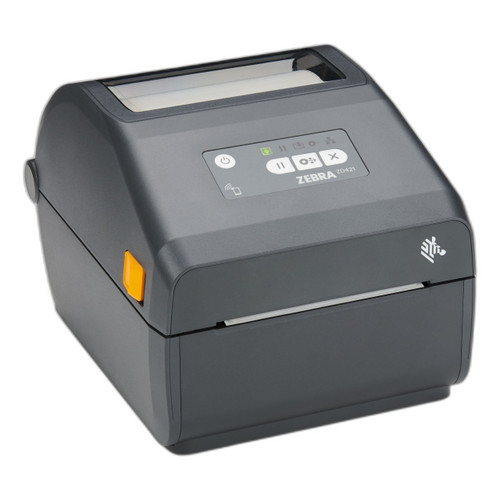
The Zebra ZD4A043-D01X01EZ prints at 300 dpi (noted as 203 dpi/8 dots per mm in a secondary spec field — the 300 dpi figure is cited in the primary resolution spec) and 4 inches per second at 300 dpi. It is direct thermal only, with no ribbon support. Memory is 512 MB Flash and 256 MB SDRAM; the Sato specifies 4 GB Flash, 1 GB DDR3, and 2 GB user storage.
On raw throughput, the Sato's 8 ips is double the Zebra's 4 ips. Resolution is close: 305 dpi (Sato) versus 300 dpi (Zebra). The Sato's dual-mode capability and larger memory pool offer more production flexibility; the Zebra's direct-thermal-only design eliminates ribbon management entirely.
How do the two printers differ in physical design, power source, and operating environment?
The Sato WWHC04041-NHR is a mains-powered desktop unit (AC 100–240 V, 50/60 Hz) measuring 7.0" × 9.375" × 8.4375" and weighing 8.0 lbs (3.6 kg). Its housing is constructed from antimicrobial, disinfectant-resistant plastic — a specification directly relevant to clinical and patient-care environments. Operating temperature is rated 32°F to 104°F (0°C to 40°C). It includes a 4.3-inch full-color touchscreen.
The Zebra ZD4A043-D01X01EZ carries a 2750 mAh battery enabling full-shift cordless operation, with Wi-Fi as its stated connectivity. Mount type is listed as wall or rack. No mains voltage specification, operating temperature range, housing material, or display size is provided in the available specs. Storage humidity is noted as 5%–95% non-condensing.
The Sato is clearly a fixed desktop deployment; the Zebra's battery and wall/rack mount options suggest a more mobile or space-flexible installation. The Sato's antimicrobial housing is a spec the Zebra does not claim. Physical dimensions and weight are not specified for the Zebra.
Which unit offers broader connectivity and workflow integration, including scanning capability?
The Sato WWHC04041-NHR provides USB, Ethernet, Wi-Fi, and Bluetooth connectivity, covering wired and wireless network integration as well as direct device pairing. No integrated scan engine is specified. The printer runs on an unspecified OS but exposes 4 GB Flash and 2 GB user storage for forms and firmware.
The Zebra ZD4A043-D01X01EZ includes an integrated 2D scan engine supporting QR Code, Data Matrix, PDF417, Code 128, Code 39, UPC, and EAN symbologies — a capability absent from the Sato spec. Connectivity is Wi-Fi only per the available specifications, with Bluetooth Low Energy (BLE) and NFC (Print Touch tag) also noted. The operating system is Link-OS. Ethernet is not specified for the Zebra.
For sites requiring wired Ethernet fallback, the Sato covers that; the Zebra does not list Ethernet. Conversely, the Zebra's integrated 2D scanner enables scan-and-print workflows from a single device, which the Sato cannot match. Link-OS provides Zebra's established device management and application ecosystem.
Which should you choose: the WWHC04041-NHR or the ZD4A043-D01X01EZ?
Our take: The WWHC04041-NHR is the stronger choice when the deployment is a fixed clinical or healthcare station requiring disinfectant-resistant construction, faster throughput, and wired network reliability. Key spec deltas: the Sato prints at 8 ips versus the Zebra's 4 ips — a 2× speed advantage; the Sato offers Ethernet in addition to Wi-Fi and Bluetooth while the Zebra lists Wi-Fi only; and the Sato's antimicrobial housing is an explicit spec the Zebra does not claim. The Zebra ZD4A043-D01X01EZ is the better fit where cordless mobility, scan-and-print workflows, or wall/rack mounting are priorities — its 2750 mAh battery, integrated 2D scan engine (QR, Data Matrix, PDF417, Code 128, and more), and Link-OS ecosystem provide capabilities the Sato does not specify. Buyers should note that several Zebra specs — including dimensions, weight, operating temperature, and a secondary resolution field showing 203 dpi — are inconsistent or absent in the provided data and should be verified against the manufacturer datasheet before purchase.
Side-by-Side Comparison
Spec-for-spec, from manufacturer data.
| Specification | Sato WWHC04041-NHR | Zebra ZD4A043-D01X01EZ |
|---|---|---|
| Print Technology | Direct Thermal / Thermal Transfer | Direct Thermal only |
| Print Resolution | 305 dpi | 300 dpi |
| Print Speed | 8 ips | 4 ips |
| Max Print Width | 4.09" | — |
| Max Media Width | 4.1" | — |
| Max Roll Diameter | 5" | — |
| Max Ribbon Length | 984 ft (300 m) | N/A (no ribbon) |
| Display | 4.3" full-color touchscreen | — |
| Connectivity | USB, Ethernet, Wi-Fi, Bluetooth | Wi-Fi, BLE, NFC |
| Integrated Scan Engine | — | 2D (QR, Data Matrix, PDF417, Code 128, Code 39, UPC, EAN) |
| Battery | None (AC mains powered) | 2750 mAh |
| Power Input | AC 100–240 V, 50/60 Hz | — |
| Housing | Antimicrobial, disinfectant-resistant plastic | — |
| Memory | 4 GB Flash / 1 GB DDR3 / 2 GB user storage | 512 MB Flash / 256 MB SDRAM |
| Operating Temperature | 32°F–104°F (0°C–40°C) | — |
| Dimensions (W×D×H) | 7.0" × 9.375" × 8.4375" | — |
| Weight | 8.0 lbs (3.6 kg) | — |
| Mount Type | Desktop | Wall / Rack |
| Warranty | 1 year | 1 year |
Frequently Asked Questions
Which should you choose: the WWHC04041-NHR or the ZD4A043-D01X01EZ?
The WWHC04041-NHR is the stronger choice when the deployment is a fixed clinical or healthcare station requiring disinfectant-resistant construction, faster throughput, and wired network reliability. Key spec deltas: the Sato prints at 8 ips versus the Zebra's 4 ips — a 2× speed advantage; the Sato offers Ethernet in addition to Wi-Fi and Bluetooth while the Zebra lists Wi-Fi only; and the Sato's antimicrobial housing is an explicit spec the Zebra does not claim. The Zebra ZD4A043-D01X01EZ is the better fit where cordless mobility, scan-and-print workflows, or wall/rack mounting are priorities — its 2750 mAh battery, integrated 2D scan engine (QR, Data Matrix, PDF417, Code 128, and more), and Link-OS ecosystem provide capabilities the Sato does not specify. Buyers should note that several Zebra specs — including dimensions, weight, operating temperature, and a secondary resolution field showing 203 dpi — are inconsistent or absent in the provided data and should be verified against the manufacturer datasheet before purchase.
Is the WWHC04041-NHR or ZD4A043-D01X01EZ better for hospital or clinical labeling environments?
The Sato WWHC04041-NHR is specifically designed for healthcare settings: its housing is explicitly rated antimicrobial and disinfectant-resistant, it supports both direct thermal and thermal transfer media for wristbands and specimen labels, and it provides a 4.3-inch color touchscreen for staff interaction. The Zebra ZD4A043-D01X01EZ does not specify antimicrobial housing or thermal transfer capability in the available specs. For confirmed clinical-grade construction, the Sato is the spec-supported choice.
Can the ZD4A043-D01X01EZ operate without being plugged into the wall, and does the WWHC04041-NHR offer the same?
The Zebra ZD4A043-D01X01EZ includes a 2750 mAh battery rated for full-shift cordless operation, making it suitable for mobile or untethered use cases. The Sato WWHC04041-NHR is mains-powered (AC 100–240 V) with no battery option specified; it requires a wall outlet and is classified as a desktop unit. If cordless operation is a requirement, the Zebra is the only option supported by the available specifications.
Which printer can scan barcodes as well as print them — and does that matter for my workflow?
The Zebra ZD4A043-D01X01EZ includes an integrated 2D scan engine supporting QR Code, Data Matrix, PDF417, Code 128, Code 39, UPC, and EAN symbologies, enabling scan-and-print or scan-to-verify workflows from a single device. The Sato WWHC04041-NHR does not specify any integrated scan engine. If your workflow requires reading existing barcodes — for example, scanning a patient wristband to trigger label reprinting — the Zebra provides that capability without an additional scanner; the Sato does not.
More Label Printer Comparisons
- Sato WWCT04241-NAR vs Zebra ZD4A043-D01X01EZ
- Sato WWCT04241-NAR vs Zebra ZT41142-T010000Z
- Sato WWCT04241-NAR vs Zebra ZT41142-T31A000Z
- Sato WWCT04241-NAR vs Sato WWCT04441-WCN
- Sato WWCT04241-NAR vs Sato WWHC03041-WAN
- Sato WWCT04441-WCN vs Zebra ZD4A043-D01X01EZ
Label Printer Buying Guides
Get a Second Opinion on Your Camera Choice
Share your site layout, coverage goals, and budget. Our team will validate the camera selection, flag anything we would change, and recommend products that match the use case.