
Sato WWCT04241-NAR vs Zebra ZD4A043-D01X01EZ: Specification Comparison
Both the Sato CT4-LX WWCT04241-NAR and the Zebra ZD4A043-D01X01EZ are desktop-class direct thermal label printers aimed at B2B barcode and label production environments. The Sato adds thermal transfer capability and UHF RFID encoding, while the Zebra integrates a 2D scan engine and runs on a rechargeable battery. This comparison covers print performance, connectivity and memory architecture, and the specialized feature sets that differentiate each unit for specific deployment scenarios.
In This Guide
- Which printer delivers faster throughput and higher output quality?
- How do the two units compare on connectivity options and onboard memory?
- Which unit is better equipped for RFID encoding or integrated scanning workflows?
- Which should you choose: the WWCT04241-NAR or the ZD4A043-D01X01EZ?
- Side-by-Side Specs
- FAQ
Which printer delivers faster throughput and higher output quality?
The Sato WWCT04241-NAR is rated at 8 ips at 305 dpi, with a maximum print width of 4.09 inches. It supports both direct thermal and thermal transfer print methods, giving operators the option to use ribbon media for longer-lasting labels. The 305 dpi resolution is spec-confirmed across multiple data fields.
The Zebra ZD4A043-D01X01EZ is rated at 4 in./sec (4 ips) at 300 dpi, making it half the print speed of the Sato. It is direct thermal only, with no thermal transfer capability noted in the provided specs. Print width for the Zebra is not explicitly stated in the supplied specifications. The Sato holds a clear advantage in both speed (8 ips vs. 4 ips) and confirmed print method flexibility.
How do the two units compare on connectivity options and onboard memory?
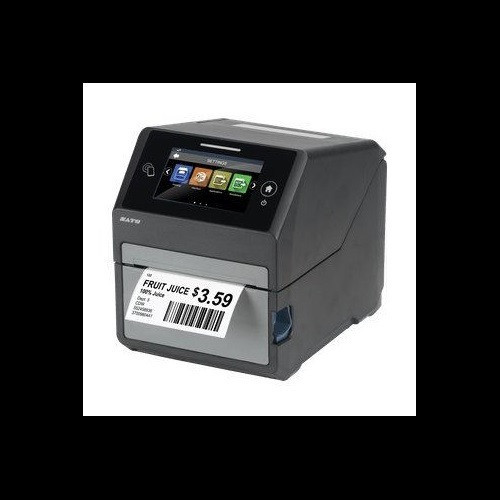
The Sato WWCT04241-NAR offers Ethernet, Wi-Fi, Bluetooth, and USB 2.0, covering wired and wireless network environments. Its memory spec is substantial: 4 GB Flash, 1 GB DDR3 RAM, and 2 GB user storage. A 4.3-inch touchscreen is included for local configuration. Power is supplied via AC 100–240V, 50/60 Hz.
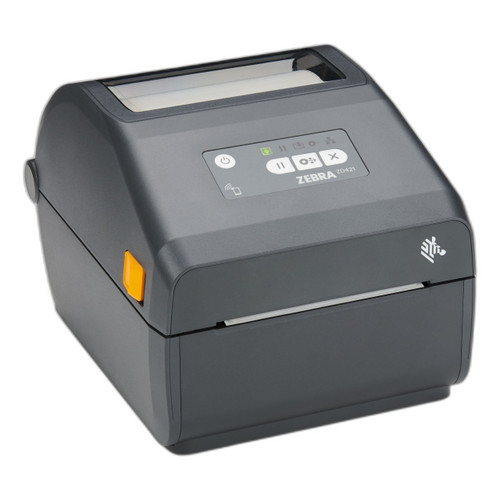
The Zebra ZD4A043-D01X01EZ lists Wi-Fi as its primary connectivity, with Bluetooth Low Energy (BLE) and NFC (Print Touch) also noted in the specs. Wired Ethernet is not listed. Memory is specified at 512 MB Flash and 256 MB SDRAM — significantly less than the Sato on both counts. The Zebra runs on a 2,750 mAh rechargeable battery, enabling cordless, untethered operation where AC power is unavailable — an attribute the Sato does not offer.
Which unit is better equipped for RFID encoding or integrated scanning workflows?
The Sato WWCT04241-NAR includes a built-in UHF RFID encoder operating at 860–960 MHz and compliant with EPC Class 1 Gen 2, with auto antenna optimization noted in the product bullets. This makes it purpose-built for RFID smart label printing without any add-on hardware. Max media roll diameter is 5 inches; max ribbon length is 984 ft. Media width range is 1 inch to 4.1 inches.
The Zebra ZD4A043-D01X01EZ incorporates a 2D scan engine supporting QR Code, Data Matrix, PDF417, Code 128, Code 39, UPC, and EAN symbologies — enabling label verification or receive-and-print workflows at the point of printing. RFID encoding capability is not listed in the provided Zebra specs. The Zebra's battery-powered, Wi-Fi-connected design, combined with its integrated scanner, makes it suited to mobile or counter-based scan-and-print tasks. Operating temperature range and physical dimensions are not provided for the Zebra in the supplied data.
Which should you choose: the WWCT04241-NAR or the ZD4A043-D01X01EZ?
Our take: The WWCT04241-NAR is the stronger choice when the deployment requires UHF RFID smart label encoding, higher throughput, or wired network integration. It prints at 8 ips versus the ZD4A043-D01X01EZ's 4 ips — a 2× speed advantage — and carries 4 GB Flash and 1 GB DDR3 versus the Zebra's 512 MB Flash and 256 MB SDRAM. Its four-interface connectivity (Ethernet, Wi-Fi, Bluetooth, USB) gives it broader infrastructure compatibility than the Zebra's Wi-Fi/BLE-only stack. Conversely, the ZD4A043-D01X01EZ is the better fit when cordless mobility matters: its 2,750 mAh battery enables untethered shift operation, and its integrated 2D scan engine (QR, Data Matrix, PDF417, Code 128, UPC, EAN) adds inline verification capability absent from the Sato. Choose the Sato for fixed-station, RFID-enabled, high-volume label lines; choose the Zebra for mobile, scan-and-print, or battery-dependent counter environments.
Side-by-Side Comparison
Spec-for-spec, from manufacturer data.
| Specification | Sato WWCT04241-NAR | Zebra ZD4A043-D01X01EZ |
|---|---|---|
| Print Method | Direct Thermal / Thermal Transfer | Direct Thermal only |
| Print Resolution | 305 dpi | 300 dpi |
| Print Speed | 8 ips | 4 ips |
| Max Print Width | 4.09 in. | Not specified |
| Media Width Range | 1 in. – 4.1 in. | Not specified |
| Max Media Roll Diameter | 5 in. | Not specified |
| Max Ribbon Length | 984 ft | — (no ribbon, DT only) |
| RFID Encoding | UHF 860–960 MHz, EPC C1G2 | — |
| Integrated Scanner | — | 2D (QR, Data Matrix, PDF417, Code 128, Code 39, UPC, EAN) |
| Connectivity | Ethernet, Wi-Fi, Bluetooth, USB 2.0 | Wi-Fi, BLE, NFC |
| Memory (Flash) | 4 GB | 512 MB |
| Memory (RAM) | 1 GB DDR3 | 256 MB SDRAM |
| User Storage | 2 GB | Not specified |
| Touchscreen | 4.3 in. | Not specified |
| Power Source | AC 100–240V, 50/60 Hz | 2,750 mAh battery |
| Warranty | 1 year | 1 year |
Frequently Asked Questions
Which should you choose: the WWCT04241-NAR or the ZD4A043-D01X01EZ?
The WWCT04241-NAR is the stronger choice when the deployment requires UHF RFID smart label encoding, higher throughput, or wired network integration. It prints at 8 ips versus the ZD4A043-D01X01EZ's 4 ips — a 2× speed advantage — and carries 4 GB Flash and 1 GB DDR3 versus the Zebra's 512 MB Flash and 256 MB SDRAM. Its four-interface connectivity (Ethernet, Wi-Fi, Bluetooth, USB) gives it broader infrastructure compatibility than the Zebra's Wi-Fi/BLE-only stack. Conversely, the ZD4A043-D01X01EZ is the better fit when cordless mobility matters: its 2,750 mAh battery enables untethered shift operation, and its integrated 2D scan engine (QR, Data Matrix, PDF417, Code 128, UPC, EAN) adds inline verification capability absent from the Sato. Choose the Sato for fixed-station, RFID-enabled, high-volume label lines; choose the Zebra for mobile, scan-and-print, or battery-dependent counter environments.
Does either printer support RFID label encoding out of the box?
Yes — the Sato WWCT04241-NAR includes a built-in UHF RFID encoder (860–960 MHz, EPC C1G2) as a standard feature. The Zebra ZD4A043-D01X01EZ does not list RFID encoding capability in the provided specifications.
Can the Zebra ZD4A043-D01X01EZ work without a power outlet?
Yes. The Zebra is equipped with a 2,750 mAh rechargeable battery rated for full-shift cordless operation. The Sato WWCT04241-NAR requires AC power (100–240V, 50/60 Hz) and does not list a battery option in the provided specs.
Which printer is faster, and does that matter for my line?
The Sato WWCT04241-NAR prints at 8 ips (305 dpi); the Zebra ZD4A043-D01X01EZ prints at 4 ips (300 dpi). If your operation demands continuous high-volume label output — shipping lines, manufacturing, warehouse pick-and-pack — the Sato's 2× speed advantage is meaningful. For lower-volume, on-demand, or point-of-use printing, the Zebra's throughput is likely sufficient.
More Label Printer Comparisons
- Sato WWCT04241-NAR vs Zebra ZT41142-T010000Z
- Sato WWCT04241-NAR vs Zebra ZT41142-T31A000Z
- Sato WWCT04241-NAR vs Sato WWCT04441-WCN
- Sato WWCT04241-NAR vs Sato WWHC03041-WAN
- Sato WWCT04441-WCN vs Zebra ZD4A043-D01X01EZ
- Sato WWCT04441-WCN vs Zebra ZT41142-T010000Z
Label Printer Buying Guides
Get a Second Opinion on Your Camera Choice
Share your site layout, coverage goals, and budget. Our team will validate the camera selection, flag anything we would change, and recommend products that match the use case.