
Pelco SRXP4-3V29-EBT-IR vs Pelco SRXV2-2V13-EBT-IR: Specification Comparison
Both the Pelco SRXP4-3V29-EBT-IR (Sarix Pro 4) and the SRXV2-2V13-EBT-IR (Sarix Value 2) are 2MP outdoor bullet cameras with IR illumination, PoE power, and IK09 vandal resistance — a pairing a systems integrator would legitimately cross-shop when selecting perimeter or area-surveillance cameras on the same Pelco platform. The comparison turns on imaging performance headroom (WDR depth, frame rate, low-light floor), lens flexibility versus reach, analytics capability, and ONVIF profile breadth relative to project budget tier.
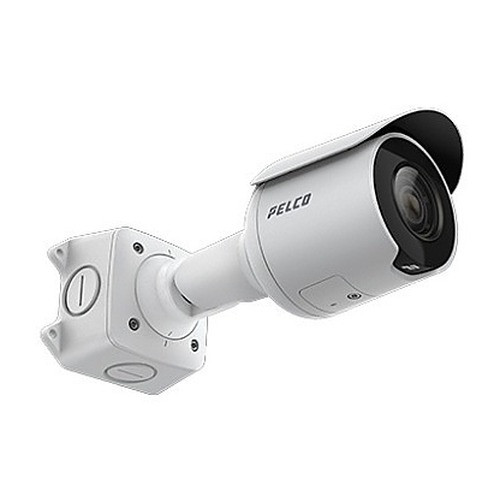
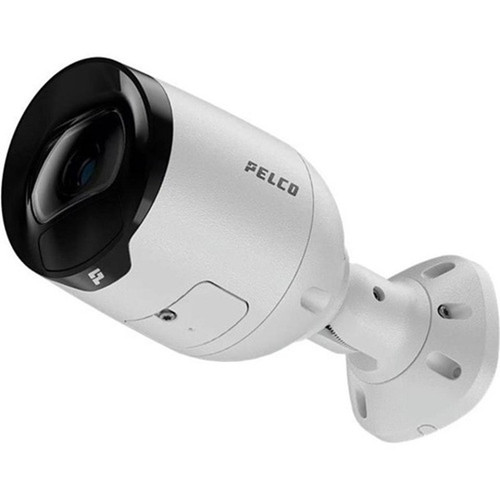
In This Guide
How do the imaging specs compare?
Both cameras share a 1/2.8-inch progressive-scan CMOS sensor at 1920×1080 resolution, but diverge meaningfully in dynamic range and frame rate. The SRXP4-3V29-EBT-IR delivers 130 dB WDR (branded SureVision) versus 120 dB on the SRXV2-2V13-EBT-IR — a 10 dB advantage that translates to handling roughly three times the luminance ratio before clipping. The Pro 4 also runs at 60 fps maximum versus 30 fps on the Value 2, a relevant delta for capturing fast-moving vehicles or persons without motion blur artifacts.
On low-light and IR, the SRXP4-3V29-EBT-IR specifies a color minimum illumination of 0.01 lux versus 0.02 lux on the SRXV2-2V13-EBT-IR; both reach 0 lux in IR mode with 850 nm illuminators. The lens configurations differ substantially: the Pro 4 carries a 4.4–9.3 mm motorized varifocal (32–109° HFOV) enabling remote zoom and focus adjustment after installation, while the Value 2's focal length is listed in one field as a 2.7–13.5 mm varifocal and in another as a fixed 13 mm — the specs are internally inconsistent; buyers should confirm the exact lens configuration with the datasheet before specifying. IR illumination range is not stated in the provided specs for either model.
What about installation and environment?
Both cameras are rated IP66 and IK09, carry white housings, and are powered via PoE Class 3. The SRXP4-3V29-EBT-IR adds an IP67 rating per its marketing bullets, though the formal spec field lists IP66 only — confirm with the datasheet for submersion-rated installations. Operating temperature range is specified only for the SRXV2-2V13-EBT-IR at −40 °C to +60 °C; the Pro 4's spec field lists a storage temperature of −10 °C to +70 °C but does not clearly state an operating range — integrators in extreme-cold deployments should verify the Pro 4's operating floor before specifying.
Mounting options diverge slightly: the Pro 4 lists wall, ceiling, and pendant mounts; the Value 2 adds pole and corner mounts, giving it more flexibility for perimeter column or street-pole installations without an adapter. The Pro 4 is heavier at approximately 0.81–1.07 kg (depending on configuration) versus the Value 2 at approximately 0.54–0.64 kg, relevant for junction-box load ratings. RJ-45 connectivity is confirmed for the Value 2; the Pro 4 spec does not explicitly list connector type but PoE delivery implies Ethernet.
Which fits your VMS and analytics better?
The SRXP4-3V29-EBT-IR supports ONVIF Profile S, Profile T, Profile G, and Profile M — the broadest current ONVIF suite, including Profile G for on-camera recording and Profile M for metadata and analytics interoperability. The SRXV2-2V13-EBT-IR is limited to ONVIF Profile S and Profile T, omitting Profile G and Profile M. For VMS platforms that leverage Profile G edge-recording failover or Profile M analytics metadata streams, only the Pro 4 qualifies natively.
Edge analytics are available only on the SRXP4-3V29-EBT-IR, which specifies Smart Analytics including Person/Vehicle Detection, Directional Violation, Loitering, Beam Crossing, Crowd Detection, and Tamper Alert. The SRXV2-2V13-EBT-IR lists no edge analytics in the provided specs. Both cameras support microSD edge storage and HTTPS encryption. Audio input (microphone supported) is noted for the Pro 4; no audio capability is stated in the Value 2 specs. The Pro 4 carries 1 GB RAM / 512 MB Flash versus 512 MB RAM / 256 MB Flash on the Value 2, supporting the heavier analytics and compression workload.
Which should you choose: the SRXP4-3V29-EBT-IR or the SRXV2-2V13-EBT-IR?
Our take: The SRXP4-3V29-EBT-IR is the stronger choice when imaging fidelity, edge analytics, or broad ONVIF integration are project requirements. Concretely: it delivers 130 dB WDR versus 120 dB on the Value 2 — a 10 dB margin critical in high-contrast entry or parking environments; it runs at 60 fps versus 30 fps, halving motion blur risk on fast-moving subjects; and it adds ONVIF Profile G and Profile M that the Value 2 lacks, enabling VMS-agnostic on-camera recording failover and metadata-driven search. The SRXV2-2V13-EBT-IR is the appropriate selection where budget is the primary constraint, a fixed long-range lens suits the scene, pole or corner mounting is needed, or the VMS relies solely on Profile S/T. Cold-climate deployments should verify the Pro 4's operating temperature floor, as only the Value 2 explicitly specifies −40 °C operation.
Side-by-Side Comparison
Spec-for-spec, from manufacturer data.
| Specification | Pelco SRXP4-3V29-EBT-IR | Pelco SRXV2-2V13-EBT-IR |
|---|---|---|
| Series | Sarix Professional 4 | Sarix Value 2 |
| Part Number | SRXP4-3V29-EBT-IR | SRXV2-2V13-EBT-IR |
| Resolution | 2MP (1920×1080) | 2MP (1920×1080) |
| Image Sensor | 1/2.8" Progressive Scan CMOS | 1/2.8" Progressive Scan CMOS |
| Lens / Focal Length | 4.4–9.3 mm motorized varifocal | Spec inconsistent: 2.7–13.5 mm varifocal or 13 mm fixed — verify datasheet |
| HFOV | 32–109° | — |
| Aperture | F1.4 | F1.4 |
| Min Illumination (Color / IR) | 0.01 lux / 0 lux | 0.02 lux / 0 lux |
| WDR | 130 dB SureVision | 120 dB |
| Max Frame Rate | 60 fps | 30 fps |
| Video Compression | H.264; H.265; Smart Compression | H.265; H.264; Motion JPEG |
| ONVIF Profiles | S, T, G, M | S, T |
| Edge Analytics | Person/Vehicle Detection, Directional Violation, Loitering, Beam Crossing, Crowd Detection, Tamper Alert | — |
| IP Rating | IP66 (IP67 per marketing field — verify) | IP66 |
| IK / Impact Rating | IK09 | IK09 |
| Operating Temperature | Not explicitly stated in provided specs | −40 °C to +60 °C |
| Power / PoE Class | PoE Class 3 (802.3af) | PoE Class 3 (802.3af) |
| Edge Storage | microSD | microSD |
| Audio | Microphone supported | — |
| Memory | 1 GB RAM / 512 MB Flash | 512 MB RAM / 256 MB Flash |
| Mount Types | Wall; Ceiling; Pendant | Wall; Ceiling; Pole; Pendant; Corner |
| Weight | 0.81–1.07 kg (config-dependent) | 0.54–0.64 kg (config-dependent) |
| Warranty | 5-year | 5-year |
| NDAA Section 889 | — | Compliant |
Frequently Asked Questions
Which should you choose: the SRXP4-3V29-EBT-IR or the SRXV2-2V13-EBT-IR?
The SRXP4-3V29-EBT-IR is the stronger choice when imaging fidelity, edge analytics, or broad ONVIF integration are project requirements. Concretely: it delivers 130 dB WDR versus 120 dB on the Value 2 — a 10 dB margin critical in high-contrast entry or parking environments; it runs at 60 fps versus 30 fps, halving motion blur risk on fast-moving subjects; and it adds ONVIF Profile G and Profile M that the Value 2 lacks, enabling VMS-agnostic on-camera recording failover and metadata-driven search. The SRXV2-2V13-EBT-IR is the appropriate selection where budget is the primary constraint, a fixed long-range lens suits the scene, pole or corner mounting is needed, or the VMS relies solely on Profile S/T. Cold-climate deployments should verify the Pro 4's operating temperature floor, as only the Value 2 explicitly specifies −40 °C operation.
Is the SRXP4-3V29-EBT-IR or SRXV2-2V13-EBT-IR better for low light?
Both reach 0 lux in IR mode with 850 nm illumination. In color/day-night transition, the SRXP4-3V29-EBT-IR has a specified color minimum illumination of 0.01 lux versus 0.02 lux on the SRXV2-2V13-EBT-IR — a one-stop advantage. The Pro 4 also carries 130 dB WDR versus 120 dB, providing better handling of mixed bright and dark zones simultaneously. For scenes with significant artificial lighting contrast, the Pro 4's WDR margin is the more meaningful differentiator.
Can the SRXV2-2V13-EBT-IR run person or vehicle detection at the edge?
No. Based on the provided specifications, edge analytics (Person/Vehicle Detection, Loitering, Directional Violation, Beam Crossing, Crowd Detection, Tamper Alert) are listed only for the SRXP4-3V29-EBT-IR. The SRXV2-2V13-EBT-IR does not include any edge analytics in its spec data. If onboard detection is required to reduce VMS server load or enable standalone alerting, the Pro 4 is the appropriate model.
Which camera works better in extreme cold, such as a northern outdoor perimeter?
The SRXV2-2V13-EBT-IR explicitly specifies an operating temperature range of −40 °C to +60 °C, making it suitable for severe northern climates. The SRXP4-3V29-EBT-IR's provided specs list a storage temperature of −10 °C to +70 °C but do not clearly state a confirmed operating minimum in the supplied data. Integrators deploying in sub-−10 °C environments should obtain the Pro 4's operating temperature specification directly from Pelco's datasheet before specifying it for cold-climate perimeter use.
Get a Second Opinion on Your Camera Choice
Share your site layout, coverage goals, and budget. Our team will validate the camera selection, flag anything we would change, and recommend products that match the use case.