
Pelco SRXP4-2V10-IMD vs Pelco SRXP4-3V10-IMD-IR: Specification Comparison
Both the Pelco SRXP4-2V10-IMD and the SRXP4-3V10-IMD-IR are 2MP indoor fixed dome cameras from the Sarix Professional 4 series, sharing the same 1/2.8-inch progressive scan CMOS sensor and IK09 vandal rating. The comparison centers on three meaningful differentiators: lens range and field of view, integrated IR illumination, edge analytics depth, and WDR performance—spec differences that drive distinct deployment use cases within the same resolution and camera-type class.
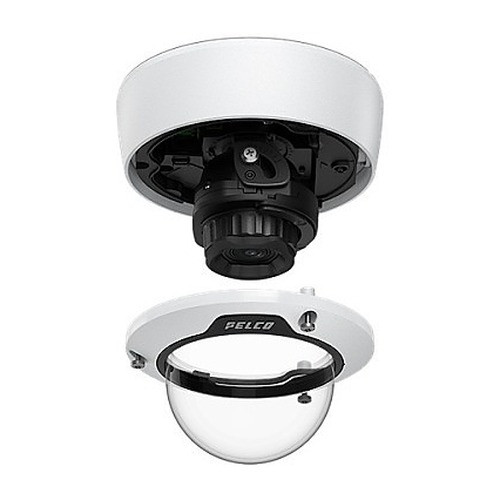

In This Guide
How do the imaging specs compare?
Both cameras resolve at 1920×1080 (2MP) with a 1/2.8-inch progressive scan CMOS sensor and a maximum frame rate of 60 fps. The SRXP4-2V10-IMD uses a 3.4–10.5 mm motorized varifocal lens delivering a horizontal field of view of 101° to 31°, while the SRXP4-3V10-IMD-IR uses a 4.4–9.3 mm motorized varifocal yielding a wider maximum HFOV of 109° down to 32°. The SRXP4-2V10-IMD specifies color minimum illumination at 0.01 lux and monochrome at 0.005 lux (both at 33 ms exposure); the SRXP4-3V10-IMD-IR matches 0.01 lux in color but achieves 0 lux in IR mode via its integrated 850 nm IR illuminator rated to 15–20 meters.
On dynamic range, the SRXP4-2V10-IMD is rated 126 dB WDR (on) and 83 dB without WDR. The SRXP4-3V10-IMD-IR is rated 130 dB via Pelco SureVision—a 4 dB advantage per specification. The SRXP4-2V10-IMD specifies a signal-to-noise ratio greater than 50 dB and 3D noise reduction support; these parameters are not stated in the provided specifications for the SRXP4-3V10-IMD-IR. The SRXP4-2V10-IMD also lists an electronic shutter range of 1/7.5 to 1/30,000 sec and P-Iris control; the SRXP4-3V10-IMD-IR does not specify those parameters in the provided data.
What about installation and environment?
Both cameras carry an IK09 vandal rating and are rated for indoor environments. Both are powered by PoE Class 3 and use an RJ45 connector on CAT5 or higher cabling. Neither requires a separate power supply. The SRXP4-2V10-IMD specifies a 100BASE-TX network interface; the SRXP4-3V10-IMD-IR does not enumerate its network interface speed in the provided specifications. The SRXP4-3V10-IMD-IR lists a storage temperature range of −10 °C to +70 °C (14 °F to 158 °F); the SRXP4-2V10-IMD does not list an explicit operating or storage temperature in its provided specifications.
Mounting options differ: the SRXP4-2V10-IMD specifies wall, ceiling, pole, pendant, and corner mounting; the SRXP4-3V10-IMD-IR specifies wall, ceiling, and pendant. Both are white housing. The SRXP4-2V10-IMD includes Corridor Mode (90°/270° image rotation) enabling portrait-aspect coverage of hallways; that capability is not listed for the SRXP4-3V10-IMD-IR. Both cameras list IP66 in their provided data, though neither is designated for outdoor installation per their environmental rating.
Which fits your VMS and analytics better?
Both cameras are ONVIF Profile S, T, G, and M compliant and support H.264, H.265, and Pelco Smart Compression with Idle Scene Mode for bandwidth management. Both support microSD/SDHC/SDXC onboard edge storage; the SRXP4-2V10-IMD explicitly rates capacity up to 1.5 TB, while the SRXP4-3V10-IMD-IR lists microSD support without a stated capacity ceiling in the provided specifications. Both include 1 GB RAM and 512 MB Flash. The SRXP4-2V10-IMD lists USB 2.0 and alarm I/O (in/out); the SRXP4-3V10-IMD-IR does not enumerate alarm I/O or USB in the provided specifications.
Analytics depth diverges significantly. The SRXP4-2V10-IMD supports Pixel Motion detection and Classified Object Detection per specification. The SRXP4-3V10-IMD-IR specifies a substantially broader Smart Analytics suite: person and vehicle detection, directional violation, loitering, beam crossing, crowd detection, and tamper alert—without requiring a separate VMS analytics license for those functions, per the provided spec. The SRXP4-3V10-IMD-IR also lists microphone/audio support; the SRXP4-2V10-IMD specifies G.711 PCM 8 kHz and Opus audio compression with line-level I/O. Both carry a 5-year warranty.
Which should you choose: the SRXP4-2V10-IMD or the SRXP4-3V10-IMD-IR?
Our take: The SRXP4-3V10-IMD-IR is the stronger choice when the deployment requires true darkness capability and on-camera analytics without VMS dependency. Its integrated 850 nm IR illuminator enables 0-lux monochrome operation at 15–20 m—a capability the SRXP4-2V10-IMD cannot match, as that model has no IR emitter and bottoms out at 0.005 lux monochrome. The SRXP4-3V10-IMD-IR also edges ahead on WDR at 130 dB (SureVision) versus 126 dB, and its built-in Smart Analytics suite—covering loitering, directional violation, crowd detection, and beam crossing—exceeds the SRXP4-2V10-IMD's Pixel Motion and Classified Object Detection. Conversely, choose the SRXP4-2V10-IMD when the site is fully illuminated (eliminating the IR advantage), when Corridor Mode for narrow-hall framing is required, when alarm I/O terminations are needed at the camera head, or when a longer varifocal reach (3.4–10.5 mm vs. 4.4–9.3 mm) is necessary.
Side-by-Side Comparison
Spec-for-spec, from manufacturer data.
| Specification | Pelco SRXP4-2V10-IMD | Pelco SRXP4-3V10-IMD-IR |
|---|---|---|
| Resolution | 2MP (1920×1080) | 2MP (1920×1080) |
| Image Sensor | 1/2.8" progressive scan CMOS | 1/2.8" progressive scan CMOS |
| Lens / Focal Length | 3.4–10.5 mm motorized varifocal | 4.4–9.3 mm motorized varifocal |
| Horizontal FOV | 101° to 31° | 109° to 32° |
| Min Illumination (Color) | 0.01 lux at 33 ms | 0.01 lux |
| Min Illumination (Mono / IR) | 0.005 lux at 33 ms (no IR) | 0 lux (integrated IR) |
| IR Illumination | — | 850 nm, 15–20 m range |
| WDR | 126 dB (WDR on) | 130 dB SureVision |
| Max Frame Rate | 60 fps | 60 fps |
| Video Compression | H.264; H.265; MJPEG; Smart Compression | H.264; H.265; Smart Compression |
| ONVIF Compliance | Profile S, T, G, M | Profile S, T, G, M |
| Edge Analytics | Pixel Motion; Classified Object Detection | Person/Vehicle, Directional Violation, Loitering, Beam Crossing, Crowd Detection, Tamper Alert |
| Audio | Line-level I/O; G.711 PCM 8 kHz; Opus | Microphone supported |
| Alarm I/O | Alarm In + Alarm Out | — |
| Onboard Storage | microSD/SDHC/SDXC up to 1.5 TB | microSD (max capacity not specified) |
| PoE Class | Class 3 | Class 3 |
| IK / Impact Rating | IK09 | IK09 |
| IP Rating | IP66 (per spec data) | IP66 (per spec data) |
| Corridor Mode | Yes (0°/90°/180°/270°) | — |
| Operating Temperature | — | Storage: −10 °C to +70 °C |
| Warranty | 5 years | 5 years |
Frequently Asked Questions
Which should you choose: the SRXP4-2V10-IMD or the SRXP4-3V10-IMD-IR?
The SRXP4-3V10-IMD-IR is the stronger choice when the deployment requires true darkness capability and on-camera analytics without VMS dependency. Its integrated 850 nm IR illuminator enables 0-lux monochrome operation at 15–20 m—a capability the SRXP4-2V10-IMD cannot match, as that model has no IR emitter and bottoms out at 0.005 lux monochrome. The SRXP4-3V10-IMD-IR also edges ahead on WDR at 130 dB (SureVision) versus 126 dB, and its built-in Smart Analytics suite—covering loitering, directional violation, crowd detection, and beam crossing—exceeds the SRXP4-2V10-IMD's Pixel Motion and Classified Object Detection. Conversely, choose the SRXP4-2V10-IMD when the site is fully illuminated (eliminating the IR advantage), when Corridor Mode for narrow-hall framing is required, when alarm I/O terminations are needed at the camera head, or when a longer varifocal reach (3.4–10.5 mm vs. 4.4–9.3 mm) is necessary.
Is the SRXP4-2V10-IMD or SRXP4-3V10-IMD-IR better for low-light performance?
The SRXP4-3V10-IMD-IR is better for true low-light and zero-light conditions. It includes an integrated 850 nm IR illuminator rated to 15–20 meters and achieves 0 lux minimum illumination in IR mode. The SRXP4-2V10-IMD has no built-in IR and is specified at 0.005 lux monochrome minimum (at 33 ms exposure), which requires ambient light. If the scene is fully illuminated, the distinction is irrelevant.
Do both cameras support edge analytics, and how do they differ?
Both support on-camera analytics, but the scope differs. The SRXP4-3V10-IMD-IR specifies a broader Smart Analytics suite including person/vehicle detection, directional violation, loitering, beam crossing, crowd detection, and tamper alert. The SRXP4-2V10-IMD specifies Pixel Motion detection and Classified Object Detection. If your VMS already handles advanced analytics, the SRXP4-2V10-IMD may be sufficient; if you need edge-native behavioral analytics without VMS licensing, the SRXP4-3V10-IMD-IR has the fuller feature set per spec.
Can either camera cover a hallway or corridor layout efficiently?
The SRXP4-2V10-IMD explicitly supports Corridor Mode (90° and 270° image rotation in addition to 0° and 180°), which allows portrait-aspect framing suited to hallways and narrow passages. The SRXP4-3V10-IMD-IR does not list Corridor Mode in its provided specifications. For narrow-hall deployments where portrait framing reduces wasted field of view, the SRXP4-2V10-IMD has a documented advantage.
Get a Second Opinion on Your Camera Choice
Share your site layout, coverage goals, and budget. Our team will validate the camera selection, flag anything we would change, and recommend products that match the use case.