
Pelco SRXP4-2V10-IMD vs Pelco SRXP4-2V10-IMD-IR: Specification Comparison
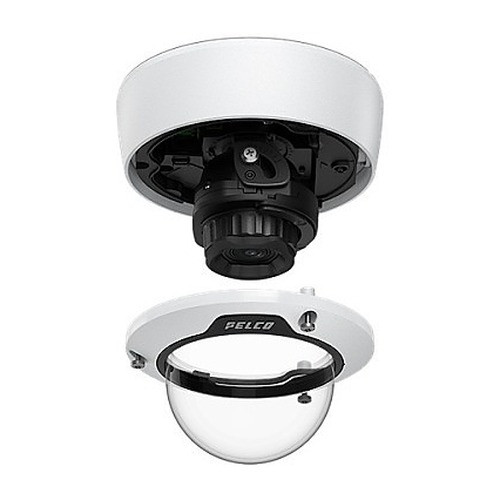
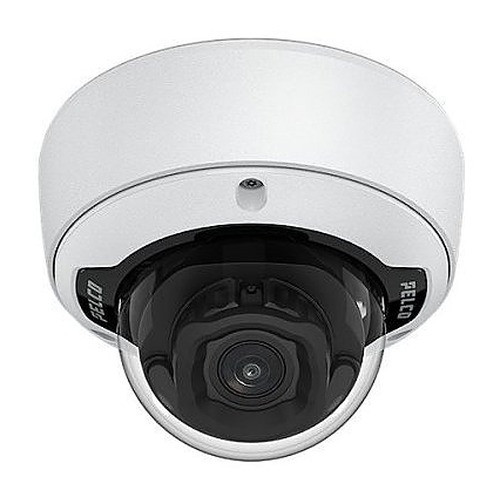
Both the Pelco SRXP4-2V10-IMD and SRXP4-2V10-IMD-IR are 2MP (1920×1080) indoor fixed dome cameras from the Sarix Professional 4 Series, sharing the same 1/2.8-inch progressive scan CMOS sensor, IK09 vandal rating, PoE Class 3 power, and five-year warranty. The meaningful differentiators are the presence of integrated IR illumination and onboard smart analytics in the IMD-IR, versus the wider WDR dynamic range specification and broader lens zoom range in the IMD. Installers choosing between them are weighing low-light illumination strategy against optical flexibility and dynamic range headroom.
In This Guide
How do the imaging specs compare?
Both cameras resolve at 1920×1080 with a 1/2.8-inch progressive scan CMOS sensor and share a maximum frame rate of 60 fps. The SRXP4-2V10-IMD carries a motorized varifocal lens spanning 3.4–10.5 mm, delivering a horizontal angle of view from 101° down to 31°. The SRXP4-2V10-IMD-IR uses a narrower 4.4–9.3 mm motorized varifocal lens, covering 109° to 32° HFOV. The IMD-IR's shorter focal-length floor gives a marginally wider maximum field of view (109° vs 101°), but the IMD reaches a longer telephoto end at 10.5 mm vs 9.3 mm. The IMD specifies WDR performance at 126 dB (WDR on) and 83 dB (WDR off); the IMD-IR quotes 130 dB SureVision WDR—a 4 dB advantage on paper.
For low-light operation, the IMD specifies 0.01 lux color and 0.005 lux monochrome at 33 ms exposure. The IMD-IR specifies 0.01 lux color and 0 lux in IR mode, indicating integrated IR illumination that enables imaging in complete darkness. The IMD's 0.005 lux monochrome figure reflects passive sensitivity only; no IR illuminator is specified for that model. The IMD-IR's 0 lux IR floor is the decisive low-light differentiator. Both cameras support 3D noise reduction and P-Iris control per the IMD spec; the IMD-IR datasheet does not separately enumerate those controls, though both share the same Sarix Pro 4 platform.
What about installation and environment?
Both units are rated for indoor environments, carry an IK09 vandal impact rating, and are powered via PoE Class 3 (802.3af). Both share a white dome housing. The IMD datasheet specifies IP66 environmental sealing, which is notable for an indoor-rated unit and would support installations near washdown areas or in dusty environments. The IMD-IR datasheet references IP66 in the enrichment data. Neither model specifies an operating temperature range in a clean, directly comparable spec field; the IMD-IR raw data references a storage temperature of –10°C to +70°C (14°F to 158°F), but that is labeled as storage, not operating—operating temperature is not confirmed for either unit from the provided specs.
Mounting options differ slightly by spec: the IMD lists wall, ceiling, pole, pendant, and corner mounting; the IMD-IR lists wall, ceiling, and pendant. Both connect via RJ-45 on CAT5 or higher cabling at 100BASE-TX. The IMD explicitly lists a USB 2.0 port; the IMD-IR does not specify one. Dimensions and weight entries in both datasets contain formatting anomalies and should be verified against the official datasheets before specifying for enclosure or bracket load calculations.
Which fits your VMS and analytics better?
Both cameras are ONVIF Profile S, T, G, and M compliant and support H.264, H.265, and Smart Compression (Pelco's bandwidth management codec). Both support microSD/SDHC/SDXC onboard edge storage; the IMD explicitly states up to 1.5 TB capacity, while the IMD-IR lists microSD support without specifying a maximum capacity in the provided specs. Both units carry 1 GB RAM and 512 MB Flash. The IMD specifies supported protocols (IPv4, IPv6, HTTP, HTTPS, DNS, NTP, RTSP, RTP, TCP, UDP, DHCP), alarm I/O (alarm in, alarm out), and line-level audio I/O with G.711 PCM 8 kHz and Opus compression. The IMD-IR notes microphone support but does not specify line-level I/O or audio codec details in the provided data.
The IMD-IR carries a materially richer onboard analytics package: Person/Vehicle Detection, Directional Violation, Loitering, Beam Crossing, Crowd Detection, and Tamper Alert are all specified. The IMD lists Pixel Motion Detection and Classified Object Detection. Installers relying on edge analytics for VMS-lite or bandwidth-constrained deployments will find the IMD-IR's analytics suite significantly broader. The IMD specifies up to 64 privacy zones and image rotation including corridor mode; the IMD-IR does not enumerate those features in the provided specs.
Which should you choose: the SRXP4-2V10-IMD or the SRXP4-2V10-IMD-IR?
Our take: The SRXP4-2V10-IMD-IR is the stronger choice when the deployment requires imaging in complete darkness or near-zero ambient light, and when onboard smart analytics must operate without relying on the VMS. Its integrated IR illuminator reaches 0 lux versus the IMD's passive 0.005 lux monochrome floor—a fundamental capability gap in unlit or intermittently lit indoor spaces. Its WDR specification of 130 dB SureVision exceeds the IMD's 126 dB by 4 dB, and its onboard analytics (loitering, beam crossing, crowd detection, directional violation) go substantially beyond the IMD's pixel motion and classified object detection. Conversely, the SRXP4-2V10-IMD is the better fit when telephoto reach matters—its 10.5 mm focal length tops the IMD-IR's 9.3 mm—and when alarm I/O, line-level audio, confirmed 1.5 TB edge storage, and up to 64 privacy zones are required. Both are appropriate for ONVIF Profile S/T/G/M VMS environments with PoE Class 3 infrastructure.
Side-by-Side Comparison
Spec-for-spec, from manufacturer data.
| Specification | Pelco SRXP4-2V10-IMD | Pelco SRXP4-2V10-IMD-IR |
|---|---|---|
| Resolution | 2MP (1920×1080) | 2MP (1920×1080) |
| Image Sensor | 1/2.8" Progressive Scan CMOS | 1/2.8" Progressive Scan CMOS |
| Lens / Focal Length | 3.4–10.5 mm motorized varifocal | 4.4–9.3 mm motorized varifocal |
| Horizontal Field of View | 101° – 31° | 109° – 32° |
| WDR | 126 dB (WDR on) / 83 dB (WDR off) | 130 dB SureVision |
| Min Illumination (Color) | 0.01 lux at 33 ms | 0.01 lux |
| Min Illumination (Mono / IR) | 0.005 lux (passive, no IR) | 0 lux (IR enabled) |
| IR Illumination | — | Integrated IR |
| Max Frame Rate | 60 fps | 60 fps |
| Video Compression | H.264; H.265; MJPEG; Smart Compression | H.264; H.265; Smart Compression |
| ONVIF Compliance | Profile S, T, G, M | Profile S, T, G, M |
| Edge Analytics | Pixel Motion; Classified Object Detection | Person/Vehicle, Loitering, Beam Crossing, Directional Violation, Crowd Detection, Tamper Alert |
| Audio | Line-level I/O; G.711 PCM 8 kHz; Opus | Microphone supported (codec not specified) |
| Alarm I/O | Alarm In; Alarm Out | — |
| Onboard Storage | microSD/SDHC/SDXC up to 1.5 TB | microSD (max capacity not specified) |
| Power / PoE Class | PoE Class 3 (802.3af) | PoE Class 3 (802.3af) |
| IP Rating | IP66 | IP66 |
| IK / Impact Rating | IK09 | IK09 |
| Form Factor | Indoor Dome | Indoor Dome |
| Warranty | 5 years | 5 years |
Frequently Asked Questions
Which should you choose: the SRXP4-2V10-IMD or the SRXP4-2V10-IMD-IR?
The SRXP4-2V10-IMD-IR is the stronger choice when the deployment requires imaging in complete darkness or near-zero ambient light, and when onboard smart analytics must operate without relying on the VMS. Its integrated IR illuminator reaches 0 lux versus the IMD's passive 0.005 lux monochrome floor—a fundamental capability gap in unlit or intermittently lit indoor spaces. Its WDR specification of 130 dB SureVision exceeds the IMD's 126 dB by 4 dB, and its onboard analytics (loitering, beam crossing, crowd detection, directional violation) go substantially beyond the IMD's pixel motion and classified object detection. Conversely, the SRXP4-2V10-IMD is the better fit when telephoto reach matters—its 10.5 mm focal length tops the IMD-IR's 9.3 mm—and when alarm I/O, line-level audio, confirmed 1.5 TB edge storage, and up to 64 privacy zones are required. Both are appropriate for ONVIF Profile S/T/G/M VMS environments with PoE Class 3 infrastructure.
Is the SRXP4-2V10-IMD or SRXP4-2V10-IMD-IR better for low-light performance?
The SRXP4-2V10-IMD-IR is better for low-light deployments. It integrates an IR illuminator that enables 0 lux imaging in monochrome IR mode, meaning it can produce usable video in complete darkness. The SRXP4-2V10-IMD achieves 0.005 lux monochrome through passive sensitivity alone with no IR illuminator specified, so it requires some ambient light to produce an image.
Which camera has better onboard analytics for reducing VMS load?
The SRXP4-2V10-IMD-IR specifies a broader edge analytics suite: Person/Vehicle Detection, Directional Violation, Loitering, Beam Crossing, Crowd Detection, and Tamper Alert. The SRXP4-2V10-IMD specifies Pixel Motion Detection and Classified Object Detection. If reducing VMS processing load or operating in a VMS-lite environment is a priority, the IMD-IR's analytics package is more capable based on the provided specs.
Do both cameras support alarm I/O and two-way audio?
Based on the provided specifications, the SRXP4-2V10-IMD explicitly supports alarm in/alarm out I/O and line-level audio I/O with G.711 PCM 8 kHz and Opus codecs. The SRXP4-2V10-IMD-IR notes microphone support but does not specify line-level I/O, alarm I/O terminals, or audio codec details in the available spec data. Verify alarm and audio I/O requirements against the official IMD-IR datasheet before specifying.
Get a Second Opinion on Your Camera Choice
Share your site layout, coverage goals, and budget. Our team will validate the camera selection, flag anything we would change, and recommend products that match the use case.