
Pelco SRXE4-2V12-EMD-1 vs Pelco SRXE4-2V12-EMD-IR1: Specification Comparison
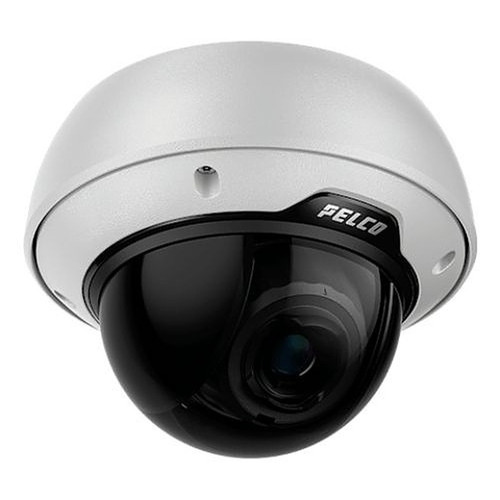
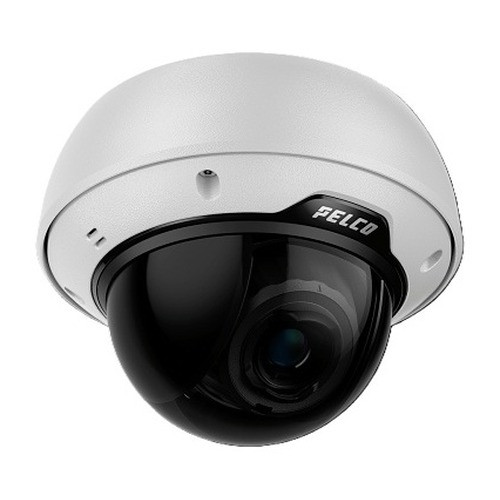
Both the Pelco SRXE4-2V12-EMD-1 and SRXE4-2V12-EMD-IR1 are 4MP outdoor dome cameras from the Sarix Enhanced 4 Series, sharing the same 1/1.8-inch progressive scan CMOS sensor, motorized varifocal lens, and cybersecurity architecture. They are direct cross-shop candidates for installers selecting a fixed outdoor dome for perimeter or facility coverage. The sole meaningful differentiator between the two models is low-light illumination approach: one relies on ambient-light sensitivity alone, while the other adds active IR illumination for zero-lux performance.
In This Guide
How do the imaging specs compare?
Both cameras deliver 2560×1440 (4MP) resolution at up to 60 fps, share a 1/1.8-inch progressive scan CMOS sensor, an F1.4 aperture, a 4.4–9.3 mm motorized varifocal lens (32–109° HFOV), and 130 dB SureVision WDR. These parameters are identical across both SKUs, so image quality in well-lit or WDR conditions is equivalent.
The critical difference is low-light performance. The SRXE4-2V12-EMD-1 specifies a minimum illumination of 0.003 Lux color / 0.001 Lux B/W with no mention of active IR illumination in the provided specs. The SRXE4-2V12-EMD-IR1 specifies 0.003 Lux color / 0 Lux IR, explicitly indicating 850 nm IR illumination that enables operation at zero lux. The IR model's Card_Bullet_2 confirms '0.001 lux mono sensitivity + 850nm IR; full visibility in near-total darkness.' No IR range distance (in meters) is provided in the specs for either model.
What about installation and environment?
Both cameras carry identical environmental ratings: IP66, IP67, IP68 (2 m for 2 hr), IPX9K, and NEMA 4X ingress protection, plus IK11 impact resistance and an operating temperature range of –50°C to +65°C (with PoE+ or external power). Form factor is dome for both, with the same specified mounting options: wall, ceiling, pole, pendant, corner, and recessed. Dimensions are also identical at (D×H) 182×132 mm / 219×198 mm / 182×203 mm depending on mount configuration.
Power input is PoE+ (802.3at) for both units; PoE Class is listed as 3 in both spec sets. The SRXE4-2V12-EMD-IR1's active IR illuminator will draw additional power when active—but no incremental wattage figure is provided in the supplied specs for either model, so a direct power-budget delta cannot be stated.
Which fits your VMS and analytics better?
Both models are ONVIF Profile S, T, G, and M compliant and support H.265, H.264, and Motion JPEG compression with Pelco Smart Compression technology and idle scene mode for bandwidth management. On-board analytics are identical per spec: Smart Analytics covering Person/Vehicle Detection, Direction Violation, Loitering, Beam Crossing, Crowd Detection, Audio Analytics, and Tamper Alert. Both support a microphone and onboard microSD storage. Cybersecurity posture is the same on both: FIPS 140-3 Level 3, TPM, Secure Boot, HTTPS, and 802.1X, with NDAA Section 889 and TAA compliance. Memory is listed as 4 GB RAM / 4 GB Flash on both units. From a VMS integration and analytics standpoint, the two cameras are functionally equivalent.
Which should you choose: the SRXE4-2V12-EMD-1 or the SRXE4-2V12-EMD-IR1?
Our take: The SRXE4-2V12-EMD-IR1 is the stronger choice when the installation site experiences periods of near-total or total darkness, because its 850 nm IR illumination enables 0 Lux IR sensitivity versus the SRXE4-2V12-EMD-1's 0.001 Lux B/W floor with no active IR. Outside of low-light performance, all decision-relevant specifications are identical: both deliver 4MP at 60 fps, 130 dB SureVision WDR, IP66/IP67/IP68/NEMA 4X environmental ratings, IK11 impact resistance, –50°C to +65°C operating range, PoE+ input, full ONVIF Profile S/T/G/M compliance, the same Smart Analytics suite, and a 5-year warranty. Specify the SRXE4-2V12-EMD-1 only where ambient lighting is consistently maintained at or above 0.001 Lux B/W and eliminating the IR emitter offers a design advantage. For any site where lighting cannot be guaranteed, the IR1 variant removes the risk without altering any other spec.
Side-by-Side Comparison
Spec-for-spec, from manufacturer data.
| Specification | Pelco SRXE4-2V12-EMD-1 | Pelco SRXE4-2V12-EMD-IR1 |
|---|---|---|
| Resolution | 4MP (2560×1440) | 4MP (2560×1440) |
| Image Sensor | 1/1.8" progressive scan CMOS | 1/1.8" progressive scan CMOS |
| Sensor Size (secondary spec field) | 1/2.8" CMOS | 1/2.8" CMOS |
| Lens / Focal Length | 4.4–9.3 mm motorized varifocal | 4.4–9.3 mm motorized varifocal |
| HFOV | 32–109° | 32–109° |
| Aperture | F1.4 | F1.4 |
| Min Illumination | 0.003 Lux color / 0.001 Lux B/W | 0.003 Lux color / 0 Lux IR |
| IR Illumination | Not specified in provided specs | 850 nm IR |
| WDR | 130 dB SureVision | 130 dB SureVision |
| Max Frame Rate | 60 fps | 60 fps |
| Video Compression | H.265; H.264; Motion JPEG | H.265; H.264; Motion JPEG |
| IP / Ingress Rating | IP66; IP67; IP68 (2m/2hr); IPX9K; NEMA 4X | IP66; IP67; IP68 (2m/2hr); IPX9K; NEMA 4X |
| Impact Rating | IK11 | IK11 |
| Operating Temperature | –50°C to +65°C (PoE+ or external power) | –50°C to +65°C (PoE+ or external power) |
| Power Input / PoE Class | PoE+ (802.3at) / Class 3 | PoE+ (802.3at) / Class 3 |
| Edge Storage | microSD | microSD |
| Audio | Microphone supported | Microphone supported |
| ONVIF Compliance | Profile S; T; G; M | Profile S; T; G; M |
| Cybersecurity | FIPS 140-3 L3; TPM; Secure Boot; HTTPS; 802.1X | FIPS 140-3 L3; TPM; Secure Boot; HTTPS; 802.1X |
| Compliance | NDAA Sec. 889; TAA | NDAA Sec. 889; TAA |
| Warranty | 5 years | 5 years |
| Dimensions (D×H) | 182×132 mm / 219×198 mm / 182×203 mm | 182×132 mm / 219×198 mm / 182×203 mm |
Frequently Asked Questions
Which should you choose: the SRXE4-2V12-EMD-1 or the SRXE4-2V12-EMD-IR1?
The SRXE4-2V12-EMD-IR1 is the stronger choice when the installation site experiences periods of near-total or total darkness, because its 850 nm IR illumination enables 0 Lux IR sensitivity versus the SRXE4-2V12-EMD-1's 0.001 Lux B/W floor with no active IR. Outside of low-light performance, all decision-relevant specifications are identical: both deliver 4MP at 60 fps, 130 dB SureVision WDR, IP66/IP67/IP68/NEMA 4X environmental ratings, IK11 impact resistance, –50°C to +65°C operating range, PoE+ input, full ONVIF Profile S/T/G/M compliance, the same Smart Analytics suite, and a 5-year warranty. Specify the SRXE4-2V12-EMD-1 only where ambient lighting is consistently maintained at or above 0.001 Lux B/W and eliminating the IR emitter offers a design advantage. For any site where lighting cannot be guaranteed, the IR1 variant removes the risk without altering any other spec.
Is the SRXE4-2V12-EMD-1 or SRXE4-2V12-EMD-IR1 better for low-light or no-light conditions?
The SRXE4-2V12-EMD-IR1 is better for low-light and no-light conditions. It includes 850 nm IR illumination and a minimum illumination spec of 0 Lux IR, meaning it can produce an image with zero ambient light. The SRXE4-2V12-EMD-1 lists 0.001 Lux B/W as its floor with no active IR specified, so it requires at least trace ambient light to function in monochrome mode.
Do the two cameras have the same analytics, ONVIF compliance, and cybersecurity features?
Yes. Both models specify identical analytics (Person/Vehicle Detection, Direction Violation, Loitering, Beam Crossing, Crowd Detection, Audio Analytics, Tamper Alert), the same ONVIF profiles (S, T, G, M), and the same cybersecurity stack (FIPS 140-3 Level 3, TPM, Secure Boot, HTTPS, 802.1X). NDAA Section 889 and TAA compliance are confirmed on both.
Are the environmental ratings and power requirements the same on both models?
Yes. Both cameras are rated IP66, IP67, IP68 (2 m for 2 hr), IPX9K, and NEMA 4X, carry IK11 impact resistance, and operate from –50°C to +65°C with PoE+ or external power. Both are powered via PoE+ (802.3at), listed as PoE Class 3. No incremental power draw figure for the IR1's illuminator is provided in the supplied specifications.
Get a Second Opinion on Your Camera Choice
Share your site layout, coverage goals, and budget. Our team will validate the camera selection, flag anything we would change, and recommend products that match the use case.