
Hanwha PNM-7082RVD vs Hanwha QND-7082R: Specification Comparison
Both the Hanwha PNM-7082RVD and QND-7082R are 2MP-class IP dome cameras with motorized varifocal lenses, IR night vision, and H.265/H.264 compression — products a buyer would legitimately cross-shop when evaluating Hanwha's mid-range dome lineup. The core distinction is deployment environment: the PNM-7082RVD is an outdoor-rated, dual-sensor vandal dome, while the QND-7082R is an indoor-only single-sensor dome. This comparison covers imaging performance, installation fit, and platform integration based solely on the provided specifications.

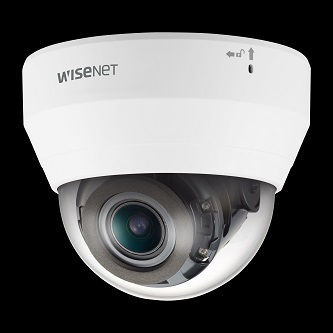
In This Guide
How do the imaging specs compare?
The PNM-7082RVD uses two 1/2.8" CMOS sensors delivering 2MP (1920×1080) per channel at 30fps, while the QND-7082R uses a single 1/3" CMOS sensor at 4MP (2560×1440) at 30fps. The QND-7082R therefore offers higher native resolution on a single channel. For low-light performance, the PNM-7082RVD reaches 0.035 Lux in color mode versus the QND-7082R's 0.1 Lux, giving the PNM-7082RVD a meaningfully lower minimum illumination threshold. Both specify IR cut to 0 Lux. IR reach differs: the PNM-7082RVD covers up to 25m (82ft) scene-dependent, versus the QND-7082R's 20m (65.62ft).
On optics, the PNM-7082RVD uses a 3–6mm motorized varifocal (2x zoom, F2.2–F3.1) with a horizontal field of view ranging 107°–56°. The QND-7082R uses a 3.2–10mm motorized varifocal (3.1x zoom, F1.6–F2.9) with a horizontal FOV of 98.6°–30.8°. The QND-7082R provides a wider zoom ratio (3.1x vs 2x) and a faster maximum aperture (F1.6 vs F2.2), which aids light gathering at wide angle. Both cameras specify extremeWDR at 120dB. The PNM-7082RVD adds WiseNR and SSNR V for noise reduction; the QND-7082R specifies SSNR only. Defog is supported on the PNM-7082RVD; it is listed as None on the QND-7082R.
What about installation and environment?
The PNM-7082RVD is rated IP66/IP67 and NEMA 4X, certified IK10 for impact resistance, and operates from -40°C to +55°C — suitable for harsh outdoor or industrial deployments. The QND-7082R carries no IP or IK certification per the provided specs and is specified for indoor use only, with an operating range of -10°C to +55°C. The cold-weather floor differs by 30°C, which is a significant constraint for any installation subject to freezing temperatures.
Power requirements also diverge. The PNM-7082RVD requires PoE+ (IEEE 802.3at, Class 4) drawing up to 17W typical 12.5W, meaning standard PoE switches may be insufficient without upgrade. The QND-7082R accepts PoE (IEEE 802.3af, Class 3) or 12VDC at a maximum of 8.6W, compatible with a wider range of existing PoE infrastructure. Physically, the PNM-7082RVD is considerably larger (215×135×93.2mm, 1,330g, aluminum housing) compared to the QND-7082R (Ø119.8×98.8mm, 320g, plastic housing). The PNM-7082RVD's Ethernet port is metal-shielded gigabit (10/100/1000BASE-T); the QND-7082R is 10/100BASE-T only.
Which fits your VMS and analytics better?
Both cameras support ONVIF and SUNAPI (HTTP API). The PNM-7082RVD is certified for ONVIF Profile S and T. The QND-7082R adds ONVIF Profile G, which enables edge recording and retrieval queries directly from conformant VMS clients — relevant if your VMS leverages Profile G for on-camera storage management. The PNM-7082RVD supports up to 20 unicast users and 10 streaming profiles; the QND-7082R is limited to 6 unicast users and 3 profiles. For high-concurrent-viewer deployments, the PNM-7082RVD has the advantage.
On analytics, the QND-7082R includes defocus detection and tampering out of the box via onboard processing. The PNM-7082RVD lists motion detection, virtual line/direction, intrusion, and loitering analytics. For audio, the QND-7082R has a built-in microphone with G.711/G.726 audio compression; the PNM-7082RVD requires the optional SPM-4210 I/O box for audio in or out. Alarm I/O is also accessory-dependent on the PNM-7082RVD (via SPM-4210), while the QND-7082R provides 1 alarm input and 1 alarm output natively. Edge storage on the PNM-7082RVD supports up to 512GB microSD; the QND-7082R is capped at 128GB. The PNM-7082RVD includes TPM 2.0 (FIPS 140-2 Level 2) hardware security; no equivalent is listed for the QND-7082R. Both cameras carry a 3-year warranty.
Which should you choose: the PNM-7082RVD or the QND-7082R?
Our take: The PNM-7082RVD is the stronger choice when the installation is outdoors, subject to vandalism, or requires operation below -10°C. Its IP66/IP67/NEMA 4X/IK10 ratings and -40°C cold-floor make it the only viable option between the two for exterior or industrial environments. It also achieves lower minimum illumination (0.035 Lux vs 0.1 Lux), a longer IR range (25m vs 20m), and supports up to 512GB edge storage versus the QND-7082R's 128GB cap, with 10 streaming profiles versus 3. However, the QND-7082R delivers higher single-channel resolution (2560×1440 vs 1920×1080), a wider 3.1x zoom ratio with a faster F1.6 aperture, native alarm I/O and built-in microphone without accessories, ONVIF Profile G support, and runs on standard PoE (802.3af) at just 8.6W. For indoor deployments on existing PoE infrastructure where resolution and native I/O matter, the QND-7082R is the more practical and cost-efficient fit.
Side-by-Side Comparison
Spec-for-spec, from manufacturer data.
| Specification | Hanwha PNM-7082RVD | Hanwha QND-7082R |
|---|---|---|
| Resolution | 2MP (1920×1080) per channel × 2CH | 4MP (2560×1440) |
| Image Sensor | 1/2.8" CMOS × 2CH | 1/3" CMOS |
| Lens / Focal Length | 3–6mm motorized varifocal (2x), F2.2–F3.1 | 3.2–10mm motorized varifocal (3.1x), F1.6–F2.9 |
| Horizontal FOV | 107°–56° | 98.6°–30.8° |
| Min. Illumination (Color) | 0.035 Lux | 0.1 Lux |
| IR Range | 15m typical / 25m scene-dependent | 20m (65.62ft) |
| Wide Dynamic Range | extremeWDR 120dB | 120dB |
| Max Frame Rate | 30fps @ 2MP | 30fps @ 4MP |
| Video Compression | H.265 / H.264 (Main/Baseline/High) / MJPEG | H.265 / H.264 (Main/High) / MJPEG |
| IP Rating | IP66 / IP67 | — (not specified; indoor only) |
| IK / Impact Rating | IK10 | — (not specified) |
| Operating Temperature | -40°C to +55°C | -10°C to +55°C |
| Power Input / PoE Class | PoE+ IEEE 802.3at, Class 4 (max 17W) | PoE IEEE 802.3af, Class 3 / 12VDC (max 8.6W) |
| Edge Storage | microSD/SDHC/SDXC up to 512GB | microSD/SDHC/SDXC up to 128GB |
| Audio | Input and output via optional SPM-4210 I/O box | Built-in microphone (G.711/G.726); no audio out |
| Alarm I/O | Via optional SPM-4210 I/O box | 1 input / 1 output (built-in) |
| ONVIF Profiles | Profile S, T | Profile S, G, T |
| Unicast Streaming Users | Up to 20 | Up to 6 |
| Streaming Profiles | Up to 10 | Up to 3 |
| Security Hardware | TPM 2.0 (FIPS 140-2 Level 2) | — (not specified) |
| Ethernet | RJ-45 10/100/1000BASE-T (metal shielded) | RJ-45 10/100BASE-T |
| RAM / Flash | 4GB RAM / 512MB Flash | 512MB RAM / 256MB Flash |
| Dimensions | 215 × 135 × 93.2mm (8.46" × 5.31" × 3.67") | Ø119.8 × 98.8mm (Ø4.72" × 3.89") |
| Weight | 1,330g | 320g (0.705 lb) |
| Housing Material | Aluminum | Plastic |
| Warranty | 3-year | 3-year |
Frequently Asked Questions
Which should you choose: the PNM-7082RVD or the QND-7082R?
The PNM-7082RVD is the stronger choice when the installation is outdoors, subject to vandalism, or requires operation below -10°C. Its IP66/IP67/NEMA 4X/IK10 ratings and -40°C cold-floor make it the only viable option between the two for exterior or industrial environments. It also achieves lower minimum illumination (0.035 Lux vs 0.1 Lux), a longer IR range (25m vs 20m), and supports up to 512GB edge storage versus the QND-7082R's 128GB cap, with 10 streaming profiles versus 3. However, the QND-7082R delivers higher single-channel resolution (2560×1440 vs 1920×1080), a wider 3.1x zoom ratio with a faster F1.6 aperture, native alarm I/O and built-in microphone without accessories, ONVIF Profile G support, and runs on standard PoE (802.3af) at just 8.6W. For indoor deployments on existing PoE infrastructure where resolution and native I/O matter, the QND-7082R is the more practical and cost-efficient fit.
Is the PNM-7082RVD or QND-7082R better for low-light performance?
The PNM-7082RVD specifies a minimum illumination of 0.035 Lux in color mode and IR reach up to 25m (82ft). The QND-7082R specifies 0.1 Lux in color mode and IR reach of 20m (65.62ft). Based on the provided specs, the PNM-7082RVD has a lower illumination threshold and longer IR range, giving it the edge in low-light conditions.
Can I use the QND-7082R outdoors or in a parking structure?
No. The QND-7082R is specified as an indoor camera with no IP or IK rating listed in its specs and an operating temperature floor of -10°C. The PNM-7082RVD carries IP66/IP67, NEMA 4X, and IK10 ratings with a -40°C lower operating limit, making it the appropriate choice for outdoor or exposed environments.
Will these cameras work with my existing PoE switch?
That depends on your switch. The QND-7082R accepts standard PoE (IEEE 802.3af, Class 3) at a maximum of 8.6W, compatible with most deployed PoE switches. The PNM-7082RVD requires PoE+ (IEEE 802.3at, Class 4) at up to 17W — if your switch only provides 802.3af, you will need either a PoE+ capable switch or a mid-span injector to power the PNM-7082RVD.
Get a Second Opinion on Your Camera Choice
Share your site layout, coverage goals, and budget. Our team will validate the camera selection, flag anything we would change, and recommend products that match the use case.