
Hanwha PNM-7082RVD vs Hanwha QNV-7082R: Specification Comparison
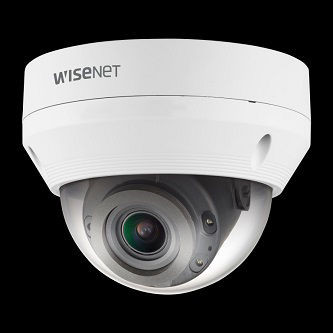
Both the Hanwha PNM-7082RVD and QNV-7082R are outdoor vandal-dome IP cameras drawing from the same approximate resolution tier — each specified as 4MP-class products — using motorized varifocal lenses, IR illumination, and 120dB WDR. The PNM-7082RVD is a dual-sensor (2×2MP) wide-angle dome; the QNV-7082R is a single-sensor 4MP (2560×1440) dome with a longer zoom range. Installers and IT buyers evaluating these should compare sensor architecture, lens range, power budget, analytics depth, and integration capability.

In This Guide
How do the imaging specs compare?
The PNM-7082RVD uses two 1/2.8" CMOS sensors, each delivering 2MP (1920×1080) at 30fps, for a combined dual-channel output. Its motorized varifocal lens covers 3–6mm (2× zoom ratio) with apertures of F2.2 (wide) to F3.1 (tele), providing a horizontal field of view of 107° to 56°. Minimum illumination is 0.035 Lux (color) / 0 Lux (IR), and IR range is specified at 15m typical / 25m scene-dependent. The QNV-7082R uses a single 1/3" CMOS sensor at 2560×1440 (approximately 3.7MP) at 30fps. Its lens covers 3.2–10mm (3.1× zoom ratio) with apertures of F1.6 (wide) to F2.9 (tele) — a notably brighter wide-end aperture. Minimum illumination is 0.1 Lux (color) / 0 Lux (IR), with IR range specified at 30m.
On low-light performance, the PNM-7082RVD's 0.035 Lux color threshold is lower than the QNV-7082R's 0.1 Lux, suggesting better passive low-light sensitivity before IR activates, though its IR throw (25m max) is shorter than the QNV-7082R's 30m. The QNV-7082R's brighter F1.6 wide aperture partially compensates. Both cameras deliver 120dB WDR — the PNM-7082RVD labels it 'extremeWDR' with SSDR and WiseNR/SSNRⅤ noise reduction; the QNV-7082R lists SSNR (generation not specified in the provided specs). The PNM-7082RVD adds a Defog function not listed for the QNV-7082R. The QNV-7082R's 3.1× zoom range (3.2–10mm) substantially outreaches the PNM-7082RVD's 2× range (3–6mm), which is relevant for tele-end detection: at 25PPM, the QNV-7082R tele detect distance is 129m vs. the PNM-7082RVD's 72.2m.
What about installation and environment?
Both cameras carry IP66 and IK10 ratings and operate across -40°C to +55°C, making them equivalently rated for outdoor vandal-resistant deployment. The PNM-7082RVD adds IP67 and NEMA 4X (NEMA 250 Type 4X) certifications not listed for the QNV-7082R, providing a higher ingress protection tier and UL-recognized enclosure classification. The PNM-7082RVD also carries UL 62368-1 and CAN/CSA C22.2 No. 62368-1 safety certifications, TPM 2.0 (FIPS 140-2 Level 2) hardware security, and FCC/CE/UKCA/VCCI/RCM/KS EMC marks; the QNV-7082R's EMC and safety certifications are not detailed in the provided specs.
Power requirements differ materially. The PNM-7082RVD requires PoE+ (IEEE 802.3at, Class 4) with a maximum draw of 17W (typical 12.5W); the QNV-7082R operates on standard PoE (IEEE 802.3af, Class 3) or 12VDC, drawing a maximum of 11.4W. This means the QNV-7082R can be powered by any 802.3af switch port without a PoE+ upgrade. The PNM-7082RVD is larger and heavier: 215×135×93.2mm / 1,330g vs. the QNV-7082R's Ø137.0×106.1mm / 710g (1.57 lb). The PNM-7082RVD's Ethernet port is metal-shielded Gigabit (10/100/1000BASE-T); the QNV-7082R's is 10/100BASE-T only. The PNM-7082RVD requires the optional SPM-4210 I/O box for alarm I/O and audio; the QNV-7082R has one alarm input and one alarm output plus a line-in audio input built in.
Which fits your VMS and analytics better?
The PNM-7082RVD supports ONVIF Profile S and T, plus SUNAPI (HTTP API) and an open platform designation; it does not list Profile G in the provided specs. The QNV-7082R supports ONVIF Profile S, G, and T plus SUNAPI. Profile G enables on-camera recording management through ONVIF-compliant VMS platforms, which is relevant for edge-recording workflows. The PNM-7082RVD supports up to 10 simultaneous streaming profiles with unicast to 20 users; the QNV-7082R supports up to 3 profiles with unicast to 6 users — a meaningful difference for multi-client or multi-stream VMS deployments.
On analytics, the PNM-7082RVD lists motion detection (8 polygonal zones), virtual line/direction, intrusion, and loitering; the QNV-7082R lists defocus detection, directional detection, motion detection (4 polygonal zones), enter/exit, tampering, and virtual line. Privacy masking is more capable on the PNM-7082RVD: 32 zones with mosaic and color options vs. the QNV-7082R's 6 rectangular zones. Edge storage capacity also differs: the PNM-7082RVD supports up to 512GB microSD; the QNV-7082R is rated to 128GB. On audio, the QNV-7082R includes a built-in line input and G.711/G.726 compression; the PNM-7082RVD requires the optional SPM-4210 accessory for any audio function. The PNM-7082RVD carries 4GB RAM / 512MB Flash vs. the QNV-7082R's 512MB RAM / 256MB Flash.
Which should you choose: the PNM-7082RVD or the QNV-7082R?
Our take: The PNM-7082RVD is the stronger choice when a wide, dual-sensor field of view, deeper low-light sensitivity, higher-capacity streaming, and advanced security certifications are the priority; the QNV-7082R is the stronger choice when a single-sensor 2560×1440 image, a longer 3.1× zoom range, standard PoE compatibility, built-in alarm I/O, and native audio input matter more. Concretely: the PNM-7082RVD achieves 0.035 Lux color vs. the QNV-7082R's 0.1 Lux, supports 10 streaming profiles to 20 unicast users vs. 3 profiles to 6 users, and stores up to 512GB on-board vs. 128GB. Conversely, the QNV-7082R's tele detect range reaches 129m at 25PPM vs. 72.2m, draws only 11.4W on 802.3af Class 3, and includes hardwired alarm I/O plus line-in audio without accessories. Specify the PNM-7082RVD on PoE+ infrastructure needing broad dual-sensor coverage; specify the QNV-7082R on 802.3af-only switches needing longer-range zoom and built-in I/O.
Side-by-Side Comparison
Spec-for-spec, from manufacturer data.
| Specification | Hanwha PNM-7082RVD | Hanwha QNV-7082R |
|---|---|---|
| Resolution | 2×2MP (1920×1080) dual-sensor | 2560×1440 single-sensor |
| Image Sensor | 1/2.8" CMOS ×2 | 1/3" CMOS ×1 |
| Lens / Focal Length | 3–6mm motorized varifocal (2× zoom) | 3.2–10mm motorized varifocal (3.1× zoom) |
| Max. Aperture | F2.2 (Wide) / F3.1 (Tele) | F1.6 (Wide) / F2.9 (Tele) |
| Min. Illumination | 0.035 Lux color / 0 Lux IR | 0.1 Lux color / 0 Lux IR |
| IR Range | 15m typical / 25m scene-dependent | 30m |
| WDR | extremeWDR 120dB | 120dB WDR |
| Max Frame Rate | 30fps @ 2MP (per channel) | 30fps @ 2560×1440 |
| Video Compression | H.265 / H.264 (Main/Baseline/High) / MJPEG | H.265 / H.264 (Main/High) / MJPEG |
| IP Rating | IP66 / IP67 / NEMA 4X | IP66 |
| IK / Impact Rating | IK10 | IK10 |
| Operating Temperature | -40°C to +55°C | -40°C to +55°C |
| Power Input / PoE Class | PoE+ IEEE 802.3at Class 4 / Max 17W | PoE IEEE 802.3af Class 3 or 12VDC / Max 11.4W |
| Alarm I/O | Via optional SPM-4210 I/O box | 1 input / 1 output (built-in) |
| Audio | Via optional SPM-4210 I/O box | Line in (built-in); G.711/G.726 |
| Edge Storage | microSD up to 512GB | microSD up to 128GB |
| Streaming Profiles / Unicast Users | Up to 10 profiles / 20 unicast users | Up to 3 profiles / 6 unicast users |
| ONVIF Profiles | Profile S, T | Profile S, G, T |
| RAM / Flash | 4GB RAM / 512MB Flash | 512MB RAM / 256MB Flash |
| Dimensions | 215×135×93.2mm (8.46"×5.31"×3.67") | Ø137.0×106.1mm (Ø5.39"×4.18") |
| Weight | 1,330g | 710g (1.57 lb) |
| Warranty | 3-year | 3-year |
Frequently Asked Questions
Which should you choose: the PNM-7082RVD or the QNV-7082R?
The PNM-7082RVD is the stronger choice when a wide, dual-sensor field of view, deeper low-light sensitivity, higher-capacity streaming, and advanced security certifications are the priority; the QNV-7082R is the stronger choice when a single-sensor 2560×1440 image, a longer 3.1× zoom range, standard PoE compatibility, built-in alarm I/O, and native audio input matter more. Concretely: the PNM-7082RVD achieves 0.035 Lux color vs. the QNV-7082R's 0.1 Lux, supports 10 streaming profiles to 20 unicast users vs. 3 profiles to 6 users, and stores up to 512GB on-board vs. 128GB. Conversely, the QNV-7082R's tele detect range reaches 129m at 25PPM vs. 72.2m, draws only 11.4W on 802.3af Class 3, and includes hardwired alarm I/O plus line-in audio without accessories. Specify the PNM-7082RVD on PoE+ infrastructure needing broad dual-sensor coverage; specify the QNV-7082R on 802.3af-only switches needing longer-range zoom and built-in I/O.
Is the PNM-7082RVD or QNV-7082R better for low-light performance?
Based on specified minimum illumination, the PNM-7082RVD reaches 0.035 Lux in color mode versus the QNV-7082R's 0.1 Lux, indicating greater passive low-light sensitivity before IR activates. However, the QNV-7082R has a brighter F1.6 wide-end aperture (vs. F2.2 on the PNM-7082RVD) and a longer IR throw of 30m versus 25m max for the PNM-7082RVD. Both cameras reach 0 Lux with IR active.
Can I power either camera from a standard PoE (802.3af) switch?
Only the QNV-7082R. It is specified for PoE (IEEE 802.3af, Class 3) or 12VDC at a maximum of 11.4W. The PNM-7082RVD requires PoE+ (IEEE 802.3at, Class 4) with a maximum draw of 17W and will not operate correctly on a standard 802.3af port that cannot supply sufficient power.
Which camera is better suited for a VMS that uses ONVIF Profile G for edge recording management?
The QNV-7082R lists ONVIF Profile S, G, and T in its provided specifications. Profile G enables VMS-managed recording directly to the camera's edge storage over ONVIF. The PNM-7082RVD's provided specs list ONVIF Profile S and T only — Profile G is not listed, so edge-recording management via ONVIF Profile G would not be confirmed on that model based on the available spec data.
Get a Second Opinion on Your Camera Choice
Share your site layout, coverage goals, and budget. Our team will validate the camera selection, flag anything we would change, and recommend products that match the use case.