
Hanwha PNM-7082RVD vs i-PRO S35402-F2LG: Specification Comparison
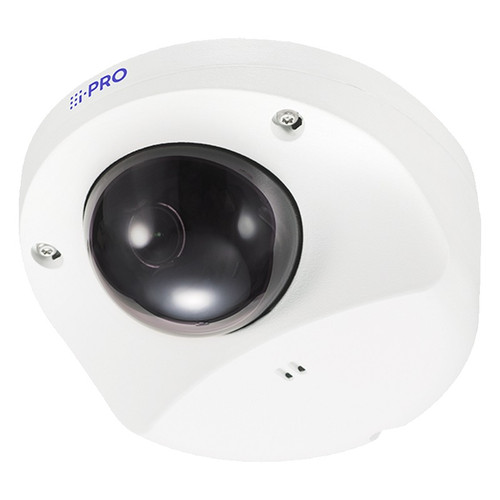
Both the Hanwha PNM-7082RVD and the i-PRO WV-S35402-F2LG are outdoor fixed dome IP cameras targeting the 4MP class — the Hanwha achieves this via dual 2MP sensors while the i-PRO delivers native 4MP from a single sensor — both rated IP66/IK10 and suited for perimeter or general surveillance. This comparison examines their imaging performance, installation requirements, and VMS/analytics integration to help integrators and IT buyers identify which unit fits a given deployment.

In This Guide
How do the imaging specs compare?
The Hanwha PNM-7082RVD uses two 1/2.8" CMOS sensors each delivering 1920×1080 (2MP per channel, 4MP combined), with a motorized varifocal 3–6mm lens (2× zoom, F2.2–F3.1) covering 107°–56° horizontal. IR reach is 15m typical / 25m scene-dependent. Its extremeWDR is rated at 120dB, and minimum color illumination is 0.035 Lux. The i-PRO WV-S35402-F2LG uses a single 1/2.8" CMOS delivering up to 2560×1440 (4MP native), with a fixed 2.4mm lens at F2.1 covering 121° horizontal. IR reach is 14m (High) / 10m (Medium). Its Super Dynamic WDR is rated at 132dB maximum, and minimum color illumination is 0.19 lx @ 30IRE.
On low-light performance the Hanwha's 0.035 Lux color threshold is significantly lower than the i-PRO's 0.19 Lux, suggesting better passive sensitivity. However, the i-PRO's 132dB Super Dynamic WDR rating exceeds the Hanwha's 120dB extremeWDR, which may produce superior results in high-contrast scenes. The Hanwha's motorized varifocal lens provides field-of-view flexibility at install time (107° wide to 56° tele), whereas the i-PRO's fixed 2.4mm lens is locked at 121° horizontal — useful for broad area coverage but not adjustable. DORI figures are closely matched at the Detect threshold (Hanwha wide: 28.4m vs i-PRO: 29.0m).
What about installation and environment?
Both cameras carry IP66 and IK10 ratings and NEMA 4X compliance. The Hanwha additionally carries IP67 and IEC/EN 63000, and its operating temperature range is -40°C to +55°C. The i-PRO operates from -40°C to +50°C — a 5°C narrower upper limit. The i-PRO also specifies wind resistance up to 40 m/s (~89 mph), a spec absent from the Hanwha's provided data. The Hanwha measures 215×135×93.2mm and weighs 1,330g; the i-PRO is considerably more compact at 109×119×53mm and weighs approximately 475g — roughly one-third the mass, which affects bracket selection and conduit sizing.
Power requirements differ meaningfully: the Hanwha requires PoE+ (IEEE 802.3at, Class 4, max 17W / typical 12.5W), meaning switches and injectors must support 802.3at. The i-PRO draws only 8.6W and operates on standard PoE (IEEE 802.3af, Class 0), compatible with a broader installed base of PoE switches without uprating infrastructure. The Hanwha lists conduit compatibility (1/2" / M20) and a specific hanging mount accessory (SBP-215HMW); the i-PRO specifies a tamper-resistant enclosure but specific accessory mount part numbers are not included in the provided specs.
Which fits your VMS and analytics better?
The Hanwha PNM-7082RVD supports ONVIF Profile S and T, Hanwha's SUNAPI (HTTP API), and an open platform. On-board edge storage reaches 512GB via a single microSD/SDHC/SDXC slot. Analytics include motion detection, virtual line/direction, intrusion detection, and loitering — delivered via the WiseStream II smart codec. Alarm I/O and audio I/O both require the optional SPM-4210 accessory box; neither is built in. Security includes TPM 2.0 (FIPS 140-2 Level 2) and 802.1X (EAP-TLS, EAP-LEAP, EAP-PEAP MSCHAPv2). The camera supports up to 10 simultaneous stream profiles and 20 unicast users.
The i-PRO WV-S35402-F2LG supports ONVIF Profile G, M, S, and T — a broader profile set that includes Profile G (edge recording) and Profile M (metadata/analytics). It lists built-in audio with AI Sound Classification (gunshot, yell, vehicle horn, glass break) plus AI analytics for motion, face, people, vehicle, non-mask detection, and occupancy — all without an accessory module. On-board storage also reaches 512GB microSDXC. The i-PRO limits simultaneous users to 14 vs the Hanwha's 20 unicast. Protocol support adds SFTP and MQTT (not listed for the Hanwha). The i-PRO's audio is built in; the Hanwha's audio requires the optional SPM-4210 I/O box.
Which should you choose: the PNM-7082RVD or the S35402-F2LG?
Our take: The PNM-7082RVD is the stronger choice when field-adjustable zoom, superior passive low-light sensitivity, and a wider operating temperature ceiling are the priorities; the WV-S35402-F2LG is the stronger choice for deployments where standard PoE infrastructure, built-in AI audio classification, broader ONVIF profile coverage, and a compact lightweight form factor matter most. Three concrete spec deltas: (1) minimum color illumination — Hanwha 0.035 Lux vs i-PRO 0.19 Lux, a roughly 5× sensitivity advantage for the Hanwha; (2) power draw — i-PRO 8.6W on 802.3af vs Hanwha max 17W requiring 802.3at, a meaningful infrastructure cost difference across large deployments; (3) weight — i-PRO 475g vs Hanwha 1,330g, nearly 3× heavier for the Hanwha, affecting mounting hardware. Platform qualifier: the i-PRO's ONVIF Profile G and M support and native AI analytics suit VMS-agnostic enterprise deployments; the Hanwha integrates most deeply with Wisenet VMS ecosystems.
Side-by-Side Comparison
Spec-for-spec, from manufacturer data.
| Specification | Hanwha PNM-7082RVD | i-PRO S35402-F2LG |
|---|---|---|
| Resolution | 2×2MP (1920×1080 per channel, 4MP combined) | 4MP native (up to 2560×1440) |
| Image Sensor | 1/2.8" CMOS ×2 (dual channel) | Approx. 1/2.8" type CMOS (single sensor) |
| Lens / Focal Length | Motorized varifocal 3–6mm (2×) | Fixed 2.4mm |
| Horizontal Field of View | 107° (wide) – 56° (tele) | 121° |
| Max Aperture | F2.2 (wide) / F3.1 (tele) | F2.1 |
| Min. Illumination (Color) | 0.035 Lux | 0.19 lx @ 30IRE |
| Min. Illumination (B&W / IR) | 0 Lux (IR) | 0 Lux (with IR) |
| IR Range | 15m typical / 25m scene-dependent | 14m (High) / 10m (Medium) |
| WDR | extremeWDR 120dB | Super Dynamic 132dB max |
| Max Frame Rate | 30fps @ 2MP | 25/30fps |
| Video Compression | H.265 / H.264 (Main/Baseline/High) / MJPEG | H.265 / H.264 / JPEG |
| ONVIF Profiles | Profile S, T | Profile G, M, S, T |
| AI / Edge Analytics | Motion, virtual line, intrusion, loitering | AI Motion, Face, People, Vehicle, Non-Mask, Occupancy; AI Sound Classification |
| Audio | Requires optional SPM-4210 I/O box | Built-in mic; AI Sound Classification |
| Power Input / PoE Class | PoE+ IEEE 802.3at, Class 4, max 17W | PoE IEEE 802.3af, Class 0, max 8.6W |
| IP / Impact Rating | IP66 / IP67 / NEMA 4X / IK10 | IP66 / NEMA 4X / IK10 |
| Operating Temperature | -40°C to +55°C | -40°C to +50°C |
| Edge Storage | microSD/SDHC/SDXC up to 512GB (1 slot) | microSDXC/SDHC/SD up to 512GB |
| Dimensions (W×D×H) | 215×135×93.2mm (8.46"×5.31"×3.67") | 109×119×53mm (4.3"×4.7"×2.1") |
| Weight | 1,330g (2.93 lbs) | approx. 475g (1.05 lbs) |
| Warranty | 3-year | 5-year |
Frequently Asked Questions
Which should you choose: the PNM-7082RVD or the S35402-F2LG?
The PNM-7082RVD is the stronger choice when field-adjustable zoom, superior passive low-light sensitivity, and a wider operating temperature ceiling are the priorities; the WV-S35402-F2LG is the stronger choice for deployments where standard PoE infrastructure, built-in AI audio classification, broader ONVIF profile coverage, and a compact lightweight form factor matter most. Three concrete spec deltas: (1) minimum color illumination — Hanwha 0.035 Lux vs i-PRO 0.19 Lux, a roughly 5× sensitivity advantage for the Hanwha; (2) power draw — i-PRO 8.6W on 802.3af vs Hanwha max 17W requiring 802.3at, a meaningful infrastructure cost difference across large deployments; (3) weight — i-PRO 475g vs Hanwha 1,330g, nearly 3× heavier for the Hanwha, affecting mounting hardware. Platform qualifier: the i-PRO's ONVIF Profile G and M support and native AI analytics suit VMS-agnostic enterprise deployments; the Hanwha integrates most deeply with Wisenet VMS ecosystems.
Is the PNM-7082RVD or WV-S35402-F2LG better for low-light performance?
Based on specified minimum illumination, the Hanwha PNM-7082RVD has a lower color threshold at 0.035 Lux versus the i-PRO's 0.19 Lux @ 30IRE, indicating better passive sensitivity in dim conditions. Both reach 0 Lux with IR active. However, the i-PRO's Super Dynamic WDR is rated at 132dB versus the Hanwha's 120dB, which may provide better detail in high-contrast scenes with mixed bright and dark areas.
Can I install either camera on an existing standard PoE (802.3af) switch?
The i-PRO WV-S35402-F2LG draws a maximum of 8.6W and is specified as IEEE 802.3af compliant (Class 0), so it will operate on any standard PoE switch. The Hanwha PNM-7082RVD requires PoE+ (IEEE 802.3at, Class 4, max 17W). Installing the Hanwha on a switch that only supports 802.3af may result in insufficient power; 802.3at-capable switches or midspan injectors are required.
Does either camera include built-in audio without additional accessories?
The i-PRO WV-S35402-F2LG includes built-in audio with AI Sound Classification (gunshot, yell, vehicle horn, glass break) — no additional hardware is required. The Hanwha PNM-7082RVD does not include built-in audio; both audio input and audio output require the optional SPM-4210 I/O accessory box, which is sold separately.
Get a Second Opinion on Your Camera Choice
Share your site layout, coverage goals, and budget. Our team will validate the camera selection, flag anything we would change, and recommend products that match the use case.