
Kantech KT-SIG-20KTKS-02 vs DMP 7463-W: Specification Comparison
Both the Kantech KT-SIG-20KTKS-02 and the DMP 7463-W are access control credential-entry devices that combine a proximity card reader with a keypad, supporting dual-factor authentication (card plus PIN). A buyer fitting out a commercial door or zone will evaluate both as front-end reader/keypad units that sit at the door, collect credentials, and relay them upstream. The comparison covers credential breadth and reader technology, form factor and installation requirements, and communication and system integration — the three axes that govern which unit fits a given site and platform.
In This Guide
- Which device supports a broader range of credential types and reader technologies?
- How do the two devices differ in physical form factor, mounting, and power requirements?
- What communication protocols do the two devices use, and how does that affect system integration?
- Which should you choose: the KT-SIG-20KTKS-02 or the 7463-W?
- Side-by-Side Specs
- FAQ
Which device supports a broader range of credential types and reader technologies?
The KT-SIG-20KTKS-02 is a multi-technology reader supporting MIFARE (13.56 MHz smart card), HID, NFC/13.56 MHz, and 125 kHz proximity formats including Indala ShadowProx 15024. Its keypad outputs an 8-bit burst format. This breadth means a site can credential with legacy 125 kHz prox cards, contactless smart cards, or mobile NFC — all from one head-end device. Reader type is listed as Multi-Technology, Smart Card, Proximity, and Keypad.
The 7463-W specifies proximity card plus PIN entry. The spec does not enumerate specific proximity card formats (e.g., 125 kHz vs. 13.56 MHz, HID vs. MIFARE), so format breadth cannot be confirmed from the available data. Buyers with a mixed-card environment should verify compatibility with DMP directly before specifying the 7463-W.
How do the two devices differ in physical form factor, mounting, and power requirements?
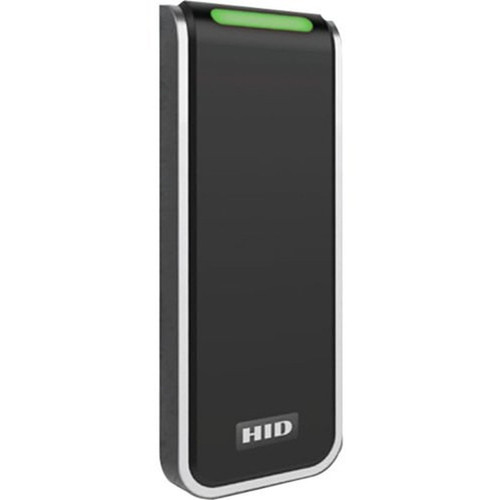
The KT-SIG-20KTKS-02 is a mullion-style reader weighing 0.36 lb, finished in black with silver trim, and designed for wall or pole mounting — specifically door-frame and mullion installs. Country of origin is Canada. Power requirements are not stated in the provided specifications.
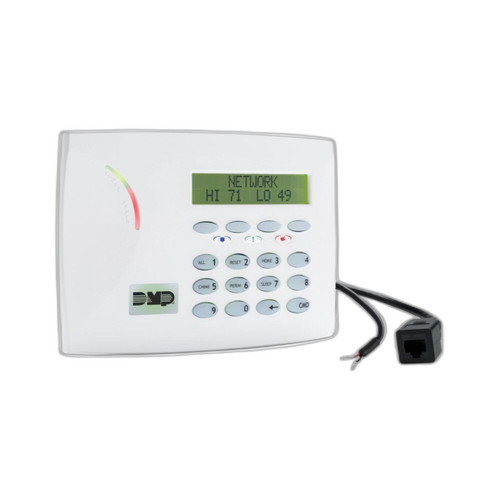
The 7463-W is a thinline form factor LCD keypad with integrated proximity reader. It is rated for commercial and light industrial installation. Power input is specified as 8.5–15 VDC (with 15 VDC noted as the nominal figure). A key differentiator: the 7463-W includes a built-in backup battery providing four hours of standby power, eliminating the need for an external battery enclosure. The keypad display turns red under alarm conditions — a visual alarm indicator absent from the KT-SIG-20KTKS-02 spec. Mounting style is not enumerated for the 7463-W beyond its thinline categorization.
What communication protocols do the two devices use, and how does that affect system integration?
The KT-SIG-20KTKS-02 outputs credentials over Wiegand and RS-485. Wiegand is the dominant legacy access control interface and is supported by virtually all access control panels on the market. RS-485 enables longer cable runs and multi-drop topologies. The spec also lists door capacity as 4 doors and notes expansion slots as 'Kits' and connectivity as 'Lock Licences,' though the meaning of those fields in the context of a reader (rather than a controller) is ambiguous in the provided data.
The 7463-W communicates over a network protocol. Network communication replaces dedicated point-to-point wiring runs with structured cabling or IP infrastructure, simplifying multi-keypad deployments and potentially reducing installation labor on larger sites. However, network-native keypads are typically tied to the manufacturer's panel ecosystem — in this case, DMP — whereas the Wiegand output of the KT-SIG-20KTKS-02 allows connection to any panel accepting a standard Wiegand reader. Buyers integrating into a non-DMP control platform should treat the 7463-W's network communication as a potential compatibility constraint.
Which should you choose: the KT-SIG-20KTKS-02 or the 7463-W?
Our take: The KT-SIG-20KTKS-02 is the stronger choice when credential flexibility and panel-agnostic integration are the priority. It supports four distinct credential technologies — 125 kHz proximity, MIFARE/13.56 MHz, NFC, and HID — versus the 7463-W's unspecified proximity format, and its Wiegand plus RS-485 output connects to virtually any access control panel on the market. The 7463-W has the advantage in networked, multi-device deployments: network communication eliminates dedicated reader wiring, and the built-in 4-hour backup battery removes the need for an external power enclosure — two installation cost factors the KT-SIG-20KTKS-02 spec does not address. The 7463-W's LCD with red alarm indication also adds on-device status feedback absent from the KT-SIG-20KTKS-02. Specify the KT-SIG-20KTKS-02 for multi-technology card environments or mixed-panel sites; specify the 7463-W for DMP-ecosystem deployments where network infrastructure is already in place and backup power simplicity is valued.
Side-by-Side Comparison
Spec-for-spec, from manufacturer data.
| Specification | Kantech KT-SIG-20KTKS-02 | DMP 7463-W |
|---|---|---|
| Device Category | Mullion Reader with Keypad | Network LCD Keypad with Prox Reader |
| Form Factor | Mullion | Thinline |
| Mount Type | Wall; Pole | — |
| Reader Technology | Multi-Technology (Proximity, Smart Card, NFC) | Proximity |
| Credential Types | MIFARE, HID, NFC/13.56 MHz, 125 kHz Prox, PIN | Proximity Card, PIN |
| Proximity Formats Specified | Indala ShadowProx 15024; 125 kHz; 13.56 MHz; HID | — |
| Communication Protocol | Wiegand; RS-485 | Network Protocol |
| Panel Compatibility | Any Wiegand/RS-485 panel | DMP ecosystem (network-native) |
| Power Input | — | 8.5–15 VDC |
| Backup Battery | — | Built-in; 4 hours standby |
| Visual Alarm Indicator | — | Keypad turns red in alarm |
| Keypad Output Format | 8-bit burst | — |
| Weight | 0.36 lb | — |
| Country of Origin | CA | — |
| Installation Environment | — | Commercial and Light Industrial |
| Warranty | — | Manufacturer Warranty |
Frequently Asked Questions
Which should you choose: the KT-SIG-20KTKS-02 or the 7463-W?
The KT-SIG-20KTKS-02 is the stronger choice when credential flexibility and panel-agnostic integration are the priority. It supports four distinct credential technologies — 125 kHz proximity, MIFARE/13.56 MHz, NFC, and HID — versus the 7463-W's unspecified proximity format, and its Wiegand plus RS-485 output connects to virtually any access control panel on the market. The 7463-W has the advantage in networked, multi-device deployments: network communication eliminates dedicated reader wiring, and the built-in 4-hour backup battery removes the need for an external power enclosure — two installation cost factors the KT-SIG-20KTKS-02 spec does not address. The 7463-W's LCD with red alarm indication also adds on-device status feedback absent from the KT-SIG-20KTKS-02. Specify the KT-SIG-20KTKS-02 for multi-technology card environments or mixed-panel sites; specify the 7463-W for DMP-ecosystem deployments where network infrastructure is already in place and backup power simplicity is valued.
Can either device work with my existing 125 kHz proximity cards?
The KT-SIG-20KTKS-02 explicitly lists 125 kHz proximity as a supported credential type, including Indala ShadowProx 15024 format. The 7463-W's spec states proximity card support but does not specify which frequency or format is supported — confirm the card type with DMP before purchasing.
Which unit is easier to install in a retrofit where I want to avoid running new dedicated wiring to each reader?
The 7463-W uses network communication, meaning it can ride existing structured cabling or IP infrastructure rather than requiring dedicated point-to-point wiring to each reader location. The KT-SIG-20KTKS-02 uses Wiegand and RS-485, which are conventional hardwired interfaces and typically require dedicated cable runs from reader to panel.
Which device keeps working during a power outage?
The 7463-W's provided specifications state it includes a backup battery that provides four hours of standby power during AC loss, with no external enclosure required. The KT-SIG-20KTKS-02's specifications do not mention an integrated battery or backup power capability.
More Access Control Reader Comparisons
- SDC 923P vs Ubiquiti UA-G3-FLEX-B
- SDC 923P vs Kantech KT-SIG-20KTKS-01
- SDC 923P vs Speco Technologies AP620HA
- SDC 923P vs DMP 7463-W
- SDC 923P vs SDC 920P
- Ubiquiti UA-G3-FLEX-B vs Kantech KT-SIG-20KTKS-01
Access Control Reader Buying Guides
Get a Second Opinion on Your Camera Choice
Share your site layout, coverage goals, and budget. Our team will validate the camera selection, flag anything we would change, and recommend products that match the use case.