
i-PRO S22500-F6L vs i-PRO S22500-V3LG: Specification Comparison
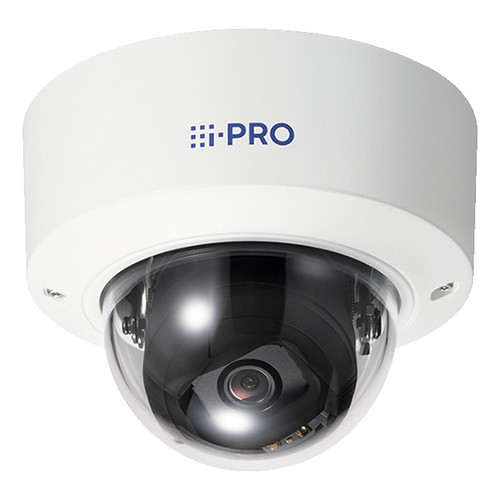
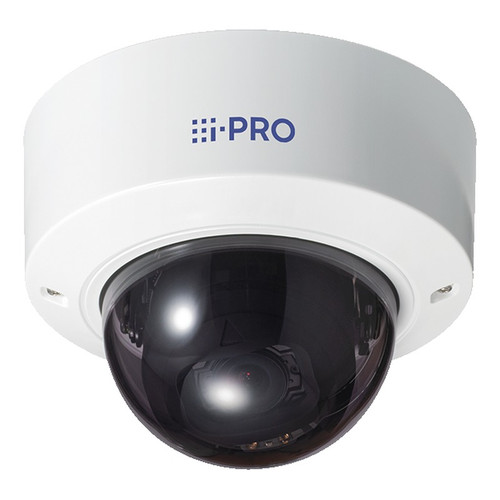
The i-PRO WV-S22500-F6L and WV-S22500-V3LG are both 5MP IK10 vandal-resistant indoor dome cameras sharing the same 1/2.8-inch CMOS sensor, Ambarella CV22 SoC, and PoE (802.3af) power input. The central difference is the lens system: the F6L uses a fixed 3.2 mm lens at f/1.6, while the V3LG uses a 3.1x motorized varifocal lens (2.9–9 mm, f/1.3–f/2.5). This comparison helps installers and IT buyers evaluate which variant matches their site geometry, low-light requirements, and commissioning workflow.
In This Guide
How do the imaging specs compare?
Both cameras share the same 1/2.8-type CMOS sensor (5.12 mm × 3.84 mm scanning area), Ambarella CV22 SoC, 5MP resolution (up to 3072×2304 at 30 fps), and 132 dB Super Dynamic WDR at level 31. The lens is where they diverge. The F6L is fixed at 3.2 mm with a maximum aperture of f/1.6 and a 48° horizontal field of view (16:9). Its brighter f/1.6 aperture enables a lower minimum illumination: 0.08 lx color (30IRE, F1.6, 1/30s) and 0.07 lx B&W, with IR-cut to 0 lx. The V3LG's 3.1x motorized varifocal lens covers 2.9–9 mm with a field of view of 105° (wide) to 33° (tele), but its aperture ranges from f/1.3 at wide to f/2.5 at tele. At the wider setting, the V3LG's f/1.3 aperture is actually brighter than the F6L, but its specified minimum illumination is 0.15 lx color and 0.12 lx B&W — higher (worse) than the F6L.
DORI performance reflects the lens difference. The F6L achieves a fixed Detect range of 138 m / 452.7 ft and an Identify range of 13.8 m / 45.3 ft. The V3LG, due to its varifocal design, spans Wide Detect at 47.1 m / 154.7 ft to Tele Detect at 207.4 m / 680.5 ft, with Tele Identify at 20.7 m / 68.1 ft. The F6L's fixed 3.2 mm lens also allows focus from 1.0 m, while the V3LG focuses as close as 0.3 m. Both cameras share a 25 m IR LED range specification and the same IR LED spec notation in their datasheets. The F6L spec sheet additionally notes IR performance at both 25 m (30IRE) and 20 m (50IRE), while the V3LG lists 25 m maximum range without a secondary IRE qualifier.
What about installation and environment?
Both cameras share identical physical form factors: ø129.5 mm × 102.5 mm (H) dome with a 41.5 mm dome radius, aluminum die-cast body with polycarbonate dome, white finish, and 800 g weight. Both are IK10-rated (IEC 62262) for impact resistance and are specified for indoor environments only — no IP (ingress protection) rating is listed in the provided specs for either model. Operating temperature is identical: −10°C to +50°C ambient (power-on minimum 0°C), with 10–90% relative humidity (non-condensing).
Both models accept DC 12V or PoE IEEE 802.3af (Class 0) power. The V3LG explicitly states 12 W power consumption and a 1A DC input; the F6L lists DC 12V at 880 mA but does not state a watt figure in the provided spec. The V3LG's motorized varifocal lens adds remote zoom and focus adjustment capability, which reduces the need for physical access during commissioning and can simplify aiming in hard-to-reach ceiling locations. The F6L's fixed lens requires precise mechanical aim at installation time. Mounting adjustability is identical for both: −240° to +120° horizontal, −30° to +85° vertical, ±100° yaw.
Which fits your VMS and analytics better?
Both cameras are ONVIF Profile G / M / S / T compliant and support H.265, H.264, and MJPEG compression with the same resolution ladder (3072×1728 down to 320×180 in 16:9; 3072×2304 in 4:3) at up to 30 fps. Smart Coding (GOP control) and up to 14 simultaneous users are identical. On-board storage is the same: microSDXC up to 512 GB. Security certification is FIPS 140-2 Level 3 with NXP SE050F secure element on both. The F6L spec lists a broader IPv6 protocol suite (including SSL/TLS, SMTP, DNS, NTP, SNMPv1/v2/v3, DHCPv6, RTP, MLD, ICMP, ARP, IEEE 802.1X, DiffServ, FTP, SFTP, MQTT, LLDP) compared to the V3LG's shorter IPv6 listing (IPv6, TCP/IP, UDP/IP, HTTP, HTTPS, MQTT) — though this likely reflects a spec documentation difference rather than a functional gap.
AI analytics are functionally identical per the provided specs: AI Motion Detection, Face Detection, Vehicle Detection, and AI Sound Classification (Gunshot, Yell, Vehicle Horn, Glass Break) on both. Both include VMD (4 areas), Scene Change Detection (1 area), Audio Detection, Privacy Zone (8 zones), and VIQS (8 zones). Audio I/O is the same on both: 3.5 mm stereo mic input with plug-in power, 3.5 mm stereo audio output at 600Ω, G.726/G.711 compression, and full-duplex support. The V3LG additionally documents its audio output level at −20 dBV; the F6L does not specify output level in the provided data. Alarm terminals (3× IN/OUT, 1× AUX OUT), alarm actions, and mobile compatibility (iPad, iPhone, Android) are identical.
Which should you choose: the S22500-F6L or the S22500-V3LG?
Our take: The S22500-V3LG is the stronger choice when the camera's mounting position is fixed but the coverage zone is not yet determined at install time, or when a single camera must serve variable distances. Its 3.1x motorized varifocal lens (2.9–9 mm) lets installers remotely adjust field of view from 105° to 33° without physical access, and its tele DORI Detect of 207.4 m versus the F6L's fixed 138 m extends long-range identification potential significantly. Conversely, the S22500-F6L is the stronger choice for corridors, entrances, or fixed-geometry spaces where the 3.2 mm / 48° fixed lens is a known fit and low-light performance is the priority: its specified minimum color illumination of 0.08 lx is lower than the V3LG's 0.15 lx, and its f/1.6 aperture versus the V3LG's f/2.5 at tele delivers a measurable low-light advantage in static deployments. Both carry identical IK10, 5MP, ONVIF Profile G/M/S/T, and 5-year warranty credentials.
Side-by-Side Comparison
Spec-for-spec, from manufacturer data.
| Specification | i-PRO S22500-F6L | i-PRO S22500-V3LG |
|---|---|---|
| Resolution | 5MP (3072×2304 max) | 5MP (3072×2304 max) |
| Image Sensor | 1/2.8-type CMOS | 1/2.8-type CMOS |
| Scanning Area | 5.12 mm (H) × 3.84 mm (V) | 5.12 mm (H) × 3.84 mm (V) |
| Lens Type | Fixed, 3.2 mm | Motorized varifocal, 2.9–9 mm |
| Optical Zoom | 1x | 3.1x |
| Field of View (H) | 48° (16:9) | 33°–105° (16:9) |
| Max Aperture | f/1.6 | f/1.3 (wide) – f/2.5 (tele) |
| Min Illumination (Color) | 0.08 lx (30IRE, F1.6, 1/30s) | 0.15 lx (30IRE) |
| Min Illumination (B&W) | 0.07 lx | 0.12 lx (F1.3) |
| IR LED Range | 25 m (30IRE) / 20 m (50IRE) | 25 m max |
| Dynamic Range (WDR) | 132 dB (Super Dynamic On, Level 31) | 132 dB (Super Dynamic On, Level 31) |
| Max Frame Rate | 30 fps | 30 fps |
| Video Compression | H.265, H.264, MJPEG | H.265, H.264, MJPEG |
| IK / Impact Rating | IK10 (IEC 62262) | IK10 (IEC 62262) |
| IP Rating | Not specified in provided specs | Not specified in provided specs |
| Operating Temperature | -10°C to +50°C | -10°C to +50°C |
| Power Input / PoE Class | DC 12V 880mA or PoE 802.3af (Class 0) | DC 12V / 1A or PoE 802.3af (Class 0), 12W |
| Edge Storage | microSDXC up to 512 GB | microSDXC up to 512 GB |
| ONVIF Profiles | G / M / S / T | G / M / S / T |
| AI Analytics | Motion, Face, Vehicle Detection; AI Sound Classification | Motion, Face, Vehicle Detection; AI Sound Classification |
| Audio I/O | 3.5mm mic in / 3.5mm audio out, 600Ω | 3.5mm mic in / 3.5mm audio out, 600Ω, -20dBV |
| Dimensions | ø129.5 mm × 102.5 mm (H) | ø129.5 mm × 102.5 mm (H) |
| Weight | 800 g (1.77 lbs) | 800 g (1.77 lbs) |
| Security Certification | FIPS 140-2 Level 3, NXP SE050F | FIPS 140-2 Level 3, NXP EdgeLock SE050F |
| Warranty | 5-Year | 5-Year |
Frequently Asked Questions
Which should you choose: the S22500-F6L or the S22500-V3LG?
The S22500-V3LG is the stronger choice when the camera's mounting position is fixed but the coverage zone is not yet determined at install time, or when a single camera must serve variable distances. Its 3.1x motorized varifocal lens (2.9–9 mm) lets installers remotely adjust field of view from 105° to 33° without physical access, and its tele DORI Detect of 207.4 m versus the F6L's fixed 138 m extends long-range identification potential significantly. Conversely, the S22500-F6L is the stronger choice for corridors, entrances, or fixed-geometry spaces where the 3.2 mm / 48° fixed lens is a known fit and low-light performance is the priority: its specified minimum color illumination of 0.08 lx is lower than the V3LG's 0.15 lx, and its f/1.6 aperture versus the V3LG's f/2.5 at tele delivers a measurable low-light advantage in static deployments. Both carry identical IK10, 5MP, ONVIF Profile G/M/S/T, and 5-year warranty credentials.
Is the S22500-F6L or S22500-V3LG better for low-light performance?
Based on the provided specs, the S22500-F6L has a lower minimum illumination: 0.08 lx color (vs. 0.15 lx for the V3LG) and 0.07 lx B&W (vs. 0.12 lx for the V3LG). Its fixed f/1.6 aperture performs better than the V3LG's f/2.5 aperture at tele. Both cameras include IR LEDs rated to 25 m and support 0 lx operation in IR mode.
Can I remotely adjust the zoom on the S22500-F6L the way I can on the S22500-V3LG?
No. The S22500-F6L uses a fixed 3.2 mm lens (1x optical zoom) with auto focus only, providing a fixed 48° horizontal field of view. The S22500-V3LG uses a 3.1x motorized zoom / motorized focus lens (2.9–9 mm) that can be adjusted remotely, covering 105° (wide) to 33° (tele) without physical access to the camera head.
Do both cameras support the same ONVIF profiles and edge analytics?
Yes. Both the S22500-F6L and S22500-V3LG support ONVIF Profile G, M, S, and T. Both include identical AI analytics per the provided specs: AI Motion Detection, Face Detection, Vehicle Detection, and AI Sound Classification (Gunshot, Yell, Vehicle Horn, Glass Break), along with VMD (4 areas), Privacy Zones (8), and VIQS (8). On-board storage (microSDXC up to 512 GB) and FIPS 140-2 Level 3 security certification are also identical on both.
Get a Second Opinion on Your Camera Choice
Share your site layout, coverage goals, and budget. Our team will validate the camera selection, flag anything we would change, and recommend products that match the use case.